Treat Bob and Joe as having the same utility function as
provided at the beginning of the question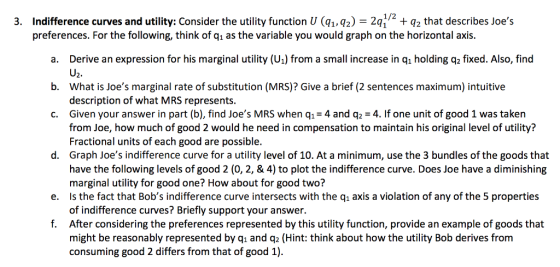
Homework Answers


Add Answer to:
Treat Bob and Joe as having the same utility function as
provided at the beginning of...
Treat Bob and Joe as the same individual and having the same utility function as provided...
 Treat Bob and Joe as the same individual and having the same
utility function as provided at the beginning of the question.
Looking for the solutions to part e and f.
Indifference curves and utility: Consider the utility function U (qi,%)-2q1/2 + q2 that describes Joe's preferences. For the following, think of q1 as the variable you would graph on the horizontal axis. 3. a. Derive an expression for his marginal utility (U) from a small increase in qi holding...
Treat Bob and Joe as the same individual and having the same
utility function as provided at the beginning of the question.
Looking for the solutions to part e and f.
Indifference curves and utility: Consider the utility function U (qi,%)-2q1/2 + q2 that describes Joe's preferences. For the following, think of q1 as the variable you would graph on the horizontal axis. 3. a. Derive an expression for his marginal utility (U) from a small increase in qi holding...
Indifference curves and utility: Consider the utility function ? (?1, ?2) = 6?1^1/2 + ?2 that...
Indifference curves and utility: Consider the utility function ? (?1, ?2) = 6?1^1/2 + ?2 that describes Moe’spreferences. For the following, think of q1 as the variable you would graph on the horizontal axis. a. Derive an expression for his marginal utility (U1) from a small increase in q1 holding q2 fixed. Also, find U2. b. What is Moe’s marginal rate of substitution (MRS)? Give a brief (2 sentences maximum) intuitive description of what MRS represents. c. Given your answer...
4. Bert's preferences for Coke and Mountain Dew are described by the utility function U(C, M)...
 4. Bert's preferences for Coke and Mountain Dew are described by the utility function U(C, M) 6C +2M (a) Find a formula for his indifference curves. Graph the indifference curves (b) What is Bert's marginal utility of Coke? (c) What is Bert's marginal utility of Mountain Dew? (d) What is Bert's MRS for Coke with Mountain Dew?
Phil’s quasi-linear utility function U (q1q2)= ln q1 + q2. Show that tis marginal rate of...
Phil’s quasi-linear utility function U (q1q2)= ln q1 + q2. Show that tis marginal rate of substitution (MRS) is the same in all of his indifference curves at given q1.
QUESTION 4 Reshad's preferences over goods 1 and 2 are given by the following utility function:...
 QUESTION 4 Reshad's preferences over goods 1 and 2 are given by the following utility function: U(q1, q2)q2Select all that applies: O a His preferences satisfy "more is better O b. His preferences fail the transitivity assumption C. His indifference curves are downward sloping His preferences are convex D e. He dislikes good 1 Marginal rate of substitution for his preferences is given by MRS12
1. True or False, and explain briefly. 1) The assumption that more is better implies that...
 1. True or False, and explain briefly. 1) The assumption that more is better implies that the indifference curves are upward sloping 2) Convexity of indifference curves implies that consumers are willing to give up more to get an extra the more they have 3) Consider the following three bundles. Bundle Good Goody If Bundles A and B are on the same indifference curve, preferences satisfy all the usual assumptions introduced in the lecture, Bundle Cis preferred to Bundle A...
3. Suppose the utility function for two goods, x and y, is: U = U(x,y) =...
 3. Suppose the utility function for two goods, x and y, is: U = U(x,y) = xłyż. a. Graph the indifference curve for U = 10. b. If x = 5, what must y equal to be on the U = 10 indifference curve? What is the MRS at this point? c. Derive a general expression for the MRS for this utility function. Show how it can be interpreted as the ratio of the marginal utilities. d. Does this individual...
1. Consider the following utility functions (a) For each of these utility functions: i. Find the...
 1. Consider the following utility functions (a) For each of these utility functions: i. Find the marginal utility of each good. Are the preferences mono- tone? ii. Find the marginal rate of substitution (MRS) iii. Define an indifference curve. Show that each indifference curve (for some positive level of utility) is decreasing and convex. (b) For the utility function u2(x1, x2), can you find another utility function that represents the same preferences? Find the relevant monotone trans formation f(u) (c)...
Please complete with steps. Thank you Q2) (based on textbook problem 3.19) Consider the utility function...
 Please complete with steps. Thank you
Q2) (based on textbook problem 3.19) Consider the utility function 2va +3/ a) Find MU and MUy b) Is the assumption that more is better satisfied for both goods? c) Does the marginal utility of each good diminish, remain constant, or increase as the consumer buys more? d) What is MRS Is it diminishing, constant, or increasing as the consumer sub- e) On a graph with a on the horizontal axis and y on...
Please complete with steps. Thank you
Q2) (based on textbook problem 3.19) Consider the utility function 2va +3/ a) Find MU and MUy b) Is the assumption that more is better satisfied for both goods? c) Does the marginal utility of each good diminish, remain constant, or increase as the consumer buys more? d) What is MRS Is it diminishing, constant, or increasing as the consumer sub- e) On a graph with a on the horizontal axis and y on...
Consider the following 3 utility functions with good x and good y: ? ?(?, ?) =...
Consider the following 3 utility functions with good x and good y: ? ?(?, ?) = (?^2)*sqrt(?), ? ?(?, ?) = 2? − (1/2)?, ? ? (?, ?) = 4 ln ? + ln ? a. Find Marginal Utility (MUx and MUy) for each these utility functions. b. Is assumption that more is better satisfied for both goods in all of these utility functions? If not, specify for which function(s) and for which good(s) it is not satisfied. c. Does...
 Treat Bob and Joe as the same individual and having the same
utility function as provided at the beginning of the question.
Looking for the solutions to part e and f.
Indifference curves and utility: Consider the utility function U (qi,%)-2q1/2 + q2 that describes Joe's preferences. For the following, think of q1 as the variable you would graph on the horizontal axis. 3. a. Derive an expression for his marginal utility (U) from a small increase in qi holding...
Treat Bob and Joe as the same individual and having the same
utility function as provided at the beginning of the question.
Looking for the solutions to part e and f.
Indifference curves and utility: Consider the utility function U (qi,%)-2q1/2 + q2 that describes Joe's preferences. For the following, think of q1 as the variable you would graph on the horizontal axis. 3. a. Derive an expression for his marginal utility (U) from a small increase in qi holding...
 4. Bert's preferences for Coke and Mountain Dew are described by the utility function U(C, M) 6C +2M (a) Find a formula for his indifference curves. Graph the indifference curves (b) What is Bert's marginal utility of Coke? (c) What is Bert's marginal utility of Mountain Dew? (d) What is Bert's MRS for Coke with Mountain Dew?
 QUESTION 4 Reshad's preferences over goods 1 and 2 are given by the following utility function: U(q1, q2)q2Select all that applies: O a His preferences satisfy "more is better O b. His preferences fail the transitivity assumption C. His indifference curves are downward sloping His preferences are convex D e. He dislikes good 1 Marginal rate of substitution for his preferences is given by MRS12
 1. True or False, and explain briefly. 1) The assumption that more is better implies that the indifference curves are upward sloping 2) Convexity of indifference curves implies that consumers are willing to give up more to get an extra the more they have 3) Consider the following three bundles. Bundle Good Goody If Bundles A and B are on the same indifference curve, preferences satisfy all the usual assumptions introduced in the lecture, Bundle Cis preferred to Bundle A...
 3. Suppose the utility function for two goods, x and y, is: U = U(x,y) = xłyż. a. Graph the indifference curve for U = 10. b. If x = 5, what must y equal to be on the U = 10 indifference curve? What is the MRS at this point? c. Derive a general expression for the MRS for this utility function. Show how it can be interpreted as the ratio of the marginal utilities. d. Does this individual...
 1. Consider the following utility functions (a) For each of these utility functions: i. Find the marginal utility of each good. Are the preferences mono- tone? ii. Find the marginal rate of substitution (MRS) iii. Define an indifference curve. Show that each indifference curve (for some positive level of utility) is decreasing and convex. (b) For the utility function u2(x1, x2), can you find another utility function that represents the same preferences? Find the relevant monotone trans formation f(u) (c)...
 Please complete with steps. Thank you
Q2) (based on textbook problem 3.19) Consider the utility function 2va +3/ a) Find MU and MUy b) Is the assumption that more is better satisfied for both goods? c) Does the marginal utility of each good diminish, remain constant, or increase as the consumer buys more? d) What is MRS Is it diminishing, constant, or increasing as the consumer sub- e) On a graph with a on the horizontal axis and y on...
Please complete with steps. Thank you
Q2) (based on textbook problem 3.19) Consider the utility function 2va +3/ a) Find MU and MUy b) Is the assumption that more is better satisfied for both goods? c) Does the marginal utility of each good diminish, remain constant, or increase as the consumer buys more? d) What is MRS Is it diminishing, constant, or increasing as the consumer sub- e) On a graph with a on the horizontal axis and y on...
Most questions answered within 3 hours.
-
Where is the error in this code sequence?
String s1 = "Hello";
String s2 = "ello";...
asked 10 months ago -
Financial data for Joel de Paris, Inc., for last year
follow:
Joel de Paris, Inc.
Balance...
asked 10 months ago -
Consider this reaction:
Al2(SO4)3 (aq)+ BaCl3
(aq) Al2Cl6 (aq)- +
3BaSO4(s) . What is the...
asked 10 months ago -
Suppose that Savneet is considering increasing her
recent random sample from 20 car rentals to 40...
asked 10 months ago -
Trucks arrive at an unloading terminal at an average rate of 120
per hour.
Trucks arrive...
asked 10 months ago -
Why are methanol and ethanol completely soluble in water while
octanol is not very little soluble....
asked 10 months ago -
A facilities manager at a university reads in a research report
that the mean amount of...
asked 10 months ago -
When the CuSO4 is rehydrated by adding water to the anhydrous
compound, is this an endothermic...
asked 10 months ago -
A ray of sunlight is passing from diamond into crown glass; the
angle of incidence is...
asked 10 months ago -
A block of mass 0.249 kg is placed on top of a light, vertical
spring of...
asked 10 months ago -
how do the kidneys compensate in the presences of acidosis
a) trigger hyperventilate
b) reserve acid...
asked 10 months ago -
Question 501 pts
The rental rate of capital to the firm increases. Which of the
following...
asked 10 months ago