Decko Co. is a U.S. firm with a Chinese subsidiary that produces smartphones in China and...
Decko Co. is a U.S. firm with a Chinese subsidiary that produces smartphones in China and sells them in Japan. This subsidiary pays its wages and its rent in Chinese yuan, which is stable relative to the dollar. The smartphones sold to Japan are denominated in Japanese yen. Assume that Decko Co. expects that the Chinese yuan will continue to stay stable against the dollar. The subsidiary’s main goal is to generate profits for itself and reinvest the profits. It does not plan to remit any funds to Decko, the U.S. parent.
a) Assume that the Japanese yen strengthens against the U.S. dollar over time. How would this be expected to affect the profits earned by the Chinese subsidiary?
b) If Decko Co. had established its subsidiary in Tokyo, Japan, instead of in China, would the subsidiary’s profits be more exposed or less exposed to exchange rate risk?
c) Why do you think that Decko Co. established the subsidiary in China instead of Japan? Assume no major country risk barriers.
d) If the Chinese subsidiary needs to borrow money to finance its expansion and wants to reduce its exchange rate risk, should it borrow U.S. dollars, Chinese yuan, or Japanese yen?
Homework Answers
(a) If the Japanese yen strengthens against US Dollars and Chinese yuan remains stable (as given in the question) then this implies that Japanese yen has strengthened against yuan as well. Since the phone is sold in Japanese yen, this implies that the Chinese subsidiary will get less Japanese yen for a yuan as compared to before (since Yuan is still stable), thereby leading to lower profits.
(b) If the subsidiary had been in Japan, the subsidiary''s profits would be more exposed to exchange rate risk as Yuan is expected to stay stable compared to Japanese Yen. Further more, if Yen appreciates over time like it has in part (a), the firm will be getting lesser US dollar amount for each Japanese yen, if it decides to remit back the profit in future.
(c) Decko Co. established the subsidiary in China instead of Japan, because of stable exchange rate compared to USD. Exchange rate volatiltiy can erode value creation, specially in cost items. Hence, most of the manufacturing units are located in areas of low exchange rate volatility since, the company can decide to sell products in multiple countries and earn revenue from them but it cannot shift its manufacturing units that rapidly, if the exchange rates fluctuate too often.
(d) It is always better to borrow the money in local currency i.e Chinese Yuan, if there isn't much difference in interest rates on borrowing. Transacting in local currency eliminates exchange rate risk due to changes in the currencies over time.
Add Answer to:
Decko Co. is a U.S. firm with a Chinese subsidiary that produces
smartphones in China and...
DFI Location Decision Decko Co. is a U.S. firm with a Chinese subsidiary that produces smartphones...
DFI Location Decision Decko Co. is a U.S. firm with a Chinese subsidiary that produces smartphones in China and sells them in Japan. This subsidiary pays its wages and its rent in Chinese yuan, which is stable relative to the dollar. The smartphones sold to Japan are denominated in Japanese yen. Assume that Decko Co. expects that the Chinese yuan will continue to stay stable against the dollar. The subsidiary’s main goal is to generate profits for itself and reinvest...
8. Winco Co. is a U.S. firm with a subsidiary in China. The subsidiary reinvests half...
 8. Winco Co. is a U.S. firm with a subsidiary in China. The subsidiary reinvests half of its net cash flows into operations and remits half to the parent. Winco Co. has expected cash flows of $10,000,000 from domestic business and the Chinese subsidiary is expected to generate 100 million Chinese yuan at the end of the year. The expected value of yuan at the end of the year is $.13. What are the expected dollar cash flows of the...
Suppose the world is made up of four countries: The US, England, and Japan and China....
Suppose the world is made up of four countries: The US, England, and Japan and China. The trade weights, that is, the percent of trade that the US conducts with each country is below: England 20% Japan 30% China 50% Suppose that the $ US appreciates by 10% against the Japanese Yen, depreciates by 10% against the English pound, and depreciates by 2% against the Chinese Yuan. Calculate the percent change in the effective exchange rate.
1. Why do you think that the Chinese historically pegged the value of the yuan to...
1. Why do you think that the Chinese historically pegged the value of the yuan to the U.S. dollar? 2. Why did the Chinese move to a managed-float system in 2005? 3. What are the benefits that China might gain by allowing the yuan to float freely against other major currencies such as the U.S. dollar and the euro? What are the risks? What do you think they should do? 4. Is there any evidence that the Chinese kept the...
In accordance with the valuation formula of a U.S. based multinational corporation, , which of the...
 In accordance with the valuation formula of a U.S. based
multinational corporation, ,
which of the following is correct for JJ
Company (a U.S. based multinational corporation)? JJ Company has a
subsidiary established in China.
Question options:
If the economic condition in China weakens, the value of JJ
company increases.
If the required rate of return by investors, k, increases, the
value of JJ company increases.
If the U.S. dollar appreciates against Chinese Yuan (i.e.,
Chinese Yuan appreciates against the...
In accordance with the valuation formula of a U.S. based
multinational corporation, ,
which of the following is correct for JJ
Company (a U.S. based multinational corporation)? JJ Company has a
subsidiary established in China.
Question options:
If the economic condition in China weakens, the value of JJ
company increases.
If the required rate of return by investors, k, increases, the
value of JJ company increases.
If the U.S. dollar appreciates against Chinese Yuan (i.e.,
Chinese Yuan appreciates against the...
7. Colorado Rockies Co. has a subsidiary in Japan. The subsidiary reinvests a quarter of its...
 7. Colorado Rockies Co. has a subsidiary in Japan. The subsidiary reinvests a quarter of its net cash flows into operations and remits the remainder to the parent. Colorado Rockies' expected cash flows from domestic business are $100,000 and the Japanese subsidiary is expected to generate 100 million Japanese Yen at the end of the year. The expected value of the yen is $.0095. What are the expected dollar cash flows of Colorado Rockies Co.?
31. MNC Cash Flows and Exchange Rate Risk Tuscaloosa Co. is a U.S. firm that assembles...
 31. MNC Cash Flows and Exchange Rate Risk Tuscaloosa Co. is a U.S. firm that assembles phones in Argentina and transports the final assembled products to the parent, where they are sold by the parent in the United States. The assembled products are invoiced in dollars. The Argentine subsidiary obtains some material from China, and the Chinese exporter is willing to accept Argentine pesos as payment for these materials that it exports. The Argentine subsidiary pays its employees in the...
a)Should a U.S. firm take a long or short position in British Pound futures if it...
a)Should a U.S. firm take a long or short position in British Pound futures if it wants to hedge against payables in British Pound? Explain you answer. b)Should a U.S. firm buy a call option or buy a put option on Japanese Yen if it wants to hedge against receivables in Japanese Yen? Explain your answer. c)What are the main differences between forward/futures vs. options as a hedging tool? d) Assume that the transactions listed in the first column of...
4. Many experts believe that the Chinese currency should not only be revalued against the U.S....
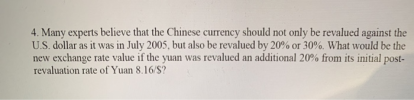 4. Many experts believe that the Chinese currency should not only be revalued against the U.S. dollar as it was in July 2005, but also be revalued by 20% or 30%. What would be the new exchange rate value if the yuan was revalued an additional 20% from its initial post- revaluation rate of Yuan 8.16/$?
3. You are a financial adviser to a U.S. corporation that expects to receive a payment...
 3. You are a financial adviser to a U.S. corporation that expects to receive a payment of 60 million Japanese yen in 180 days for goods exported to Japan. The current spot rate is 100 yen per U.S. dollar or 0.01000 dollar per yen. You are concerned that the U.S. dollar is going to appreciate against the yen over the next six months A. Assuming the exchange rate remains unchanged, how much does your firm expect to receive in U.S....
 8. Winco Co. is a U.S. firm with a subsidiary in China. The subsidiary reinvests half of its net cash flows into operations and remits half to the parent. Winco Co. has expected cash flows of $10,000,000 from domestic business and the Chinese subsidiary is expected to generate 100 million Chinese yuan at the end of the year. The expected value of yuan at the end of the year is $.13. What are the expected dollar cash flows of the...
 In accordance with the valuation formula of a U.S. based
multinational corporation, ,
which of the following is correct for JJ
Company (a U.S. based multinational corporation)? JJ Company has a
subsidiary established in China.
Question options:
If the economic condition in China weakens, the value of JJ
company increases.
If the required rate of return by investors, k, increases, the
value of JJ company increases.
If the U.S. dollar appreciates against Chinese Yuan (i.e.,
Chinese Yuan appreciates against the...
In accordance with the valuation formula of a U.S. based
multinational corporation, ,
which of the following is correct for JJ
Company (a U.S. based multinational corporation)? JJ Company has a
subsidiary established in China.
Question options:
If the economic condition in China weakens, the value of JJ
company increases.
If the required rate of return by investors, k, increases, the
value of JJ company increases.
If the U.S. dollar appreciates against Chinese Yuan (i.e.,
Chinese Yuan appreciates against the...
 7. Colorado Rockies Co. has a subsidiary in Japan. The subsidiary reinvests a quarter of its net cash flows into operations and remits the remainder to the parent. Colorado Rockies' expected cash flows from domestic business are $100,000 and the Japanese subsidiary is expected to generate 100 million Japanese Yen at the end of the year. The expected value of the yen is $.0095. What are the expected dollar cash flows of Colorado Rockies Co.?
 31. MNC Cash Flows and Exchange Rate Risk Tuscaloosa Co. is a U.S. firm that assembles phones in Argentina and transports the final assembled products to the parent, where they are sold by the parent in the United States. The assembled products are invoiced in dollars. The Argentine subsidiary obtains some material from China, and the Chinese exporter is willing to accept Argentine pesos as payment for these materials that it exports. The Argentine subsidiary pays its employees in the...
 4. Many experts believe that the Chinese currency should not only be revalued against the U.S. dollar as it was in July 2005, but also be revalued by 20% or 30%. What would be the new exchange rate value if the yuan was revalued an additional 20% from its initial post- revaluation rate of Yuan 8.16/$?
 3. You are a financial adviser to a U.S. corporation that expects to receive a payment of 60 million Japanese yen in 180 days for goods exported to Japan. The current spot rate is 100 yen per U.S. dollar or 0.01000 dollar per yen. You are concerned that the U.S. dollar is going to appreciate against the yen over the next six months A. Assuming the exchange rate remains unchanged, how much does your firm expect to receive in U.S....
Most questions answered within 3 hours.
-
Where is the error in this code sequence?
String s1 = "Hello";
String s2 = "ello";...
asked 10 months ago -
Financial data for Joel de Paris, Inc., for last year
follow:
Joel de Paris, Inc.
Balance...
asked 10 months ago -
Consider this reaction:
Al2(SO4)3 (aq)+ BaCl3
(aq) Al2Cl6 (aq)- +
3BaSO4(s) . What is the...
asked 10 months ago -
Suppose that Savneet is considering increasing her
recent random sample from 20 car rentals to 40...
asked 10 months ago -
Trucks arrive at an unloading terminal at an average rate of 120
per hour.
Trucks arrive...
asked 10 months ago -
Why are methanol and ethanol completely soluble in water while
octanol is not very little soluble....
asked 10 months ago -
A facilities manager at a university reads in a research report
that the mean amount of...
asked 10 months ago -
When the CuSO4 is rehydrated by adding water to the anhydrous
compound, is this an endothermic...
asked 10 months ago -
A ray of sunlight is passing from diamond into crown glass; the
angle of incidence is...
asked 10 months ago -
A block of mass 0.249 kg is placed on top of a light, vertical
spring of...
asked 10 months ago -
how do the kidneys compensate in the presences of acidosis
a) trigger hyperventilate
b) reserve acid...
asked 10 months ago -
Question 501 pts
The rental rate of capital to the firm increases. Which of the
following...
asked 10 months ago