
Homework Answers

Add Answer to:
A mass m in one-dimensional motion is subject to a nonlinear drag force and satisfies the...
A projectile P of mass m is fired from a point 0 with initial speed v0 at launch angle φ0 above a...
 A projectile P of mass m is fired from a point 0 with initial speed v0 at launch angle φ0 above a horizontal firing range. In addition to gravity, P is subject to the aerodynamic drag force by the surrounding air modeled as a quadratic function of speed where v is the velocity of P and k is a positive pa- rameter. 0 0 We are interested in studying the effect of Faero on various aspects of projectile motion. Since...
2. Consider a point particle of mass m undergoing a one-dimensional motion under the action of...
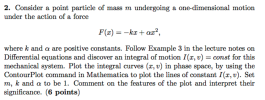 2. Consider a point particle of mass m undergoing a one-dimensional motion under the action of a force F(x) =-kx + az where k and ? are positive constants. Follow Example 3 in the lecture notes on Differential equations and discover an integral of motion I(x,v) - const for this mechanical system. Plot the integral curves (x, v) in phase space, by using the ContourPlot command in Mathematica to plot the lines of constant I(x,v). Set significance. (6 points)
Problem 36 bclow presents a model describing the drag of a fluid medium that is released from rest at time t 0 (same in...
 Problem 36 bclow presents a model describing the drag of a fluid medium that is released from rest at time t 0 (same initial conditions). Using Newton's Second Law, you build a model of the form particle moving through a (governing equation (initial velocity) mi mg-F drag '0 (0)(0)a (t) is the particle's position, m is the mass of the particle, g is the acceleration due to gravity, and Fa is the magnitude of the drag force. You account for...
A force Fx=4x+12 (in N, with x in m) acts on an object in one-dimensional motion....
A force Fx=4x+12 (in N, with x in m) acts on an object in one-dimensional motion. Find the work done by that force in moving an object from x = 0 to x = 9.0 m .
A linear spring-mass system (without friction) satisfies m(d^2x/dt^2) = -kx, Derive that m/2 (dx/dt)^2 + k/2...
 A linear spring-mass system (without friction) satisfies m(d^2x/dt^2) = -kx, Derive that m/2 (dx/dt)^2 + k/2 x^2 = constant = E. Consider the initial value problem such that at t = 0, = x_0 and dx/dt = v_0. Evaluate E. Using the expression for conservation of energy, evaluate the maximum displacement of the mass from its equilibrium position. Compare this to the result obtained from the exact explicit solution.
A particle of mass m slides without slipping down and inclined plane of mass M. The...
A particle of mass m slides without slipping down and inclined plane of mass M. The plane(a triangle) in turn can slide along the horizontal surface without friction. Find the Lagrangian in terms of (x, s, dx/dt, ds/dt), where s is the distance the particle has traveled down the incline, and solve the corresponding Euler-Lagrangian equations. Let x(t) be the location of the block, relative to the fixed origin, and x(0) = dx/dt(0) = 0, as well as s(0) =...
1. A ball of mass m is thrown with speed vo at an angle 0 with...
 1. A ball of mass m is thrown with speed vo at an angle 0 with respect to the horizontal. Let the drag force from the air take the form f Newton's second law, the r- and y-components of the acceleration of the ball are given by = mav where a is a constant and v is the speed of the ball. By du (t) = -av,(t), dt de,(t) ay(t)= -g-au,(t), dt where ug (t) and v,(t) are the x-...
A For a particle with mass m moving under a one dimensional potential V(x), one solution...
 A For a particle with mass m moving under a one dimensional potential V(x), one solution to the Schrödinger equation for the region 0<x< oo is x) =2 (a>0), where A is the normalization constant. The energy of the particle in the given state is 0, Show that this function is a solution, and find the corresponding potential V(x)?
A. Consider motion of a particle of mass m and energy E = 0 in the...
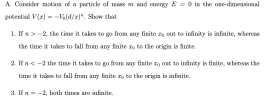 A. Consider motion of a particle of mass m and energy E = 0 in the one-dimensional potential V(x) = -V.(d/x)". Show that 1. If n > —2, the time it takes to go from any finite co out to infinity is infinite, whereas the time it takes to fall from any finite čo to the origin is finite. 2. If n < -2 the time it takes to go from any finite xo out to infinity is finite, whereas...
Elementary Differential Equation Unit Step Function Problem Project 2 A Spring-Mass Event Problenm A mass of...
 Elementary Differential Equation Unit Step Function Problem
Project 2 A Spring-Mass Event Problenm A mass of magnitude m is confined to one-dimensional motion between two springs on a frictionless horizontal surface, as shown in Figure 4.P.3. The mass, which is unattached to either spring, undergoes simple inertial motion whenever the distance from the origin of the center point of the mass, x, satisfies lxl < L. When x 2 L, the mass is in contact with the spring on the...
Elementary Differential Equation Unit Step Function Problem
Project 2 A Spring-Mass Event Problenm A mass of magnitude m is confined to one-dimensional motion between two springs on a frictionless horizontal surface, as shown in Figure 4.P.3. The mass, which is unattached to either spring, undergoes simple inertial motion whenever the distance from the origin of the center point of the mass, x, satisfies lxl < L. When x 2 L, the mass is in contact with the spring on the...
 A projectile P of mass m is fired from a point 0 with initial speed v0 at launch angle φ0 above a horizontal firing range. In addition to gravity, P is subject to the aerodynamic drag force by the surrounding air modeled as a quadratic function of speed where v is the velocity of P and k is a positive pa- rameter. 0 0 We are interested in studying the effect of Faero on various aspects of projectile motion. Since...
 2. Consider a point particle of mass m undergoing a one-dimensional motion under the action of a force F(x) =-kx + az where k and ? are positive constants. Follow Example 3 in the lecture notes on Differential equations and discover an integral of motion I(x,v) - const for this mechanical system. Plot the integral curves (x, v) in phase space, by using the ContourPlot command in Mathematica to plot the lines of constant I(x,v). Set significance. (6 points)
 Problem 36 bclow presents a model describing the drag of a fluid medium that is released from rest at time t 0 (same initial conditions). Using Newton's Second Law, you build a model of the form particle moving through a (governing equation (initial velocity) mi mg-F drag '0 (0)(0)a (t) is the particle's position, m is the mass of the particle, g is the acceleration due to gravity, and Fa is the magnitude of the drag force. You account for...
 A linear spring-mass system (without friction) satisfies m(d^2x/dt^2) = -kx, Derive that m/2 (dx/dt)^2 + k/2 x^2 = constant = E. Consider the initial value problem such that at t = 0, = x_0 and dx/dt = v_0. Evaluate E. Using the expression for conservation of energy, evaluate the maximum displacement of the mass from its equilibrium position. Compare this to the result obtained from the exact explicit solution.
 1. A ball of mass m is thrown with speed vo at an angle 0 with respect to the horizontal. Let the drag force from the air take the form f Newton's second law, the r- and y-components of the acceleration of the ball are given by = mav where a is a constant and v is the speed of the ball. By du (t) = -av,(t), dt de,(t) ay(t)= -g-au,(t), dt where ug (t) and v,(t) are the x-...
 A For a particle with mass m moving under a one dimensional potential V(x), one solution to the Schrödinger equation for the region 0<x< oo is x) =2 (a>0), where A is the normalization constant. The energy of the particle in the given state is 0, Show that this function is a solution, and find the corresponding potential V(x)?
 A. Consider motion of a particle of mass m and energy E = 0 in the one-dimensional potential V(x) = -V.(d/x)". Show that 1. If n > —2, the time it takes to go from any finite co out to infinity is infinite, whereas the time it takes to fall from any finite čo to the origin is finite. 2. If n < -2 the time it takes to go from any finite xo out to infinity is finite, whereas...
 Elementary Differential Equation Unit Step Function Problem
Project 2 A Spring-Mass Event Problenm A mass of magnitude m is confined to one-dimensional motion between two springs on a frictionless horizontal surface, as shown in Figure 4.P.3. The mass, which is unattached to either spring, undergoes simple inertial motion whenever the distance from the origin of the center point of the mass, x, satisfies lxl < L. When x 2 L, the mass is in contact with the spring on the...
Elementary Differential Equation Unit Step Function Problem
Project 2 A Spring-Mass Event Problenm A mass of magnitude m is confined to one-dimensional motion between two springs on a frictionless horizontal surface, as shown in Figure 4.P.3. The mass, which is unattached to either spring, undergoes simple inertial motion whenever the distance from the origin of the center point of the mass, x, satisfies lxl < L. When x 2 L, the mass is in contact with the spring on the...
Most questions answered within 3 hours.
-
Where is the error in this code sequence?
String s1 = "Hello";
String s2 = "ello";...
asked 10 months ago -
Financial data for Joel de Paris, Inc., for last year
follow:
Joel de Paris, Inc.
Balance...
asked 10 months ago -
Consider this reaction:
Al2(SO4)3 (aq)+ BaCl3
(aq) Al2Cl6 (aq)- +
3BaSO4(s) . What is the...
asked 10 months ago -
Suppose that Savneet is considering increasing her
recent random sample from 20 car rentals to 40...
asked 10 months ago -
Trucks arrive at an unloading terminal at an average rate of 120
per hour.
Trucks arrive...
asked 10 months ago -
Why are methanol and ethanol completely soluble in water while
octanol is not very little soluble....
asked 10 months ago -
A facilities manager at a university reads in a research report
that the mean amount of...
asked 10 months ago -
When the CuSO4 is rehydrated by adding water to the anhydrous
compound, is this an endothermic...
asked 10 months ago -
A ray of sunlight is passing from diamond into crown glass; the
angle of incidence is...
asked 10 months ago -
A block of mass 0.249 kg is placed on top of a light, vertical
spring of...
asked 10 months ago -
how do the kidneys compensate in the presences of acidosis
a) trigger hyperventilate
b) reserve acid...
asked 10 months ago -
Question 501 pts
The rental rate of capital to the firm increases. Which of the
following...
asked 10 months ago