
Homework Answers
a
| K = N |
| Bond Price =∑ [(Annual Coupon)/(1 + YTM)^k] + Par value/(1 + YTM)^N |
| k=1 |
| K =10 |
| Bond Price =∑ [(5*1000/100)/(1 + 10/100)^k] + 1000/(1 + 10/100)^10 |
| k=1 |
| Bond Price = 692.77 |
| Please ask remaining parts seperately, questions are unrelated |
Add Answer to:
A 10-year bond pays 5% on a face value of $1,000. If similar bonds are currently...
please answer both (c) and (d) please provide working. Kenanga Investment Bank is evaluating an equity....
 please answer both (c) and (d)
please provide working.
Kenanga Investment Bank is evaluating an equity. Recently, Malaysia government's risk free rate is 3.5%. Calculate the following investment's expected retun and its standard deviation. Should Kenanga Investment Bank invest in this equity compared to Malaysia risk free rate? Why (c) Return -5% 3% 7% 9% Probability 0.20 0.10 0.40 0.30 (10 marks) (d) Using the CAPM (capital asset pricing model) and SML (security market line), what is the expected rate...
please answer both (c) and (d)
please provide working.
Kenanga Investment Bank is evaluating an equity. Recently, Malaysia government's risk free rate is 3.5%. Calculate the following investment's expected retun and its standard deviation. Should Kenanga Investment Bank invest in this equity compared to Malaysia risk free rate? Why (c) Return -5% 3% 7% 9% Probability 0.20 0.10 0.40 0.30 (10 marks) (d) Using the CAPM (capital asset pricing model) and SML (security market line), what is the expected rate...
A 20-year bond pays 9% on a face value of $1,000. If similar bonds are currently...
A 20-year bond pays 9% on a face value of $1,000. If similar bonds are currently yielding 6%, what is the market value of the bond? Use annual analysis. Use time value of money tables in Appendix B and Appendix D. Multiple Choice Under $1,300 Exactly $1,000 Over $1,300 Not enough information is given to tell.
A 20-year bond pays 6% annually on a face value of $1,000. If similar bonds are...
A 20-year bond pays 6% annually on a face value of $1,000. If similar bonds are currently yielding 4%, what is the market value of the bond? Use time value of money tables in Appendix B and Appendix D.
"A 10-year bond pays 5% (Paid Annually) on a face value of $1,000. If similar bonds...
 "A 10-year bond pays 5% (Paid Annually) on a face value of $1,000. If similar bonds are currently yielding 10%, what is the market value of the bond?" O $693.25 O $386.00 O "$3,390.85" O "$1,386.09 Question Completion Status: > A Moving to the next question prevents changes to this answer. Question 12 The difference between the price and the par value of a zero-coupon bond represents O taxes payable by the bond buyer O the accumulated principal over the...
1. (Bonds) A zero-coupon bond has a $1,000 par value, 10 years to maturity, and sells...
1. (Bonds) A zero-coupon bond has a $1,000 par value, 10 years to maturity, and sells for $583.89. What is its yield to maturity? Assume annual compounding. Record your answer to the nearest 0.01% (no % symbol). E.g., if your answer is 3.455%, record it as 3.46. 2. (Stocks) A stock with the required rate of return of 14.38% is expected to pay a $0.9 dividend over the next year. The dividends are expected to grow at a constant rate...
1. Last year, Ahmed corp. issued 10-year 5% coupon bonds with face value of $500 each....
 1. Last year, Ahmed corp. issued 10-year 5% coupon bonds with face value of $500 each. If then market rate for Ahmed's risk class was 6%, how much money did the firm raise from each bond? 2. Wheeler bought 1000 of these bonds last year. This year interests drops by 2%. If Wheeler decides to sell these bonds now, how much money will he make in capital gain (or loss)? 3. Profit corp. analysts estimated the following probability distributions for...
Question 2 Orange Corp has 1 million shares outstanding, and the stock is currently trading at...
 Question 2 Orange Corp has 1 million shares outstanding, and the stock is currently trading at $10 per share. The company has two different bonds outstanding. First, it has 5000 zero coupon bonds outstanding. Each zero coupon bond has a face value of $1000, will mature in 5 years, and is currently priced at 65% of face value. Second, the company has 5000 coupon paying bonds outstanding. Each coupon paying bond is currently priced at $940.00, and the YTM is...
Question 2 Orange Corp has 1 million shares outstanding, and the stock is currently trading at...
 Question 2 Orange Corp has 1 million shares outstanding, and the stock is currently trading at $10 per share. The company has two different bonds outstanding. First, it has 5000 zero coupon bonds outstanding. Each zero coupon bond has a face value of $1000, will mature in 5 years, and is currently priced at 65% of face value. Second, the company has 5000 coupon paying bonds outstanding. Each coupon paying bond is currently priced at $940.00, and the YTM is...
13. A 10-year, 10.00% coupon bond with a face value of $1,000 is currently selling for...
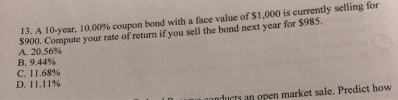 13. A 10-year, 10.00% coupon bond with a face value of $1,000 is currently selling for $900. Compute your rate of return if you sell the bond next year for $985. A. 20.56% B. 9.44% C. 11.68% D. 11.11% conducts an open market sale. Predict how
1) IBM has outstanding bonds with 8% annual coupon rate, that pays interest semiannually. Par value...
1) IBM has outstanding bonds with 8% annual coupon rate, that pays interest semiannually. Par value of these bonds are $1,000 and they were issued 7 years ago, at the time, with a 30-year maturity (remember that N is the time-to-maturity). a) If similar bonds have 9% return, how much would you be willing to pay for this bond? b) If the bond is currently selling for $950, what would your annual Yield-to-Maturity be if you were to buy it...
 please answer both (c) and (d)
please provide working.
Kenanga Investment Bank is evaluating an equity. Recently, Malaysia government's risk free rate is 3.5%. Calculate the following investment's expected retun and its standard deviation. Should Kenanga Investment Bank invest in this equity compared to Malaysia risk free rate? Why (c) Return -5% 3% 7% 9% Probability 0.20 0.10 0.40 0.30 (10 marks) (d) Using the CAPM (capital asset pricing model) and SML (security market line), what is the expected rate...
please answer both (c) and (d)
please provide working.
Kenanga Investment Bank is evaluating an equity. Recently, Malaysia government's risk free rate is 3.5%. Calculate the following investment's expected retun and its standard deviation. Should Kenanga Investment Bank invest in this equity compared to Malaysia risk free rate? Why (c) Return -5% 3% 7% 9% Probability 0.20 0.10 0.40 0.30 (10 marks) (d) Using the CAPM (capital asset pricing model) and SML (security market line), what is the expected rate...
 "A 10-year bond pays 5% (Paid Annually) on a face value of $1,000. If similar bonds are currently yielding 10%, what is the market value of the bond?" O $693.25 O $386.00 O "$3,390.85" O "$1,386.09 Question Completion Status: > A Moving to the next question prevents changes to this answer. Question 12 The difference between the price and the par value of a zero-coupon bond represents O taxes payable by the bond buyer O the accumulated principal over the...
 1. Last year, Ahmed corp. issued 10-year 5% coupon bonds with face value of $500 each. If then market rate for Ahmed's risk class was 6%, how much money did the firm raise from each bond? 2. Wheeler bought 1000 of these bonds last year. This year interests drops by 2%. If Wheeler decides to sell these bonds now, how much money will he make in capital gain (or loss)? 3. Profit corp. analysts estimated the following probability distributions for...
 Question 2 Orange Corp has 1 million shares outstanding, and the stock is currently trading at $10 per share. The company has two different bonds outstanding. First, it has 5000 zero coupon bonds outstanding. Each zero coupon bond has a face value of $1000, will mature in 5 years, and is currently priced at 65% of face value. Second, the company has 5000 coupon paying bonds outstanding. Each coupon paying bond is currently priced at $940.00, and the YTM is...
 Question 2 Orange Corp has 1 million shares outstanding, and the stock is currently trading at $10 per share. The company has two different bonds outstanding. First, it has 5000 zero coupon bonds outstanding. Each zero coupon bond has a face value of $1000, will mature in 5 years, and is currently priced at 65% of face value. Second, the company has 5000 coupon paying bonds outstanding. Each coupon paying bond is currently priced at $940.00, and the YTM is...
 13. A 10-year, 10.00% coupon bond with a face value of $1,000 is currently selling for $900. Compute your rate of return if you sell the bond next year for $985. A. 20.56% B. 9.44% C. 11.68% D. 11.11% conducts an open market sale. Predict how
Most questions answered within 3 hours.
-
Where is the error in this code sequence?
String s1 = "Hello";
String s2 = "ello";...
asked 11 months ago -
Financial data for Joel de Paris, Inc., for last year
follow:
Joel de Paris, Inc.
Balance...
asked 11 months ago -
Consider this reaction:
Al2(SO4)3 (aq)+ BaCl3
(aq) Al2Cl6 (aq)- +
3BaSO4(s) . What is the...
asked 11 months ago -
Suppose that Savneet is considering increasing her
recent random sample from 20 car rentals to 40...
asked 11 months ago -
Trucks arrive at an unloading terminal at an average rate of 120
per hour.
Trucks arrive...
asked 11 months ago -
Why are methanol and ethanol completely soluble in water while
octanol is not very little soluble....
asked 11 months ago -
A facilities manager at a university reads in a research report
that the mean amount of...
asked 11 months ago -
When the CuSO4 is rehydrated by adding water to the anhydrous
compound, is this an endothermic...
asked 11 months ago -
A ray of sunlight is passing from diamond into crown glass; the
angle of incidence is...
asked 11 months ago -
A block of mass 0.249 kg is placed on top of a light, vertical
spring of...
asked 11 months ago -
how do the kidneys compensate in the presences of acidosis
a) trigger hyperventilate
b) reserve acid...
asked 11 months ago -
Question 501 pts
The rental rate of capital to the firm increases. Which of the
following...
asked 11 months ago