
Homework Answers
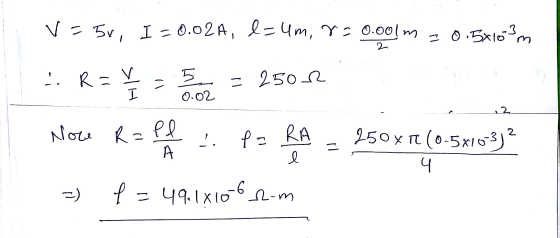
When a potential difference of 12 V is applied to a wire 6.6 m long and...
When a potential difference of 12 V is applied to a wire 6.6 m long and 0.33 mm in diameter the result is an electric current of 2.0 A . 1. What is the resistivity of the wire?
When a potential difference of 12 V is applied to a wire 6.6 m long and...
When a potential difference of 12 V is applied to a wire 6.6 m long and 0.32 mm in diameter the result is an electric current of 2.1 A . What is the resistivity of the wire?
1. A number 12 copper wire has a diameter of 2.053 mm. Calculate the resistance of...
1. A number 12 copper wire has a diameter of 2.053 mm. Calculate the resistance of a 37.0 m long piece of such wire. (Use 1.72×10⁻⁸ Ωm for the resistivity of copper.) Use the formula for resistance remembering that the diameter is specified rather than the radius. 2. For safety, the National Electrical Code limits the allowable amount of current which such a wire may carry. When used in indoor wiring, the limit is 20.0 A for rubber insulated wire...
a.) A 33.9-m length of copper wire at 20.0°C has a radius of 0.31 mm. If...
a.) A 33.9-m length of copper wire at 20.0°C has a radius of 0.31 mm. If a potential difference of 7.00 V is applied across the length of the wire, determine the current in the wire. b.) If the wire is heated to 40.0°C while the 7.00-V potential difference is maintained, what is the resulting current in the wire?
(a) A 35.3-m length of copper wire at 20.0°C has a radius of 0.31 mm. If...
 (a) A 35.3-m length of copper wire at 20.0°C has a radius of 0.31 mm. If a potential difference of 7.0 V is applied across the length of the wire, determine the current in the wire. (Use the values in this table.) 1.48 A (b) If the wire is heated to 40.0°C while the 7.0-V potential difference is maintained, what is the resulting current in the wire?
(a) A 34.1-m length of copper wire at 20.0°C has a radius of 0.21 mm. If...
(a) A 34.1-m length of copper wire at 20.0°C has a radius of 0.21 mm. If a potential difference of 8.00 V is applied across the length of the wire, determine the current in the wire. (Use the values in this table.) A (b) If the wire is heated to 40.0°C while the 8.00-V potential difference is maintained, what is the resulting current in the wire? A
A 3.00-m length of copper wire at 20 ∘C has a 1.20-m-long section with diameter 1.2...
A 3.00-m length of copper wire at 20 ∘C has a 1.20-m-long section with diameter 1.2 mm and a 1.80-m-long section with diameter 0.60 mm . There is a current of 3.0 mA in the 1.2 mm -diameter section. A)What is the current in the 0.60 mm -diameter section? B)What is the magnitude of E⃗ in the 1.2 mm -diameter section? C)What is the magnitude of E⃗ in the 0.60 mm -diameter section? D)What is the potential difference between the ends of...
A 100 m copper wire 2 mm in diameter has a 1.0 A current inside. The...
A 100 m copper wire 2 mm in diameter has a 1.0 A current inside. The copper wire is joined end to end to a 114 m long iron wire of the same diameter. Find the potential drop across the iron wire, ρIron = 9.7x10⁻⁸ Ω-m.
A copper wire has a diameter of 1.29x10^-3m. It carries a current density of 7.65x10^6A/m^2, which...
A copper wire has a diameter of 1.29x10^-3m. It carries a current density of 7.65x10^6A/m^2, which is assumed to be uniform over the cross section. (a) Calculate the current in the wire. (b) The copper has a conductivity of 5.8x10^7A/Vm with such a wire of 1 mile long, determine the resistance of the copper wire. (c) Determine the potential difference between the two ends of the wire with the current and resistance. (d) Determine the field intensity of E in...
A copper wire 10 m long must experience a voltage drop of less than 1.0 V...
 A copper wire 10 m long must experience a voltage drop of less than 1.0 V when a current of 3.0 A passes through it. Using the data in Table 12.1, compute the minimum diameter of the wire. Table 12.1 Room-Temperature Electrical Conductivities for Nine Common Metals and Alloys Metal Electrical Conductivity (22-m)!) Silver 6.8 * 107 Copper 6.0 x 10⁷ Gold 4.3 x 10⁷ Aluminum 3.8 x 10⁷ Brass (70 Cu-30 Zn) 1.6 × 10⁷ Iron 1.0 x 10⁷...
 (a) A 35.3-m length of copper wire at 20.0°C has a radius of 0.31 mm. If a potential difference of 7.0 V is applied across the length of the wire, determine the current in the wire. (Use the values in this table.) 1.48 A (b) If the wire is heated to 40.0°C while the 7.0-V potential difference is maintained, what is the resulting current in the wire?
 A copper wire 10 m long must experience a voltage drop of less than 1.0 V when a current of 3.0 A passes through it. Using the data in Table 12.1, compute the minimum diameter of the wire. Table 12.1 Room-Temperature Electrical Conductivities for Nine Common Metals and Alloys Metal Electrical Conductivity (22-m)!) Silver 6.8 * 107 Copper 6.0 x 10⁷ Gold 4.3 x 10⁷ Aluminum 3.8 x 10⁷ Brass (70 Cu-30 Zn) 1.6 × 10⁷ Iron 1.0 x 10⁷...
Most questions answered within 3 hours.
-
Where is the error in this code sequence?
String s1 = "Hello";
String s2 = "ello";...
asked 11 months ago -
Financial data for Joel de Paris, Inc., for last year
follow:
Joel de Paris, Inc.
Balance...
asked 11 months ago -
Consider this reaction:
Al2(SO4)3 (aq)+ BaCl3
(aq) Al2Cl6 (aq)- +
3BaSO4(s) . What is the...
asked 11 months ago -
Suppose that Savneet is considering increasing her
recent random sample from 20 car rentals to 40...
asked 11 months ago -
Trucks arrive at an unloading terminal at an average rate of 120
per hour.
Trucks arrive...
asked 11 months ago -
Why are methanol and ethanol completely soluble in water while
octanol is not very little soluble....
asked 11 months ago -
A facilities manager at a university reads in a research report
that the mean amount of...
asked 11 months ago -
When the CuSO4 is rehydrated by adding water to the anhydrous
compound, is this an endothermic...
asked 11 months ago -
A ray of sunlight is passing from diamond into crown glass; the
angle of incidence is...
asked 11 months ago -
A block of mass 0.249 kg is placed on top of a light, vertical
spring of...
asked 11 months ago -
how do the kidneys compensate in the presences of acidosis
a) trigger hyperventilate
b) reserve acid...
asked 11 months ago -
Question 501 pts
The rental rate of capital to the firm increases. Which of the
following...
asked 11 months ago