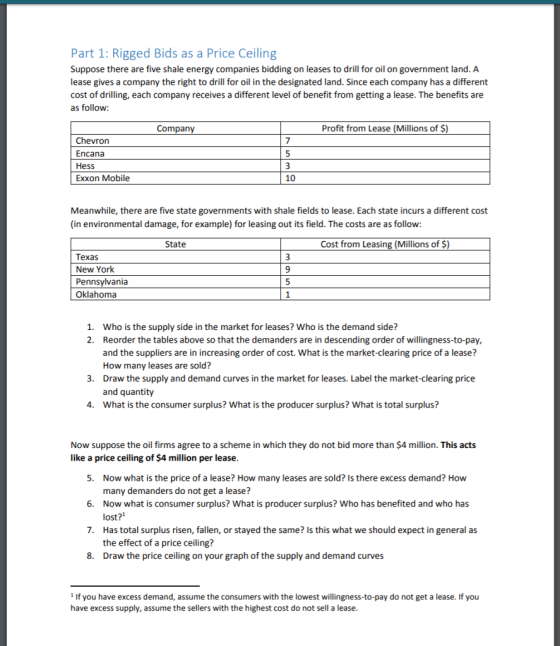
Can someone solve question 6 for me? Thank you very much.
Homework Answers
Producer surplus (PS)is defined as the difference between how much a producer is willing to sell his goods for and the amount he receives from selling the good.
Consumer surplus(CS) is defined as the difference between how much a consumer is willing to pay for a good and how much he is actually paying.
Price ceiling is the price above which price of a good cannot go. It is upper bound. For question 6,
the following states and companies have the following PS and CS
COMPANIES CS($ mil) STATES PS ($ mil)
Chevron 7-4=3 Texas 4-3=1
Encana 5-4=1 NY 4-9=-5
Hess 3-4=-1 PENN 4-5=-1
Exxon 10-4=6 OKLAHOMA 4-1=3
So we can see that consumers(companies) Chevron, encana and exxon have benefitted as their profit generated will be more than what they are having to pay to lease the land. Exxon benefits the most(6 million dollars). Hess is the only company that losses as it will suffer a loss of 1 million dollars because it can only profit 3 million dollars which is not enough to recover the cost.
In case of producers(states), Texas and oklahoma benefits as they will receive more money than the cost they incur. Okhlahoma benefits most(3 million dollars). But NY and Pennsylvania incurs more cost than 4 million dollars and thus will suffer loss with NY suffering the most(5 million dollars).
Add Answer to:
Can someone solve question 6 for me? Thank you very much.
Part 1: Rigged Bids as...
1 Standard Model of Taxes Consider the standard supply and demand model shown in 1. The...
 1 Standard Model of Taxes Consider the standard supply and demand model shown in 1. The demand curve in the figure is given by PD 10-Q. One interpretation of demand curves is that they show the willingness to pay of the marginal consumer. For example, the willingness to pay of the person who buys the 5th unit is 10-5-5. The supply curve is given by PS Q. We saw in EC311 that supply curves are interpretable as the marginal cost...
can you answer question 3 only plz thank you i need it as soon as possible Home demand: D 100-20P Home supply: S 30+20P What is the import demand schedule in home country, what is the equilibrium...
 can you answer question 3 only plz thank you i need it as soon
as possible
Home demand: D 100-20P Home supply: S 30+20P What is the import demand schedule in home country, what is the equilibrium price without trade? b Please draw the demand and supply curves at home, calculate and mark domestic consumer surplus and producer surplus without trade on the graph. 2 Foreign demand D 80-20P* Foreign supply: S 50 20P* What is the export supply schedule...
can you answer question 3 only plz thank you i need it as soon
as possible
Home demand: D 100-20P Home supply: S 30+20P What is the import demand schedule in home country, what is the equilibrium price without trade? b Please draw the demand and supply curves at home, calculate and mark domestic consumer surplus and producer surplus without trade on the graph. 2 Foreign demand D 80-20P* Foreign supply: S 50 20P* What is the export supply schedule...
h) If the price of tomatoes increase how would you explain the change in demand for...
 h) If the price of tomatoes increase how would you explain the change in demand for avocados with substitution and income effects? Explain in detail. 1) What is income elasticity of demand for avocado at the market clearing equilibrium price and quantity in Brooklyn avocado market? Explain. Also, based on your results explain what type of good tomatoes must be in Brooklyn. 1) Explain why as the price of avocado increases the demand for avocados becomes relatively more elastic? Also...
2. In the U.S. the two main sources of energy are natural gas and oil. Assume...
 2. In the U.S. the two main sources of energy are natural gas and oil. Assume that the supply curve for natural gas (per thousand cubic feet) is given by Q = 15.9 +0.72PG + 0.05Po where Pg corresponds to the price per thousand cubic feet (Tcf) of natural gas, and Po is the oil barrel price. The demand curve for natural gas (in Tcf) is Q = 0.02 - 1.8PG + 0.69Po. (a) Are natural gas and oil complements...
Can someone help me solve this problem? I want to know the solving method. Thank you!...
Can someone help me solve this problem? I want to know the solving method. Thank you! :) Questions 1 and 2 Refer to a market with the following information to be taken as given: ?? = 3? ?D = 20 − ? Calculate the producer surplus, assuming there is a monopoly supplier who is able to use first-degree price discrimination. a. 40 b. 42 c. 48 d. 50 Suppose the government forces the monopolist to charge a single price. It...
can someone help me with this question please 2. (30 points) Suppose the world price for a good is 50 and the domes...
 can someone help me with this question please
2. (30 points) Suppose the world price for a good is 50 and the domestic demand and supply curves are given by the following equations: Demand: P = 100 - 20 Supply: P = 20 + 30 How much is consumed? How much is produced at home? What are the values of consumer and producer surplus? If a tariff of $6 per unit is imposed, by how much docon change? unit is...
can someone help me with this question please
2. (30 points) Suppose the world price for a good is 50 and the domestic demand and supply curves are given by the following equations: Demand: P = 100 - 20 Supply: P = 20 + 30 How much is consumed? How much is produced at home? What are the values of consumer and producer surplus? If a tariff of $6 per unit is imposed, by how much docon change? unit is...
Can someone please explain C. Role of Government 1. Draw a supply and demand graph with a binding price ceiling. Label...
 Can someone please explain
C. Role of Government 1. Draw a supply and demand graph with a binding price ceiling. Label consumer and producer surplus as well as deadweight loss 2. Who benefits from the imposition of the price ceiling 3. T/F/Explain The current price for your favorite candy is $3. Government imposes a sales tax on this product of $0.50. The new equilibrium price will be $3.50 4. In the graph below, what is the customer's burden of the...
Can someone please explain
C. Role of Government 1. Draw a supply and demand graph with a binding price ceiling. Label consumer and producer surplus as well as deadweight loss 2. Who benefits from the imposition of the price ceiling 3. T/F/Explain The current price for your favorite candy is $3. Government imposes a sales tax on this product of $0.50. The new equilibrium price will be $3.50 4. In the graph below, what is the customer's burden of the...
I need help solving this question, how do you get the answer? QUESTION 2 Questions 1-6:...
 I need help solving this question, how do you get the
answer?
QUESTION 2 Questions 1-6: The diagram below depicts the supply and demand curves for bicycles. Use the diagram to answer the following questions 1 to 6. Price (5unit 150 Supply LS 120 70 Demand 10 100 200 300 of international trade, what is consumer surplus and producer a. consumer surplus S6,000 producer surplus $8,000 b. consumer surplus = $8,000 ; producer surplus = $6,000 O c, consumer surplus...
I need help solving this question, how do you get the
answer?
QUESTION 2 Questions 1-6: The diagram below depicts the supply and demand curves for bicycles. Use the diagram to answer the following questions 1 to 6. Price (5unit 150 Supply LS 120 70 Demand 10 100 200 300 of international trade, what is consumer surplus and producer a. consumer surplus S6,000 producer surplus $8,000 b. consumer surplus = $8,000 ; producer surplus = $6,000 O c, consumer surplus...
please also help questions 5 and 6. thank you! U L iebe! 1 Exercise 2: The...
 please also help questions 5 and 6. thank you!
U L iebe! 1 Exercise 2: The "welfare" implications of governmental in- tervention Suppose that market supply and supply for a standard one-bedroom apartment in Berkeley North are Jd = 1000-50P 19 -30--200, where ou (0.) corresponds to quantity demanded (supplied) and p corresponds to the monthly rent per apartment (measured in hundreds of US$). 1. Please calculate the equilibrium price that will clear this market and the accompanying equilibrium quantity....
please also help questions 5 and 6. thank you!
U L iebe! 1 Exercise 2: The "welfare" implications of governmental in- tervention Suppose that market supply and supply for a standard one-bedroom apartment in Berkeley North are Jd = 1000-50P 19 -30--200, where ou (0.) corresponds to quantity demanded (supplied) and p corresponds to the monthly rent per apartment (measured in hundreds of US$). 1. Please calculate the equilibrium price that will clear this market and the accompanying equilibrium quantity....
I need help with these Mcq's please. Thank you 37. Efficiency in a market is achieved...
 I need help with these Mcq's please. Thank you
37. Efficiency in a market is achieved when cial planner intervenes and sets the quantity of output after evaluating buyers willingness to pay and sellers' costs the sum of producer surplus and consumer surplus is maximized all firms are producing the end at the same low cost per unit. no buyer is willing to pay more than the equilibrium price for any unit of the good. C ( 38. Total surplus...
I need help with these Mcq's please. Thank you
37. Efficiency in a market is achieved when cial planner intervenes and sets the quantity of output after evaluating buyers willingness to pay and sellers' costs the sum of producer surplus and consumer surplus is maximized all firms are producing the end at the same low cost per unit. no buyer is willing to pay more than the equilibrium price for any unit of the good. C ( 38. Total surplus...
 1 Standard Model of Taxes Consider the standard supply and demand model shown in 1. The demand curve in the figure is given by PD 10-Q. One interpretation of demand curves is that they show the willingness to pay of the marginal consumer. For example, the willingness to pay of the person who buys the 5th unit is 10-5-5. The supply curve is given by PS Q. We saw in EC311 that supply curves are interpretable as the marginal cost...
 can you answer question 3 only plz thank you i need it as soon
as possible
Home demand: D 100-20P Home supply: S 30+20P What is the import demand schedule in home country, what is the equilibrium price without trade? b Please draw the demand and supply curves at home, calculate and mark domestic consumer surplus and producer surplus without trade on the graph. 2 Foreign demand D 80-20P* Foreign supply: S 50 20P* What is the export supply schedule...
can you answer question 3 only plz thank you i need it as soon
as possible
Home demand: D 100-20P Home supply: S 30+20P What is the import demand schedule in home country, what is the equilibrium price without trade? b Please draw the demand and supply curves at home, calculate and mark domestic consumer surplus and producer surplus without trade on the graph. 2 Foreign demand D 80-20P* Foreign supply: S 50 20P* What is the export supply schedule...
 h) If the price of tomatoes increase how would you explain the change in demand for avocados with substitution and income effects? Explain in detail. 1) What is income elasticity of demand for avocado at the market clearing equilibrium price and quantity in Brooklyn avocado market? Explain. Also, based on your results explain what type of good tomatoes must be in Brooklyn. 1) Explain why as the price of avocado increases the demand for avocados becomes relatively more elastic? Also...
 2. In the U.S. the two main sources of energy are natural gas and oil. Assume that the supply curve for natural gas (per thousand cubic feet) is given by Q = 15.9 +0.72PG + 0.05Po where Pg corresponds to the price per thousand cubic feet (Tcf) of natural gas, and Po is the oil barrel price. The demand curve for natural gas (in Tcf) is Q = 0.02 - 1.8PG + 0.69Po. (a) Are natural gas and oil complements...
 can someone help me with this question please
2. (30 points) Suppose the world price for a good is 50 and the domestic demand and supply curves are given by the following equations: Demand: P = 100 - 20 Supply: P = 20 + 30 How much is consumed? How much is produced at home? What are the values of consumer and producer surplus? If a tariff of $6 per unit is imposed, by how much docon change? unit is...
can someone help me with this question please
2. (30 points) Suppose the world price for a good is 50 and the domestic demand and supply curves are given by the following equations: Demand: P = 100 - 20 Supply: P = 20 + 30 How much is consumed? How much is produced at home? What are the values of consumer and producer surplus? If a tariff of $6 per unit is imposed, by how much docon change? unit is...
 Can someone please explain
C. Role of Government 1. Draw a supply and demand graph with a binding price ceiling. Label consumer and producer surplus as well as deadweight loss 2. Who benefits from the imposition of the price ceiling 3. T/F/Explain The current price for your favorite candy is $3. Government imposes a sales tax on this product of $0.50. The new equilibrium price will be $3.50 4. In the graph below, what is the customer's burden of the...
Can someone please explain
C. Role of Government 1. Draw a supply and demand graph with a binding price ceiling. Label consumer and producer surplus as well as deadweight loss 2. Who benefits from the imposition of the price ceiling 3. T/F/Explain The current price for your favorite candy is $3. Government imposes a sales tax on this product of $0.50. The new equilibrium price will be $3.50 4. In the graph below, what is the customer's burden of the...
 I need help solving this question, how do you get the
answer?
QUESTION 2 Questions 1-6: The diagram below depicts the supply and demand curves for bicycles. Use the diagram to answer the following questions 1 to 6. Price (5unit 150 Supply LS 120 70 Demand 10 100 200 300 of international trade, what is consumer surplus and producer a. consumer surplus S6,000 producer surplus $8,000 b. consumer surplus = $8,000 ; producer surplus = $6,000 O c, consumer surplus...
I need help solving this question, how do you get the
answer?
QUESTION 2 Questions 1-6: The diagram below depicts the supply and demand curves for bicycles. Use the diagram to answer the following questions 1 to 6. Price (5unit 150 Supply LS 120 70 Demand 10 100 200 300 of international trade, what is consumer surplus and producer a. consumer surplus S6,000 producer surplus $8,000 b. consumer surplus = $8,000 ; producer surplus = $6,000 O c, consumer surplus...
 please also help questions 5 and 6. thank you!
U L iebe! 1 Exercise 2: The "welfare" implications of governmental in- tervention Suppose that market supply and supply for a standard one-bedroom apartment in Berkeley North are Jd = 1000-50P 19 -30--200, where ou (0.) corresponds to quantity demanded (supplied) and p corresponds to the monthly rent per apartment (measured in hundreds of US$). 1. Please calculate the equilibrium price that will clear this market and the accompanying equilibrium quantity....
please also help questions 5 and 6. thank you!
U L iebe! 1 Exercise 2: The "welfare" implications of governmental in- tervention Suppose that market supply and supply for a standard one-bedroom apartment in Berkeley North are Jd = 1000-50P 19 -30--200, where ou (0.) corresponds to quantity demanded (supplied) and p corresponds to the monthly rent per apartment (measured in hundreds of US$). 1. Please calculate the equilibrium price that will clear this market and the accompanying equilibrium quantity....
 I need help with these Mcq's please. Thank you
37. Efficiency in a market is achieved when cial planner intervenes and sets the quantity of output after evaluating buyers willingness to pay and sellers' costs the sum of producer surplus and consumer surplus is maximized all firms are producing the end at the same low cost per unit. no buyer is willing to pay more than the equilibrium price for any unit of the good. C ( 38. Total surplus...
I need help with these Mcq's please. Thank you
37. Efficiency in a market is achieved when cial planner intervenes and sets the quantity of output after evaluating buyers willingness to pay and sellers' costs the sum of producer surplus and consumer surplus is maximized all firms are producing the end at the same low cost per unit. no buyer is willing to pay more than the equilibrium price for any unit of the good. C ( 38. Total surplus...
Most questions answered within 3 hours.
-
Where is the error in this code sequence?
String s1 = "Hello";
String s2 = "ello";...
asked 10 months ago -
Financial data for Joel de Paris, Inc., for last year
follow:
Joel de Paris, Inc.
Balance...
asked 10 months ago -
Consider this reaction:
Al2(SO4)3 (aq)+ BaCl3
(aq) Al2Cl6 (aq)- +
3BaSO4(s) . What is the...
asked 10 months ago -
Suppose that Savneet is considering increasing her
recent random sample from 20 car rentals to 40...
asked 10 months ago -
Trucks arrive at an unloading terminal at an average rate of 120
per hour.
Trucks arrive...
asked 10 months ago -
Why are methanol and ethanol completely soluble in water while
octanol is not very little soluble....
asked 10 months ago -
A facilities manager at a university reads in a research report
that the mean amount of...
asked 10 months ago -
When the CuSO4 is rehydrated by adding water to the anhydrous
compound, is this an endothermic...
asked 10 months ago -
A ray of sunlight is passing from diamond into crown glass; the
angle of incidence is...
asked 10 months ago -
A block of mass 0.249 kg is placed on top of a light, vertical
spring of...
asked 10 months ago -
how do the kidneys compensate in the presences of acidosis
a) trigger hyperventilate
b) reserve acid...
asked 10 months ago -
Question 501 pts
The rental rate of capital to the firm increases. Which of the
following...
asked 10 months ago