
Homework Answers
Add Answer to:
Review Problem 6.083 Calculate AHo in kilojoules for the following reaction, the preparation of the unstable...
Review Problem 6.084 Calcium hydroxide reacts with hydrochloric acid by the following equation: Ca(OH)2(aq)2HCI(aq)CaCl2(aq) +2H20() Calculate...
 Review Problem 6.084 Calcium hydroxide reacts with hydrochloric acid by the following equation: Ca(OH)2(aq)2HCI(aq)CaCl2(aq) +2H20() Calculate AHo in kilojoules for this reaction, using the following equations as needed. CaO(s)+2HCI(aq) CaCl2(aq) +H20() AHo=-186 k) CaO(s) +H20()Ca(OH)2(s) AHO Ca(OH)2(s)Ca(OH)2(aq) AHo = -12.6 kJ (dissolving in water) -65.1 kJ AHo kJ The number of significant digits is set to 3; the tolerance is +/-2 % Show Work is REQUIRED for this question: Open Show Work SHOW HINT LINK TO TEXT
Review Problem 6.085 Given the following thermochemical equations, COG) + Cl2(g)—COClz0) H,0() + COC126) + 2NaBr(s)...
 Review Problem 6.085 Given the following thermochemical equations, COG) + Cl2(g)—COClz0) H,0() + COC126) + 2NaBr(s) — 2NaCIG) + Ca(OH)2C) + Brz(1) Ca(OH),() — COC) + H20() calculate the value of AH° (in kilojoules) for the reaction Cl:(8)+NaBr(s) — NaCl(s) + Brz() AH'= -110.9 kJ AH° = -60.2 kJ AH° = +65.1 kJ AH = The number of significant digits is set to 3; the tolerance is +/-2% Show Work is REQUIRED for this question: Open Show Work
Review Problem 6.086 Given the following thermochemical equations, 2Cu + S(s) - Cu2S(s) AH° = -79.5...
 Review Problem 6.086 Given the following thermochemical equations, 2Cu + S(s) - Cu2S(s) AH° = -79.5 kJ S(s) + O2(g) → SO2(9) AH = -297 kJ Cu2S(s) + 202(g) → 2CụO(s) + SO2(g) AH° = -527.5 kJ calculate the standard enthalpy of formation (in kilojoules per mole) of Cuo(s). AH°(Cuo(s)) - kJ/mol The number of significant digits is set to 3; the tolerance is +/-2% Show Work is REQUIRED for this question: Open Show Work Review Problem 6.087 Given the...
Review Problem 6.088 Given the following thermochemical equations, 4NH3(g) +70,(3) — GNO (8) + 8NH3(g) —...
 Review Problem 6.088 Given the following thermochemical equations, 4NH3(g) +70,(3) — GNO (8) + 8NH3(g) — 4NO2(g) + 6H20(3) AH°=-1132 kJ N(8) + 12H,0(8) AH = -2740 kJ calculate the value of AH (in kilojoules) for the reaction 4NH3(g) + 30,($) — 2N,() + 6H20(g) AH The number of significant digits is set to 4; the tolerance is +/-2% Show Work is REQUIRED for this question: Open Show Work
Review Problem 6.085 x Incorrect. Did you perform all operations that you performed on the reactions...
 Review Problem 6.085 x Incorrect. Did you perform all operations that you performed on the reactions to the values of enthalpy for each reaction? Are all your reactants and products on the correc sides? Given the following thermochemical equations, COG+Cl(s) —Cod:6) H 0(0) + COC10) + 2NaBe(s) — 2NCKG) + Ca(OH),() + Bryl Ca(OH),() —COG) + H20(1) calculate the value of AH (in kilojoules) for the reaction 01.(8) + NaBr() NaCl@) + Br() AH'= -110.9 kJ AH = -60.2 kJ...
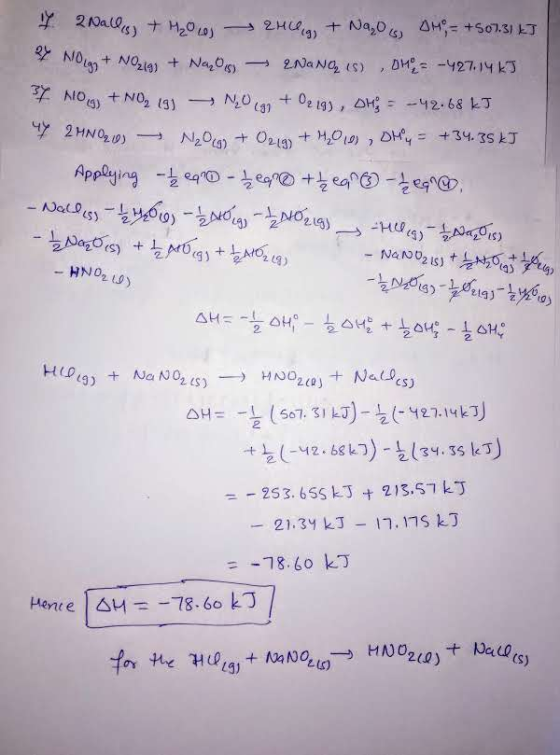
Applying Hess’s Law, from the enthalpies of reactions, 2NaCl(s) + H2O(l) --> 2HCl(g) + Na2O(s) ΔH...
Applying Hess’s Law, from the enthalpies of reactions, 2NaCl(s) + H2O(l) --> 2HCl(g) + Na2O(s) ΔH = + 507.31 kJ NO(g) + NO2(g) + Na2O(s) --> 2NaNO2(s) ΔH = − 427.14 kJ NO(g) + NO2(g) --> N2O(g) + O2(g) ΔH = − 42.68 kJ 2HNO2(l) --> N2O(g) + O2(g) + H2O(l) ΔH = + 34.35 kJ Calculate the enthalpy change (ΔHrxn) for the reaction: HCl(g) + NaNO2(s) --> HNO2(l) + NaCl(s) (You should show work to get credit) 5-Magnesium burns...
Review Problem 6.078 Methanol is used to heat food. The combustion of methanol can be described by the following th...
 Review Problem 6.078 Methanol is used to heat food. The combustion of methanol can be described by the following thermochemical equation: 2CH3OH() + 302(9) ► 2002(9) + 4H20(9) AH° = -1199 kJ How much methanol, in grams, is needed to release 584 k) of heat? g of CH3OH The number of significant digits is set to 3; the tolerance is +/-2% Show Work is REQUIRED for this question: Open Show Work
Calcium hydroxide reacts with hydrochloric acid by the following equation: Ca(OH)2(aq)+ 2Ha(aq) CaCl2(aq) + 2H20() Calculate...
 Calcium hydroxide reacts with hydrochloric acid by the following equation: Ca(OH)2(aq)+ 2Ha(aq) CaCl2(aq) + 2H20() Calculate AH in kilojoules for this reaction, using the following equations as needed. Cao(s) +2HCI(aq)CaCl2(aq) + H20(0 AHP-186 k Ca0(s)+ H20)Ca(OH)2(s) AH-65.1 k Ca(OH)2(s) Ca(OH)2(aq) AH 12.6 k) (dissolving in water) AH k) The number of significant digits is set to 3; the tolerance is +/-2 % Open Show Work Show Work is REQUIRED for this question:
Review Problem 6.075 Magnesium burns in air to produce a bright light and is often used in fireworks displays. The...
 Review Problem 6.075 Magnesium burns in air to produce a bright light and is often used in fireworks displays. The combustion of magnesium can be described by the following thermochemical equation: 2Mg(s) +02() - 2MgO(s) AH = -1203 ) Calculate the heat of reaction (in kilojoules) when the combustion of 5.49 g of magnesium occurs. Include the sign in your answer. The number of significant digits is set to 3; the tolerance is +/-29 Show Work is REQUIRED for this...
Review Problem 6.090 Which of the following thermochemical equations can have AH for the heat of the reaction? a) N...
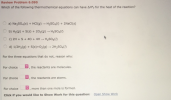 Review Problem 6.090 Which of the following thermochemical equations can have AH for the heat of the reaction? a) Na2SO4(s) + HCI(g) H2SO4( + 2NaCl(s) b) H2(g) + S(s)+ 202(g) H2SO4() c) 2H+S+40 +4H H2SO4() d) 1/2H2(g) + S(s) + O2 (g) 2H2SO4() For the three equations that do not, reason why: the reactants are molecules. For choice the reactants are atoms. For choice more than one mole is formed. For choice Open Show Work Click if you would like...
 Review Problem 6.084 Calcium hydroxide reacts with hydrochloric acid by the following equation: Ca(OH)2(aq)2HCI(aq)CaCl2(aq) +2H20() Calculate AHo in kilojoules for this reaction, using the following equations as needed. CaO(s)+2HCI(aq) CaCl2(aq) +H20() AHo=-186 k) CaO(s) +H20()Ca(OH)2(s) AHO Ca(OH)2(s)Ca(OH)2(aq) AHo = -12.6 kJ (dissolving in water) -65.1 kJ AHo kJ The number of significant digits is set to 3; the tolerance is +/-2 % Show Work is REQUIRED for this question: Open Show Work SHOW HINT LINK TO TEXT
 Review Problem 6.085 Given the following thermochemical equations, COG) + Cl2(g)—COClz0) H,0() + COC126) + 2NaBr(s) — 2NaCIG) + Ca(OH)2C) + Brz(1) Ca(OH),() — COC) + H20() calculate the value of AH° (in kilojoules) for the reaction Cl:(8)+NaBr(s) — NaCl(s) + Brz() AH'= -110.9 kJ AH° = -60.2 kJ AH° = +65.1 kJ AH = The number of significant digits is set to 3; the tolerance is +/-2% Show Work is REQUIRED for this question: Open Show Work
 Review Problem 6.086 Given the following thermochemical equations, 2Cu + S(s) - Cu2S(s) AH° = -79.5 kJ S(s) + O2(g) → SO2(9) AH = -297 kJ Cu2S(s) + 202(g) → 2CụO(s) + SO2(g) AH° = -527.5 kJ calculate the standard enthalpy of formation (in kilojoules per mole) of Cuo(s). AH°(Cuo(s)) - kJ/mol The number of significant digits is set to 3; the tolerance is +/-2% Show Work is REQUIRED for this question: Open Show Work Review Problem 6.087 Given the...
 Review Problem 6.088 Given the following thermochemical equations, 4NH3(g) +70,(3) — GNO (8) + 8NH3(g) — 4NO2(g) + 6H20(3) AH°=-1132 kJ N(8) + 12H,0(8) AH = -2740 kJ calculate the value of AH (in kilojoules) for the reaction 4NH3(g) + 30,($) — 2N,() + 6H20(g) AH The number of significant digits is set to 4; the tolerance is +/-2% Show Work is REQUIRED for this question: Open Show Work
 Review Problem 6.085 x Incorrect. Did you perform all operations that you performed on the reactions to the values of enthalpy for each reaction? Are all your reactants and products on the correc sides? Given the following thermochemical equations, COG+Cl(s) —Cod:6) H 0(0) + COC10) + 2NaBe(s) — 2NCKG) + Ca(OH),() + Bryl Ca(OH),() —COG) + H20(1) calculate the value of AH (in kilojoules) for the reaction 01.(8) + NaBr() NaCl@) + Br() AH'= -110.9 kJ AH = -60.2 kJ...
 Review Problem 6.078 Methanol is used to heat food. The combustion of methanol can be described by the following thermochemical equation: 2CH3OH() + 302(9) ► 2002(9) + 4H20(9) AH° = -1199 kJ How much methanol, in grams, is needed to release 584 k) of heat? g of CH3OH The number of significant digits is set to 3; the tolerance is +/-2% Show Work is REQUIRED for this question: Open Show Work
 Calcium hydroxide reacts with hydrochloric acid by the following equation: Ca(OH)2(aq)+ 2Ha(aq) CaCl2(aq) + 2H20() Calculate AH in kilojoules for this reaction, using the following equations as needed. Cao(s) +2HCI(aq)CaCl2(aq) + H20(0 AHP-186 k Ca0(s)+ H20)Ca(OH)2(s) AH-65.1 k Ca(OH)2(s) Ca(OH)2(aq) AH 12.6 k) (dissolving in water) AH k) The number of significant digits is set to 3; the tolerance is +/-2 % Open Show Work Show Work is REQUIRED for this question:
 Review Problem 6.075 Magnesium burns in air to produce a bright light and is often used in fireworks displays. The combustion of magnesium can be described by the following thermochemical equation: 2Mg(s) +02() - 2MgO(s) AH = -1203 ) Calculate the heat of reaction (in kilojoules) when the combustion of 5.49 g of magnesium occurs. Include the sign in your answer. The number of significant digits is set to 3; the tolerance is +/-29 Show Work is REQUIRED for this...
 Review Problem 6.090 Which of the following thermochemical equations can have AH for the heat of the reaction? a) Na2SO4(s) + HCI(g) H2SO4( + 2NaCl(s) b) H2(g) + S(s)+ 202(g) H2SO4() c) 2H+S+40 +4H H2SO4() d) 1/2H2(g) + S(s) + O2 (g) 2H2SO4() For the three equations that do not, reason why: the reactants are molecules. For choice the reactants are atoms. For choice more than one mole is formed. For choice Open Show Work Click if you would like...
Most questions answered within 3 hours.
-
Where is the error in this code sequence?
String s1 = "Hello";
String s2 = "ello";...
asked 11 months ago -
Financial data for Joel de Paris, Inc., for last year
follow:
Joel de Paris, Inc.
Balance...
asked 11 months ago -
Consider this reaction:
Al2(SO4)3 (aq)+ BaCl3
(aq) Al2Cl6 (aq)- +
3BaSO4(s) . What is the...
asked 11 months ago -
Suppose that Savneet is considering increasing her
recent random sample from 20 car rentals to 40...
asked 11 months ago -
Trucks arrive at an unloading terminal at an average rate of 120
per hour.
Trucks arrive...
asked 11 months ago -
Why are methanol and ethanol completely soluble in water while
octanol is not very little soluble....
asked 11 months ago -
A facilities manager at a university reads in a research report
that the mean amount of...
asked 11 months ago -
When the CuSO4 is rehydrated by adding water to the anhydrous
compound, is this an endothermic...
asked 11 months ago -
A ray of sunlight is passing from diamond into crown glass; the
angle of incidence is...
asked 11 months ago -
A block of mass 0.249 kg is placed on top of a light, vertical
spring of...
asked 11 months ago -
how do the kidneys compensate in the presences of acidosis
a) trigger hyperventilate
b) reserve acid...
asked 11 months ago -
Question 501 pts
The rental rate of capital to the firm increases. Which of the
following...
asked 11 months ago