
Homework Answers
Add Answer to:
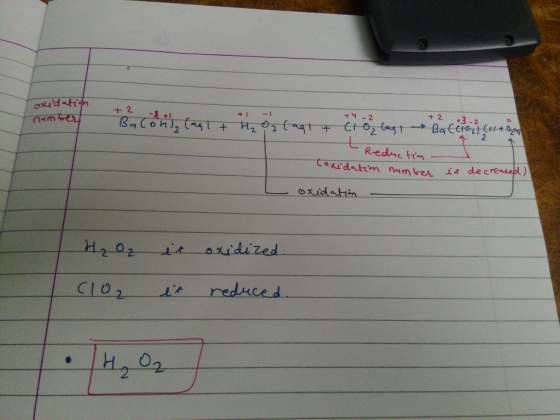
Consider the following unbalanced oxidation - reduction reaction: Ba(OH)2(aq) + H2O2(aq) + CO2(aq) + Ba(CIO2)2(s) +...
Again consider the following unbalanced oxidation - reduction reaction: Ba(OH)2(aq) + H2O2(aq) + CIO2(aq) + Ba(CIO2)2(s)...
 Again consider the following unbalanced oxidation - reduction reaction: Ba(OH)2(aq) + H2O2(aq) + CIO2(aq) + Ba(CIO2)2(s) + O2(g) Balance this reaction for basic conditions. Once both half reactions are ready to add to give the overall balanced reaction, the number of electrons lost ( = the number of electrons gained) is O 2 O 3 O 1 O none of these
Part III: Oxidation and Reduction of H2O2 1. Reduction of H2O2: H2O2(aq) + Cr(OH)3(S) (BASIC) •...
 Part III: Oxidation and Reduction of H2O2 1. Reduction of H2O2: H2O2(aq) + Cr(OH)3(S) (BASIC) • Observations · Evidence of the oxidation of Cr3+ • Reduction Half Reaction • Oxidation Half Reaction • Overall Balanced Redox Reaction · Explain occurrence or non-occurrence of reaction by calculating cell. 2. Oxidation of H2O2: H2O2(aq) + FeCl3(aq) • Observations • Evidence of the oxidation of H2O2 • Reduction Half Reaction • Oxidation Half Reaction • Overall Balanced Redox Reaction • Explain occurrence or...
2 CIO2 (aq) + 2 OH- (aq) - CIO3- (aq) + CO2- (aq) + H20 (1)...
 2 CIO2 (aq) + 2 OH- (aq) - CIO3- (aq) + CO2- (aq) + H20 (1) Experiment Number Initial Rate (CIO2(M) [OH-] (M) (M/s) 0.060 0.030 0.0248 0.020 0.030 0.00276 0.020 0 .090 0.00828 3 1) What is the magnitude of the rate constant for the reaction? A) 1.15 x 10⁴ B) 115 C) 4.6 D) 713 E) 230 2) Which reaction produces a decrease in the entropy of the system? A) 2C(s) + O2 (g) - 200 (8) B)...
Consider the reaction: Ba^2+ (aq) + 2OH^- (aq) → Ba(OH)2 (s) This reaction is NOT considered...
Consider the reaction: Ba^2+ (aq) + 2OH^- (aq) → Ba(OH)2 (s) This reaction is NOT considered a redox reaction because: a) It only results in the formation of one product b) It only involves the oxidation of barium c) the oxidation number of the element does not change d) the product is in the solid state e) it only involves the reduction of barium
Ba(OH)2(s) + 2HNO3(aq) + Ba(NO3)2(aq) + 2H2O(1) Classify the following reaction: A) Precipitation B) Oxidation-Reduction C)...
 Ba(OH)2(s) + 2HNO3(aq) + Ba(NO3)2(aq) + 2H2O(1) Classify the following reaction: A) Precipitation B) Oxidation-Reduction C) Dehydration D) Acid-Base Neutralization
Which of the following reactions is an oxidation-reduction reaction? A) NH4HS(s) → NH3(g) + H2S(g) B)...
Which of the following reactions is an oxidation-reduction reaction? A) NH4HS(s) → NH3(g) + H2S(g) B) 2 NaHCO3(s) → Na2CO3(s) + H2O(g) + CO2(g) C) N2O4(g) → 2 NO2(g) D) 2 SO2(g) + O2(g) → 2 SO3(g) E) 2 HC2H3O2(aq) + Ba(OH)2(aq) → Ba(C2H3O2)2(aq) + 2 H2O(l)
3. Consider the unbalanced reaction NO3- (aq) + Sn2+ (aq) +Snº+(aq) + NO(g) a. Atom In...
 3. Consider the unbalanced reaction NO3- (aq) + Sn2+ (aq) +Snº+(aq) + NO(g) a. Atom In the following table, identify which atom is oxidized, which atom is reduced, and their oxidation states in the reactants and products. (12 points) Oxidation State in Oxidation State in Reactant Product Oxidized Reduced b. Balance the reaction under BASIC conditions. (15 points) NO3- (aq) + Sn2+ (aq) Sn"+ (aq) + NO(g)
2. Consider the following unbalanced redox reaction: CIO2 (aq) Cr(OH)1(s)CI(aq) +Cr04(aq) (a) Balance the corresponding half...
 2. Consider the following unbalanced redox reaction: CIO2 (aq) Cr(OH)1(s)CI(aq) +Cr04(aq) (a) Balance the corresponding half reactions in acidic conditions using the lowest possible whole number coefficients Enter coeffcients for one and zero. Blanks i be marked incorrect.) CIO2 (aq) + Submil Answer Tries 0/3 H20(I) + OH (aq) + Submi AnserTries 0/3 (b) Using the results from part (a), balance the full reaction in acidic conditions with the lowest possible whole number coefficients. (Enter coefficients for one and zero....
Consider the following UNBALANCED reaction IN ACIDIC SOLUTION: Fe2+(aq) + MnO4-(aq) ⟶ Fe3+(aq) + Mn2+(aq) a....
Consider the following UNBALANCED reaction IN ACIDIC SOLUTION: Fe2+(aq) + MnO4-(aq) ⟶ Fe3+(aq) + Mn2+(aq) a. (5) Species that is oxidized (be specific – i.e. identify which atom and if there are multiple atoms with different charges, identify the correct one) b. (5) Species that is reduced (same instructions as above) c. (10) Full Balanced oxidation ½ reaction (‘full’ means with regard to mass (atoms) and charges.) d. (10) Full Balanced reduction ½ reaction e. (9) Complete Balanced Reaction Using...
8 The Following reaction is classified as: 2HCl(aq) + Ba(OH)2(aq) → BaCl(aq) + 2 H2000 a) oxidation-reduction react...
 8 The Following reaction is classified as: 2HCl(aq) + Ba(OH)2(aq) → BaCl(aq) + 2 H2000 a) oxidation-reduction reaction b) precipitation reaction c) single replacement d) acid-base neutralization reaction What is the volume of 0.1220 M HINO, solution required to completely neutralize 17.50 ml of 0.1211 M NaOH ? Reaction is: HNO, (aq) + NaOH(aq) - NaNO, (ng) + H. (A) a) 17.37 ml. b) 16.31 ml. c) 15.39 mL d) 17.84 mL 10. Which one of the following reactions is...
 Again consider the following unbalanced oxidation - reduction reaction: Ba(OH)2(aq) + H2O2(aq) + CIO2(aq) + Ba(CIO2)2(s) + O2(g) Balance this reaction for basic conditions. Once both half reactions are ready to add to give the overall balanced reaction, the number of electrons lost ( = the number of electrons gained) is O 2 O 3 O 1 O none of these
 Part III: Oxidation and Reduction of H2O2 1. Reduction of H2O2: H2O2(aq) + Cr(OH)3(S) (BASIC) • Observations · Evidence of the oxidation of Cr3+ • Reduction Half Reaction • Oxidation Half Reaction • Overall Balanced Redox Reaction · Explain occurrence or non-occurrence of reaction by calculating cell. 2. Oxidation of H2O2: H2O2(aq) + FeCl3(aq) • Observations • Evidence of the oxidation of H2O2 • Reduction Half Reaction • Oxidation Half Reaction • Overall Balanced Redox Reaction • Explain occurrence or...
 2 CIO2 (aq) + 2 OH- (aq) - CIO3- (aq) + CO2- (aq) + H20 (1) Experiment Number Initial Rate (CIO2(M) [OH-] (M) (M/s) 0.060 0.030 0.0248 0.020 0.030 0.00276 0.020 0 .090 0.00828 3 1) What is the magnitude of the rate constant for the reaction? A) 1.15 x 10⁴ B) 115 C) 4.6 D) 713 E) 230 2) Which reaction produces a decrease in the entropy of the system? A) 2C(s) + O2 (g) - 200 (8) B)...
 Ba(OH)2(s) + 2HNO3(aq) + Ba(NO3)2(aq) + 2H2O(1) Classify the following reaction: A) Precipitation B) Oxidation-Reduction C) Dehydration D) Acid-Base Neutralization
 3. Consider the unbalanced reaction NO3- (aq) + Sn2+ (aq) +Snº+(aq) + NO(g) a. Atom In the following table, identify which atom is oxidized, which atom is reduced, and their oxidation states in the reactants and products. (12 points) Oxidation State in Oxidation State in Reactant Product Oxidized Reduced b. Balance the reaction under BASIC conditions. (15 points) NO3- (aq) + Sn2+ (aq) Sn"+ (aq) + NO(g)
 2. Consider the following unbalanced redox reaction: CIO2 (aq) Cr(OH)1(s)CI(aq) +Cr04(aq) (a) Balance the corresponding half reactions in acidic conditions using the lowest possible whole number coefficients Enter coeffcients for one and zero. Blanks i be marked incorrect.) CIO2 (aq) + Submil Answer Tries 0/3 H20(I) + OH (aq) + Submi AnserTries 0/3 (b) Using the results from part (a), balance the full reaction in acidic conditions with the lowest possible whole number coefficients. (Enter coefficients for one and zero....
 8 The Following reaction is classified as: 2HCl(aq) + Ba(OH)2(aq) → BaCl(aq) + 2 H2000 a) oxidation-reduction reaction b) precipitation reaction c) single replacement d) acid-base neutralization reaction What is the volume of 0.1220 M HINO, solution required to completely neutralize 17.50 ml of 0.1211 M NaOH ? Reaction is: HNO, (aq) + NaOH(aq) - NaNO, (ng) + H. (A) a) 17.37 ml. b) 16.31 ml. c) 15.39 mL d) 17.84 mL 10. Which one of the following reactions is...
Most questions answered within 3 hours.
-
Where is the error in this code sequence?
String s1 = "Hello";
String s2 = "ello";...
asked 10 months ago -
Financial data for Joel de Paris, Inc., for last year
follow:
Joel de Paris, Inc.
Balance...
asked 10 months ago -
Consider this reaction:
Al2(SO4)3 (aq)+ BaCl3
(aq) Al2Cl6 (aq)- +
3BaSO4(s) . What is the...
asked 10 months ago -
Suppose that Savneet is considering increasing her
recent random sample from 20 car rentals to 40...
asked 10 months ago -
Trucks arrive at an unloading terminal at an average rate of 120
per hour.
Trucks arrive...
asked 10 months ago -
Why are methanol and ethanol completely soluble in water while
octanol is not very little soluble....
asked 10 months ago -
A facilities manager at a university reads in a research report
that the mean amount of...
asked 10 months ago -
When the CuSO4 is rehydrated by adding water to the anhydrous
compound, is this an endothermic...
asked 10 months ago -
A ray of sunlight is passing from diamond into crown glass; the
angle of incidence is...
asked 10 months ago -
A block of mass 0.249 kg is placed on top of a light, vertical
spring of...
asked 10 months ago -
how do the kidneys compensate in the presences of acidosis
a) trigger hyperventilate
b) reserve acid...
asked 10 months ago -
Question 501 pts
The rental rate of capital to the firm increases. Which of the
following...
asked 10 months ago