
Homework Answers
It is a primary halide will undergo SN2 mechanism.
The rate of the reaction will depends upon both concentration of nucleophile as well as alkyl halide
![Rate = [ Br] [CN-]- Nucleophile conc of electrophile increased by 4 times Conch å increased by 5 times Rateq=k5 [a br] { [ca](http://img.homeworklib.com/questions/6423d490-7007-11ea-8f1c-0308faf08f00.png?x-oss-process=image/resize,w_560) rate will increase 20 times of
initial rate.
rate will increase 20 times of
initial rate.
Add Answer to:
By what factor does the rate increase when the concentration of the nucleophile is increased by...
By what factor does the rate increase when the concentration of the nucleophile is increased by...
 By what factor does the rate increase when the concentration of the nucleophile is increased by 3 times and the electrophile is increased by 2 times for the following reaction or CN CN + Bre
Provide the major product for the following reaction? NaCl, DMF By what factor does the rate...
 Provide the major product for the following reaction? NaCl, DMF By what factor does the rate increase when the concentration of the nucleophile is increased by 5 times and the electrophile is increased by 3 times for the following reaction. Br CNVCN
6. and the nucleophile in the rate- What are the electrophile limiting step of the following...
 6. and the nucleophile in the rate- What are the electrophile limiting step of the following reaction? ilBr Br HO
11. Which of the following reactions take place more rapidly when the concentration of the nucleophile...
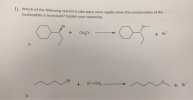 11. Which of the following reactions take place more rapidly when the concentration of the nucleophile is increased? Explain your reasoning. Br + 5-CH3 – + Br
Considering the rate law expression for decomposition, if the concentration of ammonia was increased 4 fold...
Considering the rate law expression for decomposition, if the concentration of ammonia was increased 4 fold (4 times), how many times will the reaction rate increase or decrease? Consider the rate law expression for synthesis and presume the concentration of H2 to be constant. If the concentration of nitrogen was increased 2 fold (2 times), how many times will the reaction rate increase or decrease?
Explain what the double bond does to allow an alkene to act as a nucleophile. Select...
 Explain what the double bond does to allow an alkene to act as a nucleophile. Select one: O a. The double bond acts as a Lewis base that can accept a proton b. The double bond acts as a Lewis base that can donate a proton O c. The double bond acts as a Lewis acid that can donate an electron d. The double bond acts as a Lewis base that can donate an electron pair e. The double bond...
How does doubling the concentration of both the alkyl halide and the nucleophile affect the rate...
How does doubling the concentration of both the alkyl halide and the nucleophile affect the rate of the above S N1 reaction?
How does halving the nucleophile concentration affect the rate of an E2 reaction? Select the single...
 How does halving the nucleophile concentration affect the rate of an E2 reaction? Select the single best answer. o no change O rate halved O rate quadrupled o rate doubled
Suppose you have a following reaction: How does the reaction rate change increase, decrease, does not...
 Suppose you have a following reaction: How does the reaction rate change increase, decrease, does not change) if you: a) increase the concentration of sodium iodide twice b) use n-hexane as a solvent instead of acetone c) use 2-bromopropane as electrophile instead of bromoethane d) use two times higher volume of solvent (keeping the amount of both alkyl bromide and sodium iodide the same). In each case use one-two sentences to justify your answers CH3CH3Br + Nal acetone → CH2CH3...
Which of the following would increase the proportion of a substitution reaction that proceeds via a...
 Which of the following would increase the proportion of a substitution reaction that proceeds via a $ 2 mechanism, rather than S, 1? (choose all correct answers) Use a less reactive nucleophile. Use a more highly substituted alkyl halide. Increase the concentration of the alkyl halide. Increase the concentration of the nucleophile Which of the following reactions would most likely proceed via a SN 1 mechanism? (choose all correct answers) + CH3OH Br + HO- Br + CN + HBr...
 By what factor does the rate increase when the concentration of the nucleophile is increased by 3 times and the electrophile is increased by 2 times for the following reaction or CN CN + Bre
 Provide the major product for the following reaction? NaCl, DMF By what factor does the rate increase when the concentration of the nucleophile is increased by 5 times and the electrophile is increased by 3 times for the following reaction. Br CNVCN
 6. and the nucleophile in the rate- What are the electrophile limiting step of the following reaction? ilBr Br HO
 11. Which of the following reactions take place more rapidly when the concentration of the nucleophile is increased? Explain your reasoning. Br + 5-CH3 – + Br
 Explain what the double bond does to allow an alkene to act as a nucleophile. Select one: O a. The double bond acts as a Lewis base that can accept a proton b. The double bond acts as a Lewis base that can donate a proton O c. The double bond acts as a Lewis acid that can donate an electron d. The double bond acts as a Lewis base that can donate an electron pair e. The double bond...
 How does halving the nucleophile concentration affect the rate of an E2 reaction? Select the single best answer. o no change O rate halved O rate quadrupled o rate doubled
 Suppose you have a following reaction: How does the reaction rate change increase, decrease, does not change) if you: a) increase the concentration of sodium iodide twice b) use n-hexane as a solvent instead of acetone c) use 2-bromopropane as electrophile instead of bromoethane d) use two times higher volume of solvent (keeping the amount of both alkyl bromide and sodium iodide the same). In each case use one-two sentences to justify your answers CH3CH3Br + Nal acetone → CH2CH3...
 Which of the following would increase the proportion of a substitution reaction that proceeds via a $ 2 mechanism, rather than S, 1? (choose all correct answers) Use a less reactive nucleophile. Use a more highly substituted alkyl halide. Increase the concentration of the alkyl halide. Increase the concentration of the nucleophile Which of the following reactions would most likely proceed via a SN 1 mechanism? (choose all correct answers) + CH3OH Br + HO- Br + CN + HBr...
Most questions answered within 3 hours.
-
Where is the error in this code sequence?
String s1 = "Hello";
String s2 = "ello";...
asked 10 months ago -
Financial data for Joel de Paris, Inc., for last year
follow:
Joel de Paris, Inc.
Balance...
asked 10 months ago -
Consider this reaction:
Al2(SO4)3 (aq)+ BaCl3
(aq) Al2Cl6 (aq)- +
3BaSO4(s) . What is the...
asked 10 months ago -
Suppose that Savneet is considering increasing her
recent random sample from 20 car rentals to 40...
asked 10 months ago -
Trucks arrive at an unloading terminal at an average rate of 120
per hour.
Trucks arrive...
asked 10 months ago -
Why are methanol and ethanol completely soluble in water while
octanol is not very little soluble....
asked 10 months ago -
A facilities manager at a university reads in a research report
that the mean amount of...
asked 10 months ago -
When the CuSO4 is rehydrated by adding water to the anhydrous
compound, is this an endothermic...
asked 10 months ago -
A ray of sunlight is passing from diamond into crown glass; the
angle of incidence is...
asked 10 months ago -
A block of mass 0.249 kg is placed on top of a light, vertical
spring of...
asked 10 months ago -
how do the kidneys compensate in the presences of acidosis
a) trigger hyperventilate
b) reserve acid...
asked 10 months ago -
Question 501 pts
The rental rate of capital to the firm increases. Which of the
following...
asked 10 months ago