 (please bold or circle the
answer that I need to input)
(please bold or circle the
answer that I need to input)
Homework Answers
Add Answer to:
(please bold or circle the
answer that I need to input)
Use the References to access...
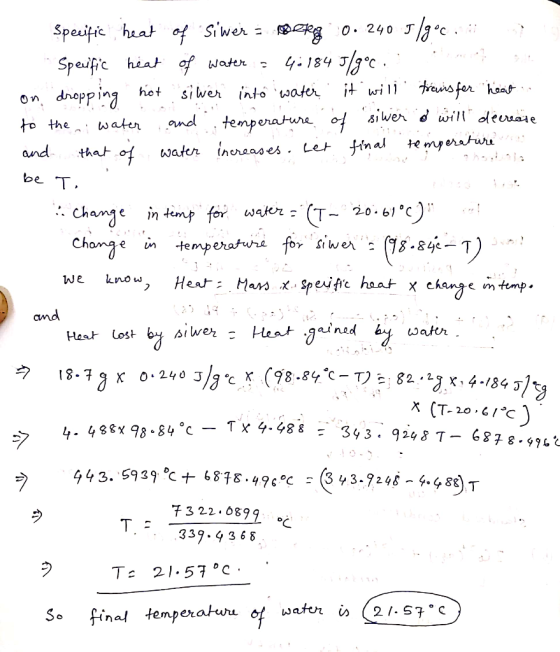
Use the References to access important value for this question A chunk of aluminum weighing 18.2...
 Use the References to access important value for this question A chunk of aluminum weighing 18.2 grams and originally at 97.06°C is dropped into an insulated cup containing 80.4 grams of water at 21.10°C Assuming that all of the heat is transferred to the water, the final temperature of the water is Submit Answer 1 question attempt remaining
Use the References to access important values if nceded for this question. Not submitted A chunk...
 Use the References to access important values if nceded for this question. Not submitted A chunk of magnesium weighing 19.9 grams and originally at 97.83°C is dropped into an insulated cup containing 78.S grams of water at 22.01°C Assuming that all of the heat is transferred to the water, the final temperature of the water is C Submit Answer 1 question attempt remaining
Use the References to access important values if seeded for this question A chunk of magneslum...
 Use the References to access important values if seeded for this question A chunk of magneslum weighing 19.5 grams and originally at 98.44°C is dropped into an insulated cup containing 78.8 grams of water at 22.73 c Assuming that all of the heat is transferred to the water, the final temperature Sf the water is C. Submit Answer 1 question atempt remaining Back
Use the References to access important values if needed for this question. A chunk of chromium weighing 19.3 grams...
 Use the References to access important values if needed for this question. A chunk of chromium weighing 19.3 grams and originally at 98.85°C is dropped into an insulated cup containing 81.5 grams of water at 22.34°C. Assuming that all of the heat is transferred to the water, the final temperature of the water is c.
Use the References to access important values if needed for this question. In the laboratory a...
Use the References to access important values if needed for this question. In the laboratory a "coffee cup" calorimeter, or constant pressure calorimeter, is frequently used to determine the specific heat of a solid, or to measure the energy of a solution phase reaction. A chunk of aluminum weighing 18.06 grams and originally at 98.31 °C is dropped into an insulated cup containing 76.85 grams of water at 20.96 °C. The heat capacity of the calorimeter (sometimes referred to as...
(please bold or circle the answer that I need to input) Use the References to access...
 (please bold or circle the
answer that I need to input)
Use the References to access important values if needed for this question. The following thermochemical equation is for the reaction of nitrogen monoxide(g) with hydrogen(g) to form N2(g) and water() 2NO(g) 2H2(g) N2(g)2H20( AH -752 kJ How many grams of NO(g) would have to react to produce 85.0 kJ of energy? grams Submit Answer 1 question attempt remaining
(please bold or circle the
answer that I need to input)
Use the References to access important values if needed for this question. The following thermochemical equation is for the reaction of nitrogen monoxide(g) with hydrogen(g) to form N2(g) and water() 2NO(g) 2H2(g) N2(g)2H20( AH -752 kJ How many grams of NO(g) would have to react to produce 85.0 kJ of energy? grams Submit Answer 1 question attempt remaining
[Review Topico) [References) Use the References to access important values if needed for this question. In...
 [Review Topico) [References) Use the References to access important values if needed for this question. In the laboratory a "coffee cup" calorimeter, or constant pressure calorimeter, is frequently used to determine the specific heat of a solid, or to measure the energy of a solution phase reaction. Therm A chunk of titanium weighing 19.45 grams and originally at 98.20 °C is dropped into an insulated cup containing 81.36 grams of water at 22.08 °C. The heat capacity of the calorimeter...
(please bold or circle the answer that I need to input) Use the References to access...
 (please bold or circle the
answer that I need to input)
Use the References to access important values if needed for this question. A gas expands and does 121 J of work on the surroundings. At the same time, the gas absorbs 257 J of heat from the surroundings. What is the change in the internal energy of the gas? Submit Answer 1 question attempt remaining
(please bold or circle the
answer that I need to input)
Use the References to access important values if needed for this question. A gas expands and does 121 J of work on the surroundings. At the same time, the gas absorbs 257 J of heat from the surroundings. What is the change in the internal energy of the gas? Submit Answer 1 question attempt remaining
(please bold or circle the answer that I need to input) Use the References to access...
 (please bold or circle the
answer that I need to input)
Use the References to access important values if needed for this question. The following information is given for water at 1 atm: AHvap(100.00 °C)= 2.259x10⁹ J/g AHfus(0.000 °C) = 333.5 J/g boiling point = 100.00 °C melting point = 0.000 °C specific heat gas = 2.010 J/g°C specific heat liquid = 4.184 J/g°C A 45.90 g sample of liquid water is initially at 23.50 °C. If the sample is...
(please bold or circle the
answer that I need to input)
Use the References to access important values if needed for this question. The following information is given for water at 1 atm: AHvap(100.00 °C)= 2.259x10⁹ J/g AHfus(0.000 °C) = 333.5 J/g boiling point = 100.00 °C melting point = 0.000 °C specific heat gas = 2.010 J/g°C specific heat liquid = 4.184 J/g°C A 45.90 g sample of liquid water is initially at 23.50 °C. If the sample is...
A chunk of magnesium weighing 20.0 grams and originally at 97.27°C is dropped into an insulated cup containing 85.0 gra...
 A chunk of magnesium weighing 20.0 grams and originally at 97.27°C is dropped into an insulated cup containing 85.0 grams of water at 21.73°C. Assuming that all of the heat is transferred to the water, the final temperature of the water is Submit Answer 1 question attempt remaining
 Use the References to access important value for this question A chunk of aluminum weighing 18.2 grams and originally at 97.06°C is dropped into an insulated cup containing 80.4 grams of water at 21.10°C Assuming that all of the heat is transferred to the water, the final temperature of the water is Submit Answer 1 question attempt remaining
 Use the References to access important values if nceded for this question. Not submitted A chunk of magnesium weighing 19.9 grams and originally at 97.83°C is dropped into an insulated cup containing 78.S grams of water at 22.01°C Assuming that all of the heat is transferred to the water, the final temperature of the water is C Submit Answer 1 question attempt remaining
 Use the References to access important values if seeded for this question A chunk of magneslum weighing 19.5 grams and originally at 98.44°C is dropped into an insulated cup containing 78.8 grams of water at 22.73 c Assuming that all of the heat is transferred to the water, the final temperature Sf the water is C. Submit Answer 1 question atempt remaining Back
 Use the References to access important values if needed for this question. A chunk of chromium weighing 19.3 grams and originally at 98.85°C is dropped into an insulated cup containing 81.5 grams of water at 22.34°C. Assuming that all of the heat is transferred to the water, the final temperature of the water is c.
 (please bold or circle the
answer that I need to input)
Use the References to access important values if needed for this question. The following thermochemical equation is for the reaction of nitrogen monoxide(g) with hydrogen(g) to form N2(g) and water() 2NO(g) 2H2(g) N2(g)2H20( AH -752 kJ How many grams of NO(g) would have to react to produce 85.0 kJ of energy? grams Submit Answer 1 question attempt remaining
(please bold or circle the
answer that I need to input)
Use the References to access important values if needed for this question. The following thermochemical equation is for the reaction of nitrogen monoxide(g) with hydrogen(g) to form N2(g) and water() 2NO(g) 2H2(g) N2(g)2H20( AH -752 kJ How many grams of NO(g) would have to react to produce 85.0 kJ of energy? grams Submit Answer 1 question attempt remaining
 [Review Topico) [References) Use the References to access important values if needed for this question. In the laboratory a "coffee cup" calorimeter, or constant pressure calorimeter, is frequently used to determine the specific heat of a solid, or to measure the energy of a solution phase reaction. Therm A chunk of titanium weighing 19.45 grams and originally at 98.20 °C is dropped into an insulated cup containing 81.36 grams of water at 22.08 °C. The heat capacity of the calorimeter...
 (please bold or circle the
answer that I need to input)
Use the References to access important values if needed for this question. A gas expands and does 121 J of work on the surroundings. At the same time, the gas absorbs 257 J of heat from the surroundings. What is the change in the internal energy of the gas? Submit Answer 1 question attempt remaining
(please bold or circle the
answer that I need to input)
Use the References to access important values if needed for this question. A gas expands and does 121 J of work on the surroundings. At the same time, the gas absorbs 257 J of heat from the surroundings. What is the change in the internal energy of the gas? Submit Answer 1 question attempt remaining
 (please bold or circle the
answer that I need to input)
Use the References to access important values if needed for this question. The following information is given for water at 1 atm: AHvap(100.00 °C)= 2.259x10⁹ J/g AHfus(0.000 °C) = 333.5 J/g boiling point = 100.00 °C melting point = 0.000 °C specific heat gas = 2.010 J/g°C specific heat liquid = 4.184 J/g°C A 45.90 g sample of liquid water is initially at 23.50 °C. If the sample is...
(please bold or circle the
answer that I need to input)
Use the References to access important values if needed for this question. The following information is given for water at 1 atm: AHvap(100.00 °C)= 2.259x10⁹ J/g AHfus(0.000 °C) = 333.5 J/g boiling point = 100.00 °C melting point = 0.000 °C specific heat gas = 2.010 J/g°C specific heat liquid = 4.184 J/g°C A 45.90 g sample of liquid water is initially at 23.50 °C. If the sample is...
 A chunk of magnesium weighing 20.0 grams and originally at 97.27°C is dropped into an insulated cup containing 85.0 grams of water at 21.73°C. Assuming that all of the heat is transferred to the water, the final temperature of the water is Submit Answer 1 question attempt remaining
Most questions answered within 3 hours.
-
Where is the error in this code sequence?
String s1 = "Hello";
String s2 = "ello";...
asked 10 months ago -
Financial data for Joel de Paris, Inc., for last year
follow:
Joel de Paris, Inc.
Balance...
asked 10 months ago -
Consider this reaction:
Al2(SO4)3 (aq)+ BaCl3
(aq) Al2Cl6 (aq)- +
3BaSO4(s) . What is the...
asked 10 months ago -
Suppose that Savneet is considering increasing her
recent random sample from 20 car rentals to 40...
asked 10 months ago -
Trucks arrive at an unloading terminal at an average rate of 120
per hour.
Trucks arrive...
asked 10 months ago -
Why are methanol and ethanol completely soluble in water while
octanol is not very little soluble....
asked 10 months ago -
A facilities manager at a university reads in a research report
that the mean amount of...
asked 10 months ago -
When the CuSO4 is rehydrated by adding water to the anhydrous
compound, is this an endothermic...
asked 10 months ago -
A ray of sunlight is passing from diamond into crown glass; the
angle of incidence is...
asked 10 months ago -
A block of mass 0.249 kg is placed on top of a light, vertical
spring of...
asked 10 months ago -
how do the kidneys compensate in the presences of acidosis
a) trigger hyperventilate
b) reserve acid...
asked 10 months ago -
Question 501 pts
The rental rate of capital to the firm increases. Which of the
following...
asked 10 months ago