
Homework Answers
Add Answer to:
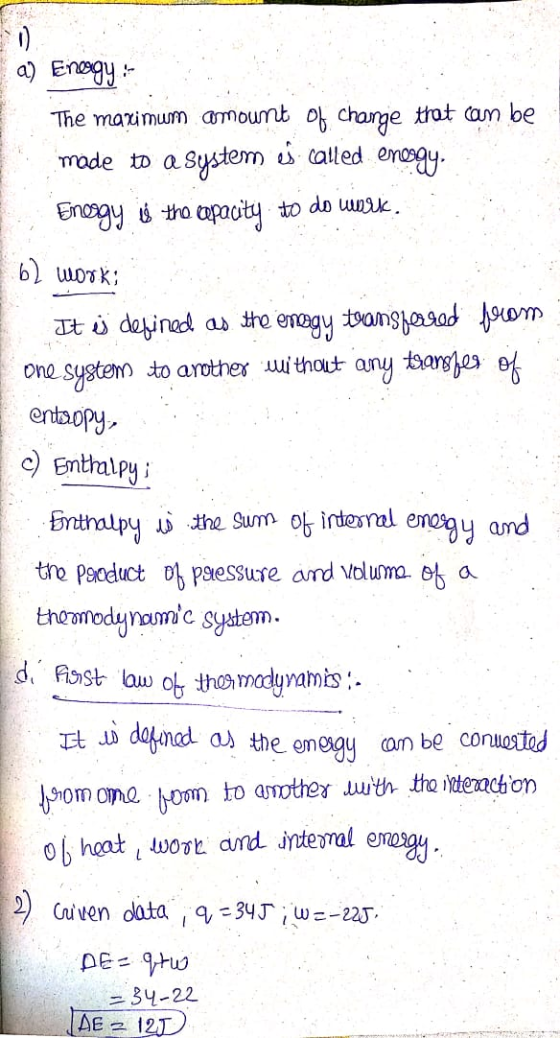
Section Number: Pre-Workshop Themochemistry Worksheet 1. (1pt) Define the following terms. a. Energy- the ability to...
1. Calculate the change in the internal energy of the following systems and then determine whether...
 1. Calculate the change in the internal energy of the following systems and then determine whether the processes are endothermic or exothermic: (a) 45 kJ of heat is transferred from the system to the surroundings. Answer: AE- the process is (b) 605 J of work is performed by the surroundings to the system. Answer: AE (c) When 145 J of work is done by the surroundings to the system, 212 J of heat is transferred from the system to the...
LAB 10 PRE LAB WORKSHEET Specific Heat Capacity (C) The energy transferred as heat that is...
 LAB 10 PRE LAB WORKSHEET Specific Heat Capacity (C) The energy transferred as heat that is required to raise the temperature of 1 gram of a substance by 1 kelvin. q= - m x Cp X AT q=heat lost or gained, m= mass of solution (grams) Cp = the Specific Heat Capacity of a compound (J/g x °C)) AT = Tfinal-Tinitial AHsolution = 9 moles of salt 1. If 1.25 g of ammonium nitrate (NH4NO3) is dissolved in 25.0 mL...
"optional question" quation : Cacho) Catag taclag + Energy aw the energy diagram, consider the entire solvation proc...
 "optional question"
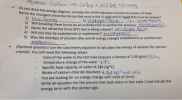
quation : Cacho) Catag taclag + Energy aw the energy diagram, consider the entire solvation process as a series of steps. the strongest attractive forces that exist in the 1) solid and 2) liquid that must be broken? 1) Lonic Banding 2) HNdoden-Band i 0ndipde forces 21 will breaking these forces be an endothermic or exothermic process? excimex 3) Name the attractive force (IPF) that is being created? 30n n e ces 4) Will this step be endothermic...
"optional question"
quation : Cacho) Catag taclag + Energy aw the energy diagram, consider the entire solvation process as a series of steps. the strongest attractive forces that exist in the 1) solid and 2) liquid that must be broken? 1) Lonic Banding 2) HNdoden-Band i 0ndipde forces 21 will breaking these forces be an endothermic or exothermic process? excimex 3) Name the attractive force (IPF) that is being created? 30n n e ces 4) Will this step be endothermic...
Which of the following is incorrect for the reaction below? 6 1^- (aq) + 4 H_2O(1)...
 Which of the following is incorrect for the reaction below? 6 1^- (aq) + 4 H_2O(1) + 2 MnO_4^- (aq) rightarrow 3 1_2 (aq) + 2MnO_2(s) + 8 OH^- (aq) The iodide ion serves as the reducing agent. The manganese in the MnO^-_4 ion has an oxidation state of +7. The oxygen and hydrogen atoms do not change oxidation state in this reaction. The manganese in MnO_2(s) has an oxidation state of +4. lodine has an oxidation state of +...
1. A gas absorbs 0.0 J of heat and then performs 30.8 J of work. The change in internal energy of the gas is a. 61....
 1. A gas absorbs 0.0 J of heat and then performs 30.8 J of work. The change in internal energy of the gas is a. 61.6 J. b. 30.8 J. c. -61.6 J. d.-30.8 J. e. none of these 2. Which of the following statements correctly describes the signs of q and w for the following exothermic process at P= 1 atm and T = 370 K? H2O(g) → H2O(1) a. q and w are negative. b. is positive, wis...
1. Which statement is incorrect?a.The Law of Conservation of Energy is another statement of...
 1. Which statement is incorrect?a.The Law of Conservation of Energy is another statement of the
First Law of Thermodynamics.b.Energy is the capacity to do work or to transfer heat.c.Potential energy is the energy that a system possesses by virtue
of its position or composition.d.Kinetic energy is the energy of motion.e.A process that absorbs energy from its surroundings is called
exothermic.____ 2. Which term is not
correctly matched?a.thermodynamic state - conditions specifying the properties of a
systemb.state function - property dependent...
1. Which statement is incorrect?a.The Law of Conservation of Energy is another statement of the
First Law of Thermodynamics.b.Energy is the capacity to do work or to transfer heat.c.Potential energy is the energy that a system possesses by virtue
of its position or composition.d.Kinetic energy is the energy of motion.e.A process that absorbs energy from its surroundings is called
exothermic.____ 2. Which term is not
correctly matched?a.thermodynamic state - conditions specifying the properties of a
systemb.state function - property dependent...
1. The dimensions of the SI unit of energy, the Joule (J), are A. K B....
1. The dimensions of the SI unit of energy, the Joule (J), are A. K B. kg m s C. kg m2 s-2 D. kg m-1 s-2 E. kg m2 s-1 2. Natural gas, or methane, is an important fuel. Combustion of one mole of methane releases 802.3 kilojoules of energy. How much energy does that represent in kilocalories? A. 3.36×10³ kcal B. 3.357 kcal C. 191.8 kcal D. 0.192 kcal E. 1.918×10⁵ kcal 3. What is the change in...
can someone help me with number 17.35 and 17.49? thank you Toe Boyle's law to determine...
 can someone help me with number 17.35 and 17.49? thank
you
Toe Boyle's law to determine the final - 33 A 220-L cylinder contains 150 atm. If the gas is allowed to opposing pressure of 1.0 atm, how The expansion will stop when the in palision will stop Il equals the external pressure. determine the final volume. nder contains an ideal gas at a pressure of 1f the gas is allowed to expand against a constant pressure of 1.0 atm,...
can someone help me with number 17.35 and 17.49? thank
you
Toe Boyle's law to determine the final - 33 A 220-L cylinder contains 150 atm. If the gas is allowed to opposing pressure of 1.0 atm, how The expansion will stop when the in palision will stop Il equals the external pressure. determine the final volume. nder contains an ideal gas at a pressure of 1f the gas is allowed to expand against a constant pressure of 1.0 atm,...
25) Objects can possess energy as (a) endothermic energy (b) potential energy (c) kinetic energy A) a only B) b...
 25) Objects can possess energy as (a) endothermic energy (b) potential energy (c) kinetic energy A) a only B) b only C) c only D) bandc E) a and 33) The value of AH' for the reaction below is - 790 kl. The enthalpy change accompanying the reaction of 0.95 g of Sis_ k 33) 25 (s) + 302 (9) -2503 (9) A) 12 B) 23 C) -23 D) - 790 E) -12 34) The value of AH' for the...
Instructions Part 1. Problem Solving Do all of the following: • Determine the problem statement for...
 Instructions Part 1. Problem Solving Do all of the following: • Determine the problem statement for the following problem. • Write a set of instructions (an algorithm) for computing the required values and making the desired conclusions. • Test your instructions by hand. Show your work. Problem: The first law of thermodynamics states that the change in internal energy of a system is equal to the heat added to the system minus the work done by the system, stated mathematically...
 1. Calculate the change in the internal energy of the following systems and then determine whether the processes are endothermic or exothermic: (a) 45 kJ of heat is transferred from the system to the surroundings. Answer: AE- the process is (b) 605 J of work is performed by the surroundings to the system. Answer: AE (c) When 145 J of work is done by the surroundings to the system, 212 J of heat is transferred from the system to the...
 LAB 10 PRE LAB WORKSHEET Specific Heat Capacity (C) The energy transferred as heat that is required to raise the temperature of 1 gram of a substance by 1 kelvin. q= - m x Cp X AT q=heat lost or gained, m= mass of solution (grams) Cp = the Specific Heat Capacity of a compound (J/g x °C)) AT = Tfinal-Tinitial AHsolution = 9 moles of salt 1. If 1.25 g of ammonium nitrate (NH4NO3) is dissolved in 25.0 mL...
 "optional question"
quation : Cacho) Catag taclag + Energy aw the energy diagram, consider the entire solvation process as a series of steps. the strongest attractive forces that exist in the 1) solid and 2) liquid that must be broken? 1) Lonic Banding 2) HNdoden-Band i 0ndipde forces 21 will breaking these forces be an endothermic or exothermic process? excimex 3) Name the attractive force (IPF) that is being created? 30n n e ces 4) Will this step be endothermic...
"optional question"
quation : Cacho) Catag taclag + Energy aw the energy diagram, consider the entire solvation process as a series of steps. the strongest attractive forces that exist in the 1) solid and 2) liquid that must be broken? 1) Lonic Banding 2) HNdoden-Band i 0ndipde forces 21 will breaking these forces be an endothermic or exothermic process? excimex 3) Name the attractive force (IPF) that is being created? 30n n e ces 4) Will this step be endothermic...
 Which of the following is incorrect for the reaction below? 6 1^- (aq) + 4 H_2O(1) + 2 MnO_4^- (aq) rightarrow 3 1_2 (aq) + 2MnO_2(s) + 8 OH^- (aq) The iodide ion serves as the reducing agent. The manganese in the MnO^-_4 ion has an oxidation state of +7. The oxygen and hydrogen atoms do not change oxidation state in this reaction. The manganese in MnO_2(s) has an oxidation state of +4. lodine has an oxidation state of +...
 1. A gas absorbs 0.0 J of heat and then performs 30.8 J of work. The change in internal energy of the gas is a. 61.6 J. b. 30.8 J. c. -61.6 J. d.-30.8 J. e. none of these 2. Which of the following statements correctly describes the signs of q and w for the following exothermic process at P= 1 atm and T = 370 K? H2O(g) → H2O(1) a. q and w are negative. b. is positive, wis...
 1. Which statement is incorrect?a.The Law of Conservation of Energy is another statement of the
First Law of Thermodynamics.b.Energy is the capacity to do work or to transfer heat.c.Potential energy is the energy that a system possesses by virtue
of its position or composition.d.Kinetic energy is the energy of motion.e.A process that absorbs energy from its surroundings is called
exothermic.____ 2. Which term is not
correctly matched?a.thermodynamic state - conditions specifying the properties of a
systemb.state function - property dependent...
1. Which statement is incorrect?a.The Law of Conservation of Energy is another statement of the
First Law of Thermodynamics.b.Energy is the capacity to do work or to transfer heat.c.Potential energy is the energy that a system possesses by virtue
of its position or composition.d.Kinetic energy is the energy of motion.e.A process that absorbs energy from its surroundings is called
exothermic.____ 2. Which term is not
correctly matched?a.thermodynamic state - conditions specifying the properties of a
systemb.state function - property dependent...
 can someone help me with number 17.35 and 17.49? thank
you
Toe Boyle's law to determine the final - 33 A 220-L cylinder contains 150 atm. If the gas is allowed to opposing pressure of 1.0 atm, how The expansion will stop when the in palision will stop Il equals the external pressure. determine the final volume. nder contains an ideal gas at a pressure of 1f the gas is allowed to expand against a constant pressure of 1.0 atm,...
can someone help me with number 17.35 and 17.49? thank
you
Toe Boyle's law to determine the final - 33 A 220-L cylinder contains 150 atm. If the gas is allowed to opposing pressure of 1.0 atm, how The expansion will stop when the in palision will stop Il equals the external pressure. determine the final volume. nder contains an ideal gas at a pressure of 1f the gas is allowed to expand against a constant pressure of 1.0 atm,...
 25) Objects can possess energy as (a) endothermic energy (b) potential energy (c) kinetic energy A) a only B) b only C) c only D) bandc E) a and 33) The value of AH' for the reaction below is - 790 kl. The enthalpy change accompanying the reaction of 0.95 g of Sis_ k 33) 25 (s) + 302 (9) -2503 (9) A) 12 B) 23 C) -23 D) - 790 E) -12 34) The value of AH' for the...
 Instructions Part 1. Problem Solving Do all of the following: • Determine the problem statement for the following problem. • Write a set of instructions (an algorithm) for computing the required values and making the desired conclusions. • Test your instructions by hand. Show your work. Problem: The first law of thermodynamics states that the change in internal energy of a system is equal to the heat added to the system minus the work done by the system, stated mathematically...
Most questions answered within 3 hours.
-
Where is the error in this code sequence?
String s1 = "Hello";
String s2 = "ello";...
asked 10 months ago -
Financial data for Joel de Paris, Inc., for last year
follow:
Joel de Paris, Inc.
Balance...
asked 10 months ago -
Consider this reaction:
Al2(SO4)3 (aq)+ BaCl3
(aq) Al2Cl6 (aq)- +
3BaSO4(s) . What is the...
asked 10 months ago -
Suppose that Savneet is considering increasing her
recent random sample from 20 car rentals to 40...
asked 10 months ago -
Trucks arrive at an unloading terminal at an average rate of 120
per hour.
Trucks arrive...
asked 10 months ago -
Why are methanol and ethanol completely soluble in water while
octanol is not very little soluble....
asked 10 months ago -
A facilities manager at a university reads in a research report
that the mean amount of...
asked 10 months ago -
When the CuSO4 is rehydrated by adding water to the anhydrous
compound, is this an endothermic...
asked 10 months ago -
A ray of sunlight is passing from diamond into crown glass; the
angle of incidence is...
asked 10 months ago -
A block of mass 0.249 kg is placed on top of a light, vertical
spring of...
asked 10 months ago -
how do the kidneys compensate in the presences of acidosis
a) trigger hyperventilate
b) reserve acid...
asked 10 months ago -
Question 501 pts
The rental rate of capital to the firm increases. Which of the
following...
asked 10 months ago