Use a thermodynamic table to calculate the equilibrium pressure in bar of CO2 above CaCO3 at...
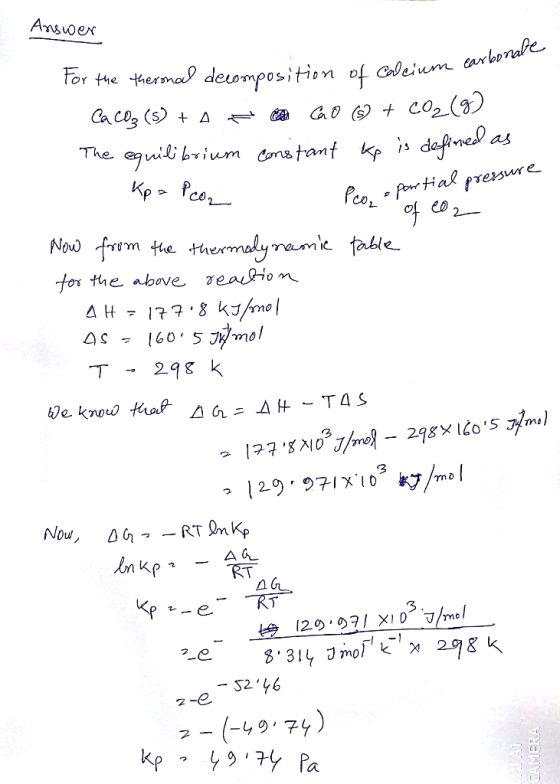
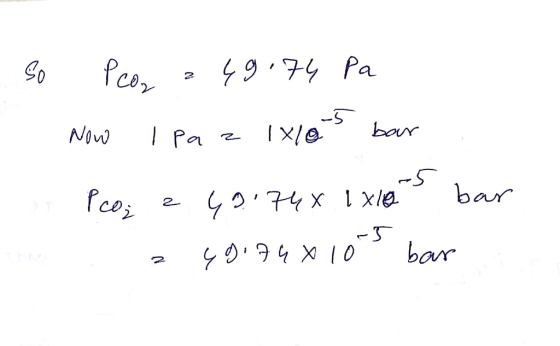
Use a thermodynamic table to calculate the equilibrium pressure in bar of CO2 above CaCO3 at 298 K.
Homework Answers
Add Answer to:
Use a thermodynamic table to calculate the equilibrium pressure
in bar of CO2 above CaCO3 at...
Use a thermodynamic table to find the equilibrium constant for the nonideal-gas reaction 2HC1(g) H2 (g)...
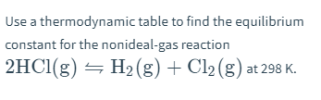 Use a thermodynamic table to find the equilibrium constant for the nonideal-gas reaction 2HC1(g) H2 (g) Cl2 (g) at 298 K.
1. Calculate the equilibrium partial pressure of CO2. 2. Calculate the equilibrium partial pressure of H2....
 1. Calculate the equilibrium partial pressure of CO2.
2. Calculate the equilibrium partial pressure of H2.
Consider the following reaction: CO(g) + H2O(g) = CO2(g) + H2(g) K = 0.0611 at 2000 K A reaction mixture initially contains a CO partial pressure of 1360 torr and a H2O partial pressure of 1770 torr at 2000 K.
1. Calculate the equilibrium partial pressure of CO2.
2. Calculate the equilibrium partial pressure of H2.
Consider the following reaction: CO(g) + H2O(g) = CO2(g) + H2(g) K = 0.0611 at 2000 K A reaction mixture initially contains a CO partial pressure of 1360 torr and a H2O partial pressure of 1770 torr at 2000 K.
At high temperatures calcium carbonate decomposes into calcium oxide and carbon dioxide. CaCO3 (solid) {> Cao...
 At high temperatures calcium carbonate decomposes into calcium oxide and carbon dioxide. CaCO3 (solid) {> Cao (solid) + CO2 (gas) Find the equilibrium pressure of this system at 1200 K if the equilibrium constant at 1400 K is 26. If the AGº of CaO(solid) and CaCO3 (solid) at 298 Kare -604 and -1128.8 kJ/mol respectively, estimate the equilibrium constant Kat 298 K and the equilibrium pressure. Discuss the effect of pressure on both the conversion of CaCO3 and the final...
At 1073 K, the equilibrium pressure of carbon dioxide above mixtures of calcium carbonate and calcium...
 At 1073 K, the equilibrium pressure of carbon dioxide above mixtures of calcium carbonate and calcium oxide is 183 torr. (a) If 5.0 g of solid calcium carbonate is placed in a 4000- mL container at 1073 K, give the final amounts of the various species. CaCO3 = Caos DOO CO2 = (b) The same as (a), except 0.50 g of CaCO3 is placed in the container. CaCO3 = DO Ca0 = CO2 =
Fill in the Blanks At 1073 K, the equilibrium pressure of carbon dioxide above mixtures of...
 Fill in the Blanks At 1073 K, the equilibrium pressure of carbon dioxide above mixtures of calcium carbonate and calcium oxide is 183 torr. (a) If 5.0 g of solid calcium carbonate is placed in a 4000-ml container at 1073K, give the final amounts of the various species. CaCO3 = Ca0 = CO2 = (b) The same as (a), except 0.50 g of CaCO3 is placed in the container, CaCO3 = Cao CO2- Unanswered
4. The gas-phase dehydrogenation of propanol (A) to yield propionaldehyde (B) is in equilibrium at 230°C. Standard thermodynamic data for the reaction species at 298 K are: Propanol: Propionaldehyde...
 4. The gas-phase dehydrogenation of propanol (A) to yield propionaldehyde (B) is in equilibrium at 230°C. Standard thermodynamic data for the reaction species at 298 K are: Propanol: Propionaldehyde : H.,--186 k/moi s'u-304.40 J/(mol K) Dihydrogen: H A -256 kJ/molSA 322.49 J/(mol K) Soc 130.68 J/(mol K) ) (4 points) Evaluate the standard enthalpy change of reaction (AH)at 298 K. ii (6 points Calculate the equilibrium constant at 298 K ) (8 points) Determine the equilibrium constant for this reaction...
How will an increase in pressure affect the following equilibrium? CaO(s) + CO2(g) ⇌ CaCO3(s) ΔH...
How will an increase in pressure affect the following equilibrium? CaO(s) + CO2(g) ⇌ CaCO3(s) ΔH = −176 kJ Shift toward products. Shift toward reactants. No change. Explain?
CaCO3(s) ⇄ CaO(s) + CO2(g) 0.100 mol of CaCO3 and 0.100 mol CaO are placed in...
CaCO3(s) ⇄ CaO(s) + CO2(g) 0.100 mol of CaCO3 and 0.100 mol CaO are placed in an 10.0 L evacuated container and heated to 385 K. When equilibrium is reached the pressure of CO2 is 0.220 atm. 0.300 atm of CO2 is added, while keeping the temperature constant and the system is allowed to reach again equilibrium. What will be the final mass of CaCO3? 7.47 g 12.54 g 18.01 g 2.00 g 10.01 g
Problem 2 (10 points). For the following heterogeneous equilibrium at 800°C: CaCO3(s) ở CaO(8) + CO2(g)...
 Problem 2 (10 points). For the following heterogeneous equilibrium at 800°C: CaCO3(s) ở CaO(8) + CO2(g) the pressure of Co, is 0.236 atm. Calculate: (a) K, and (b)K for the reaction at this temperature, Enter your answers in the boxes provided with correct units and sig. figs.: Answers: (a) Kp = K- (a) K =
Consider the decomposition reaction CaCO3 (s) « CaO (s) + CO2 (g). At 800. ̊C the...
Consider the decomposition reaction CaCO3 (s) « CaO (s) + CO2 (g). At 800. ̊C the equilibrium pressure of CO2 in the presence of CaO (s) and CaCO3 (s) is 0.220 bar. (a) From this data, determine the equilibrium constant and Delta standardG for this reaction. (b) Now consider a previously evacuated 1.00 L container at 800. ̊C into which 0.010 moles of CaO (about 0.6 g) have been placed. CO2 is now very slowly pumped in (allowing any reactions...
 Use a thermodynamic table to find the equilibrium constant for the nonideal-gas reaction 2HC1(g) H2 (g) Cl2 (g) at 298 K.
 1. Calculate the equilibrium partial pressure of CO2.
2. Calculate the equilibrium partial pressure of H2.
Consider the following reaction: CO(g) + H2O(g) = CO2(g) + H2(g) K = 0.0611 at 2000 K A reaction mixture initially contains a CO partial pressure of 1360 torr and a H2O partial pressure of 1770 torr at 2000 K.
1. Calculate the equilibrium partial pressure of CO2.
2. Calculate the equilibrium partial pressure of H2.
Consider the following reaction: CO(g) + H2O(g) = CO2(g) + H2(g) K = 0.0611 at 2000 K A reaction mixture initially contains a CO partial pressure of 1360 torr and a H2O partial pressure of 1770 torr at 2000 K.
 At high temperatures calcium carbonate decomposes into calcium oxide and carbon dioxide. CaCO3 (solid) {> Cao (solid) + CO2 (gas) Find the equilibrium pressure of this system at 1200 K if the equilibrium constant at 1400 K is 26. If the AGº of CaO(solid) and CaCO3 (solid) at 298 Kare -604 and -1128.8 kJ/mol respectively, estimate the equilibrium constant Kat 298 K and the equilibrium pressure. Discuss the effect of pressure on both the conversion of CaCO3 and the final...
 At 1073 K, the equilibrium pressure of carbon dioxide above mixtures of calcium carbonate and calcium oxide is 183 torr. (a) If 5.0 g of solid calcium carbonate is placed in a 4000- mL container at 1073 K, give the final amounts of the various species. CaCO3 = Caos DOO CO2 = (b) The same as (a), except 0.50 g of CaCO3 is placed in the container. CaCO3 = DO Ca0 = CO2 =
 Fill in the Blanks At 1073 K, the equilibrium pressure of carbon dioxide above mixtures of calcium carbonate and calcium oxide is 183 torr. (a) If 5.0 g of solid calcium carbonate is placed in a 4000-ml container at 1073K, give the final amounts of the various species. CaCO3 = Ca0 = CO2 = (b) The same as (a), except 0.50 g of CaCO3 is placed in the container, CaCO3 = Cao CO2- Unanswered
 4. The gas-phase dehydrogenation of propanol (A) to yield propionaldehyde (B) is in equilibrium at 230°C. Standard thermodynamic data for the reaction species at 298 K are: Propanol: Propionaldehyde : H.,--186 k/moi s'u-304.40 J/(mol K) Dihydrogen: H A -256 kJ/molSA 322.49 J/(mol K) Soc 130.68 J/(mol K) ) (4 points) Evaluate the standard enthalpy change of reaction (AH)at 298 K. ii (6 points Calculate the equilibrium constant at 298 K ) (8 points) Determine the equilibrium constant for this reaction...
 Problem 2 (10 points). For the following heterogeneous equilibrium at 800°C: CaCO3(s) ở CaO(8) + CO2(g) the pressure of Co, is 0.236 atm. Calculate: (a) K, and (b)K for the reaction at this temperature, Enter your answers in the boxes provided with correct units and sig. figs.: Answers: (a) Kp = K- (a) K =
Most questions answered within 3 hours.
-
Where is the error in this code sequence?
String s1 = "Hello";
String s2 = "ello";...
asked 10 months ago -
Financial data for Joel de Paris, Inc., for last year
follow:
Joel de Paris, Inc.
Balance...
asked 10 months ago -
Consider this reaction:
Al2(SO4)3 (aq)+ BaCl3
(aq) Al2Cl6 (aq)- +
3BaSO4(s) . What is the...
asked 10 months ago -
Suppose that Savneet is considering increasing her
recent random sample from 20 car rentals to 40...
asked 10 months ago -
Trucks arrive at an unloading terminal at an average rate of 120
per hour.
Trucks arrive...
asked 10 months ago -
Why are methanol and ethanol completely soluble in water while
octanol is not very little soluble....
asked 10 months ago -
A facilities manager at a university reads in a research report
that the mean amount of...
asked 10 months ago -
When the CuSO4 is rehydrated by adding water to the anhydrous
compound, is this an endothermic...
asked 10 months ago -
A ray of sunlight is passing from diamond into crown glass; the
angle of incidence is...
asked 10 months ago -
A block of mass 0.249 kg is placed on top of a light, vertical
spring of...
asked 10 months ago -
how do the kidneys compensate in the presences of acidosis
a) trigger hyperventilate
b) reserve acid...
asked 10 months ago -
Question 501 pts
The rental rate of capital to the firm increases. Which of the
following...
asked 10 months ago