
Homework Answers
The priority is decided on the basis of CIP rule
1. The atom attached to the stereocenter gets the first priority if its atomic number is greater than the rest
2. If there is a tie, the atom attached to the second position to the stereocenter is taken into consideration.
3. If there are isotopes of the same atom attached to the same stereocenter, then isotope with heavier mass number is given priority.
Thus the correct option is B
Cl > NH2 > CH3 > H
atomic no for Cl: 17
atomic no for N: 7
atomic no for C: 6
atomic no for H : 1
Add Answer to:
According to the R-S convention, which priority is correct for the following sets of groups? A)...
question 19 According to the R-S convention, which priority is correct for the following sets of...
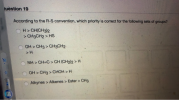 question 19 According to the R-S convention, which priority is correct for the following sets of groups?! HỒ CH(CH3)2 > CH3CH2 > HS OH > CH3 > CH3CH2 >H NH > CH=C > CH (CH2)2>H OH > CH3 > CHOH > H Alkynes > Alkenes > Ester > CH3
Draw the remaining product of the following reaction CI +2 HC- CH2- NH2 > H,C-CH2-NH CI...
 Draw the remaining product of the following reaction CI +2 HC- CH2- NH2 > H,C-CH2-NH CI +
Draw the product for the reaction in the space provided: CH3 H3C—=CH2 + HO ">
 Draw the product for the reaction in the space provided: CH3 H3C—=CH2 + HO ">
this is all the information i got so you must be able to do it b...
 this is all the information i got so you must be able to do
it
b ) NH2 -CH3 HN H3C -CH3 H2N-CH2CH3 N H E F G H > > > strongest base weakest base
this is all the information i got so you must be able to do
it
b ) NH2 -CH3 HN H3C -CH3 H2N-CH2CH3 N H E F G H > > > strongest base weakest base
which of these answers is correct? NUMBER 1 NUMBER 2 also please give the reason. Thank...
 which of these answers is correct?
NUMBER 1
NUMBER 2
also please give the reason.
Thank you!
Construct a context-free grammar for the language L={ ab'ab'an> 1}. S → AAa A → aB B → 6B|bb S->ata T-> bCb C->bCba
which of these answers is correct?
NUMBER 1
NUMBER 2
also please give the reason.
Thank you!
Construct a context-free grammar for the language L={ ab'ab'an> 1}. S → AAa A → aB B → 6B|bb S->ata T-> bCb C->bCba
Complete the following reaction of disulfide bonds in order and what is the reaction type? R-SH+R-SH...
 Complete the following reaction of disulfide bonds in order and what is the reaction type? R-SH+R-SH --->R-S-S-R' +( )+ ( ) a. 21 and 2 e: oxidation b. 3H20 and 2 e : oxidation OC2H20 and 3 e : reduction d. none e2H+ and 3 e: reduction
4. (8 pt) Which is the correct order for decreasing basicity (most basic on the left)?...
 4. (8 pt) Which is the correct order for decreasing basicity (most basic on the left)? A. ii>iv>ii>i B. iv >ii >i> ii C. ii > iv >>ii NH2 NO2 O2N iv IV
The 2 guesses are incorrect. Please help to solve correct answer 0.24, calculate the following: If...
 The 2 guesses are incorrect. Please help to solve correct
answer
0.24, calculate the following: If X follows Bernoulli distribution B, p > 0.5 and V(X) .48 .48 ELX] 48
The 2 guesses are incorrect. Please help to solve correct
answer
0.24, calculate the following: If X follows Bernoulli distribution B, p > 0.5 and V(X) .48 .48 ELX] 48
.X, be an id sample from the distribution r >1 (a) Using this distribution, find Eflog(X)...
 .X, be an id sample from the distribution r >1 (a) Using this distribution, find Eflog(X) 0.
ei0 : 0 E R} be the group of all complex numbers on the unit circle...
 ei0 : 0 E R} be the group of all complex numbers on the unit circle under multiplication. Let ø : R -> U 1. (30) Let R be the group of real numbers under addition, and let U be the map given by e2Tir (r) (i) Prove that d is a homomorphism of groups (ii) Find the kernel of ø. (Don't just write down the definition. You need to describe explicit subset of R.) an real number r for...
 question 19 According to the R-S convention, which priority is correct for the following sets of groups?! HỒ CH(CH3)2 > CH3CH2 > HS OH > CH3 > CH3CH2 >H NH > CH=C > CH (CH2)2>H OH > CH3 > CHOH > H Alkynes > Alkenes > Ester > CH3
 Draw the remaining product of the following reaction CI +2 HC- CH2- NH2 > H,C-CH2-NH CI +
 Draw the product for the reaction in the space provided: CH3 H3C—=CH2 + HO ">
 this is all the information i got so you must be able to do
it
b ) NH2 -CH3 HN H3C -CH3 H2N-CH2CH3 N H E F G H > > > strongest base weakest base
this is all the information i got so you must be able to do
it
b ) NH2 -CH3 HN H3C -CH3 H2N-CH2CH3 N H E F G H > > > strongest base weakest base
 which of these answers is correct?
NUMBER 1
NUMBER 2
also please give the reason.
Thank you!
Construct a context-free grammar for the language L={ ab'ab'an> 1}. S → AAa A → aB B → 6B|bb S->ata T-> bCb C->bCba
which of these answers is correct?
NUMBER 1
NUMBER 2
also please give the reason.
Thank you!
Construct a context-free grammar for the language L={ ab'ab'an> 1}. S → AAa A → aB B → 6B|bb S->ata T-> bCb C->bCba
 Complete the following reaction of disulfide bonds in order and what is the reaction type? R-SH+R-SH --->R-S-S-R' +( )+ ( ) a. 21 and 2 e: oxidation b. 3H20 and 2 e : oxidation OC2H20 and 3 e : reduction d. none e2H+ and 3 e: reduction
 4. (8 pt) Which is the correct order for decreasing basicity (most basic on the left)? A. ii>iv>ii>i B. iv >ii >i> ii C. ii > iv >>ii NH2 NO2 O2N iv IV
 The 2 guesses are incorrect. Please help to solve correct
answer
0.24, calculate the following: If X follows Bernoulli distribution B, p > 0.5 and V(X) .48 .48 ELX] 48
The 2 guesses are incorrect. Please help to solve correct
answer
0.24, calculate the following: If X follows Bernoulli distribution B, p > 0.5 and V(X) .48 .48 ELX] 48
 .X, be an id sample from the distribution r >1 (a) Using this distribution, find Eflog(X) 0.
 ei0 : 0 E R} be the group of all complex numbers on the unit circle under multiplication. Let ø : R -> U 1. (30) Let R be the group of real numbers under addition, and let U be the map given by e2Tir (r) (i) Prove that d is a homomorphism of groups (ii) Find the kernel of ø. (Don't just write down the definition. You need to describe explicit subset of R.) an real number r for...
Most questions answered within 3 hours.
-
Where is the error in this code sequence?
String s1 = "Hello";
String s2 = "ello";...
asked 10 months ago -
Financial data for Joel de Paris, Inc., for last year
follow:
Joel de Paris, Inc.
Balance...
asked 10 months ago -
Consider this reaction:
Al2(SO4)3 (aq)+ BaCl3
(aq) Al2Cl6 (aq)- +
3BaSO4(s) . What is the...
asked 10 months ago -
Suppose that Savneet is considering increasing her
recent random sample from 20 car rentals to 40...
asked 10 months ago -
Trucks arrive at an unloading terminal at an average rate of 120
per hour.
Trucks arrive...
asked 10 months ago -
Why are methanol and ethanol completely soluble in water while
octanol is not very little soluble....
asked 10 months ago -
A facilities manager at a university reads in a research report
that the mean amount of...
asked 10 months ago -
When the CuSO4 is rehydrated by adding water to the anhydrous
compound, is this an endothermic...
asked 10 months ago -
A ray of sunlight is passing from diamond into crown glass; the
angle of incidence is...
asked 10 months ago -
A block of mass 0.249 kg is placed on top of a light, vertical
spring of...
asked 10 months ago -
how do the kidneys compensate in the presences of acidosis
a) trigger hyperventilate
b) reserve acid...
asked 10 months ago -
Question 501 pts
The rental rate of capital to the firm increases. Which of the
following...
asked 10 months ago