
Homework Answers
Add Answer to:
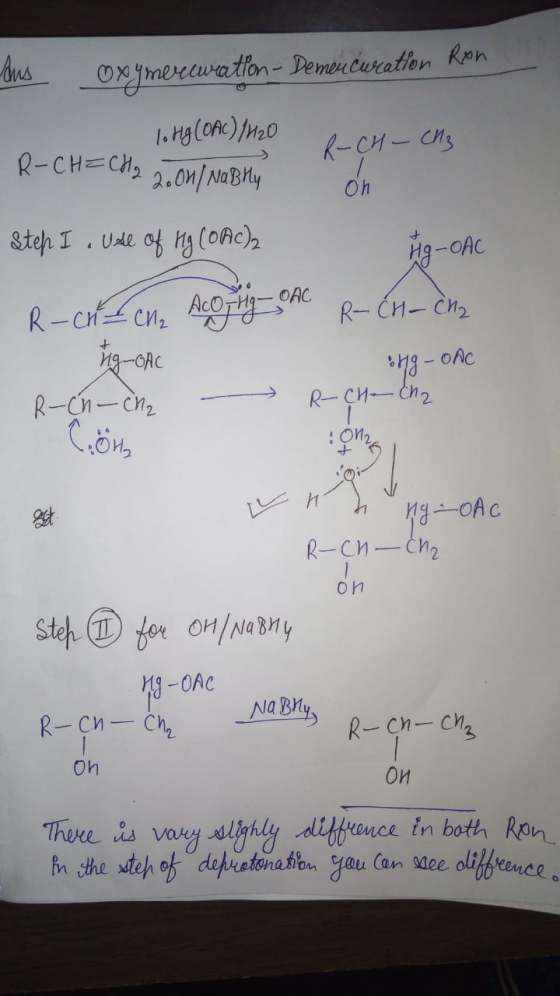
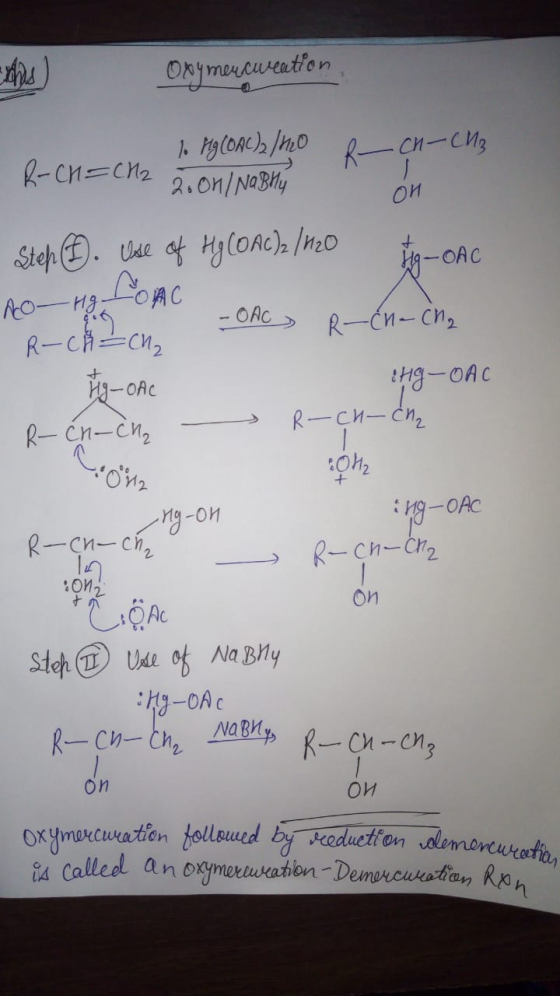
Show the following: Oxymercuration of an alkene using HacOAc), 7H.O for Step 1 and for step...
Show the following: A) Oxymercuration of an alkene using Hg(OAc): /H.O for Step 1 and for...
 Show the following: A) Oxymercuration of an alkene using Hg(OAc): /H.O for Step 1 and for step 2 OH/NaBH B) Demercuration of an alkene using Ha(OAc), /H.O for Step 1 and for step 2 OH/NaBH
Show the following: Hydroboration of an alkene using BH/OH for step 1 and H.O/OH for Step...
 Show the following: Hydroboration of an alkene using BH/OH for step 1 and H.O/OH for Step 2 (note -- OR can be used instead of -OH)
Please help with 3 a,b ,c,d 2. Acid catalyzed hydration and oxymercuration-demercuration of an alkene, both...
 Please help with 3 a,b ,c,d
2. Acid catalyzed hydration and oxymercuration-demercuration of an alkene, both add water in a Markovnikov fashion. What are some advantages for the latter process. 3. Predict the major product(s) of the following reactions and provide a mechanism; a. 1-methylcyclohexene + HBr b. 1-methyl-1-cyclopentene + H O. CH CH OH c. 1-pentyne + HBr d. 1,3-butadiene + HBr
Please help with 3 a,b ,c,d
2. Acid catalyzed hydration and oxymercuration-demercuration of an alkene, both add water in a Markovnikov fashion. What are some advantages for the latter process. 3. Predict the major product(s) of the following reactions and provide a mechanism; a. 1-methylcyclohexene + HBr b. 1-methyl-1-cyclopentene + H O. CH CH OH c. 1-pentyne + HBr d. 1,3-butadiene + HBr
Question 33 (2 points) Provide the best description for an oxymercuration demercuration reaction of an alkene....
 Question 33 (2 points) Provide the best description for an oxymercuration demercuration reaction of an alkene. O a) Markovnikov orientation with anti-addition Ob) Anti-Markovnikov orientation with anti-addition Oc) Markovnikov orientation with syn-addition d) Anti-Markovnikov orientation with syn-addition Question 34 (2 points) What is the IUPAC name of the structure below? NO2 F OH a) 1-fluoro-3-iodo-5-hydroxynitrobenzene Ob) 1-fluoro-2-nitro-3-iodo-5-phenol Oc) 3-fluoro-5-iodo-4-nitrophenol d) m-fluoro-m-iodo-p-nitrophenol
Question 3 (2 points) Provide the best description for an oxymercuration demercuration reaction of an alkene....
 Question 3 (2 points) Provide the best description for an oxymercuration demercuration reaction of an alkene. a) Anti-Markovnikov orientation with anti-addition Ob) Markovnikov orientation with anti-addition Oc) Anti-Markovnikov orientation with syn-addition O d) Markovnikov orientation with syn-addition Question 4 (2 points) How many signals would you expect in the 'H NMR spectrum of the following compound? O a) 4 Ob) 5 Oc) 7 O d) 6
Show the following: A) Hydroboration of an alkene using BH/THF for step 1 to create alkylborane...
 Show the following: A) Hydroboration of an alkene using BH/THF for step 1 to create alkylborane and CH.COOH/heat for Step 2 to create alkanes
Show the following (Label reagents, products, reactants, and mechanisms): Hydroboration of an alkene using BH/OH for...
 Show the following (Label reagents, products, reactants, and mechanisms): Hydroboration of an alkene using BH/OH for step 1 and H.O/OH for Step 2 (note - OR can be used instead of -OH)
Propose the major product from the oxymercuration reduction reaction of the following alkene. Draw the mechanism...
 Propose the major product from the oxymercuration reduction reaction of the following alkene. Draw the mechanism of the reaction with all necessary intermediates using curved arrows.
a) There are several reagents that can be used to effect addition to a double bond,...
 a) There are several reagents that can be used to effect
addition to a double bond, including: acid and water,
oxymercuration--demercuration reagents, and
hydroboration--oxidation reagents. Inspect the final product and
select all the reasons why oxymercuration--demercuration was chosen
to effect the following transformation instead of the other
reagents.
b) Complete the mechanism for the reaction by adding curved
arrows. The reagents chosen for the transformation are: 1)
Hg(OAc)2, THF, H2O and 2) NaBH4, OH
a) There are several reagents that can be used to effect
addition to a double bond, including: acid and water,
oxymercuration--demercuration reagents, and
hydroboration--oxidation reagents. Inspect the final product and
select all the reasons why oxymercuration--demercuration was chosen
to effect the following transformation instead of the other
reagents.
b) Complete the mechanism for the reaction by adding curved
arrows. The reagents chosen for the transformation are: 1)
Hg(OAc)2, THF, H2O and 2) NaBH4, OH
Acid Catalyzed Hydration-treatment of alkenes with water in the presence of acid catalyst leads to the...
 Acid Catalyzed Hydration-treatment of alkenes with water in the presence of acid catalyst leads to the formation of alcohols. H2SO4/H2O > 150°C Mechanism Major Product Acid catalyzed dehydration goes through a carbocation intermediate. This means that the Markovnikov product is obtained when carbocation rearrangements do not occur. The need for excessively high temperatures makes this reaction of limited use in laboratory synthesis. Oxymercuration - Oxymercuration involves the addition of Hg to the alkene using mercury (II) acetate Hg(OAc) followed by...
 Show the following: A) Oxymercuration of an alkene using Hg(OAc): /H.O for Step 1 and for step 2 OH/NaBH B) Demercuration of an alkene using Ha(OAc), /H.O for Step 1 and for step 2 OH/NaBH
 Show the following: Hydroboration of an alkene using BH/OH for step 1 and H.O/OH for Step 2 (note -- OR can be used instead of -OH)
 Please help with 3 a,b ,c,d
2. Acid catalyzed hydration and oxymercuration-demercuration of an alkene, both add water in a Markovnikov fashion. What are some advantages for the latter process. 3. Predict the major product(s) of the following reactions and provide a mechanism; a. 1-methylcyclohexene + HBr b. 1-methyl-1-cyclopentene + H O. CH CH OH c. 1-pentyne + HBr d. 1,3-butadiene + HBr
Please help with 3 a,b ,c,d
2. Acid catalyzed hydration and oxymercuration-demercuration of an alkene, both add water in a Markovnikov fashion. What are some advantages for the latter process. 3. Predict the major product(s) of the following reactions and provide a mechanism; a. 1-methylcyclohexene + HBr b. 1-methyl-1-cyclopentene + H O. CH CH OH c. 1-pentyne + HBr d. 1,3-butadiene + HBr
 Question 33 (2 points) Provide the best description for an oxymercuration demercuration reaction of an alkene. O a) Markovnikov orientation with anti-addition Ob) Anti-Markovnikov orientation with anti-addition Oc) Markovnikov orientation with syn-addition d) Anti-Markovnikov orientation with syn-addition Question 34 (2 points) What is the IUPAC name of the structure below? NO2 F OH a) 1-fluoro-3-iodo-5-hydroxynitrobenzene Ob) 1-fluoro-2-nitro-3-iodo-5-phenol Oc) 3-fluoro-5-iodo-4-nitrophenol d) m-fluoro-m-iodo-p-nitrophenol
 Question 3 (2 points) Provide the best description for an oxymercuration demercuration reaction of an alkene. a) Anti-Markovnikov orientation with anti-addition Ob) Markovnikov orientation with anti-addition Oc) Anti-Markovnikov orientation with syn-addition O d) Markovnikov orientation with syn-addition Question 4 (2 points) How many signals would you expect in the 'H NMR spectrum of the following compound? O a) 4 Ob) 5 Oc) 7 O d) 6
 Show the following: A) Hydroboration of an alkene using BH/THF for step 1 to create alkylborane and CH.COOH/heat for Step 2 to create alkanes
 Show the following (Label reagents, products, reactants, and mechanisms): Hydroboration of an alkene using BH/OH for step 1 and H.O/OH for Step 2 (note - OR can be used instead of -OH)
 Propose the major product from the oxymercuration reduction reaction of the following alkene. Draw the mechanism of the reaction with all necessary intermediates using curved arrows.
 a) There are several reagents that can be used to effect
addition to a double bond, including: acid and water,
oxymercuration--demercuration reagents, and
hydroboration--oxidation reagents. Inspect the final product and
select all the reasons why oxymercuration--demercuration was chosen
to effect the following transformation instead of the other
reagents.
b) Complete the mechanism for the reaction by adding curved
arrows. The reagents chosen for the transformation are: 1)
Hg(OAc)2, THF, H2O and 2) NaBH4, OH
a) There are several reagents that can be used to effect
addition to a double bond, including: acid and water,
oxymercuration--demercuration reagents, and
hydroboration--oxidation reagents. Inspect the final product and
select all the reasons why oxymercuration--demercuration was chosen
to effect the following transformation instead of the other
reagents.
b) Complete the mechanism for the reaction by adding curved
arrows. The reagents chosen for the transformation are: 1)
Hg(OAc)2, THF, H2O and 2) NaBH4, OH
 Acid Catalyzed Hydration-treatment of alkenes with water in the presence of acid catalyst leads to the formation of alcohols. H2SO4/H2O > 150°C Mechanism Major Product Acid catalyzed dehydration goes through a carbocation intermediate. This means that the Markovnikov product is obtained when carbocation rearrangements do not occur. The need for excessively high temperatures makes this reaction of limited use in laboratory synthesis. Oxymercuration - Oxymercuration involves the addition of Hg to the alkene using mercury (II) acetate Hg(OAc) followed by...
Most questions answered within 3 hours.
-
Where is the error in this code sequence?
String s1 = "Hello";
String s2 = "ello";...
asked 11 months ago -
Financial data for Joel de Paris, Inc., for last year
follow:
Joel de Paris, Inc.
Balance...
asked 11 months ago -
Consider this reaction:
Al2(SO4)3 (aq)+ BaCl3
(aq) Al2Cl6 (aq)- +
3BaSO4(s) . What is the...
asked 11 months ago -
Suppose that Savneet is considering increasing her
recent random sample from 20 car rentals to 40...
asked 11 months ago -
Trucks arrive at an unloading terminal at an average rate of 120
per hour.
Trucks arrive...
asked 11 months ago -
Why are methanol and ethanol completely soluble in water while
octanol is not very little soluble....
asked 11 months ago -
A facilities manager at a university reads in a research report
that the mean amount of...
asked 11 months ago -
When the CuSO4 is rehydrated by adding water to the anhydrous
compound, is this an endothermic...
asked 11 months ago -
A ray of sunlight is passing from diamond into crown glass; the
angle of incidence is...
asked 11 months ago -
A block of mass 0.249 kg is placed on top of a light, vertical
spring of...
asked 11 months ago -
how do the kidneys compensate in the presences of acidosis
a) trigger hyperventilate
b) reserve acid...
asked 11 months ago -
Question 501 pts
The rental rate of capital to the firm increases. Which of the
following...
asked 11 months ago