

Homework Answers
Add Answer to:
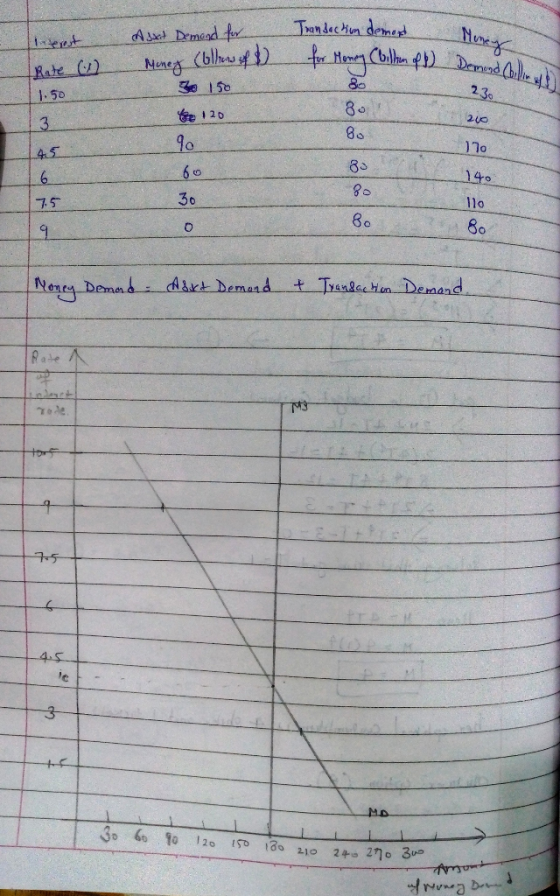
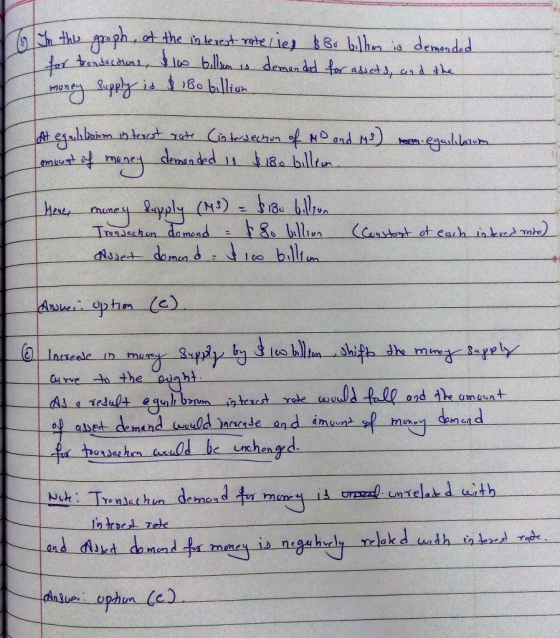
The figures below show the dernand for money and the money market. Transactions demand for money...
Assume that the following data characterize the hypothetical economy of Trance: money supply = $210 billion; quantity of money demanded for transactions = $150 billion; quantity of money demanded as an asset = $10 billion at 12 percent interest, increasin
Assume that the following data characterize the hypothetical economy of Trance: money supply = $210 billion; quantity of money demanded for transactions = $150 billion; quantity of money demanded as an asset = $10 billion at 12 percent interest, increasing by $10 billion for each 2-percentage-point fall in the interest rate. Instructions: Enter your answers as whole numbers. a. What is the equilibrium interest rate in Trance? b. At the equilibrium interest rate, what are the quantity of money supplied, the total quantity of...
The graph models an economy in equilibrium with a real GDP of $180 billion. Suppose that...
 The graph models an economy in equilibrium with a real GDP of $180 billion. Suppose that consumers' expectations about future incomes change, causing unplanned inventory investment to increase by $30 billion. Shift the planned agregate expenditure (AE) line to show the effect of this change. Planned aggregate spending (billions of dollars) 0 30 240 270 300 60 90 120 150 180 210 Real GDP billions of dollars) Planned aggregate spendin 0 30 60 90 120 150 180 210 Real GDP...
Investment demand and the market for money are shown in the graphs below. If the economy...
 Investment demand and the market for money are shown in the graphs below. If the economy has a recessionary gap of $100 billion and the MPC is 0.8, what level of the money supply should the central bank target if it wants to bring real GDP back to the full- employment level? Demonstrate your answer graphically. Instructions: Use the tool provided 'Sm2' to draw the new money supply curve. Use the graph on the right to plot your line such...
The total demand for money is equal to the transactions demand plus the asset demand for...
 The total demand for money is equal to the transactions demand plus the asset demand for money 1. Assume that each dollar held for transactions purpose is spent on the average 2 times per year to buy final goods and services. If nominal GOP is 600 billion dollars, what is the transaction's demand for money? Number 2. The table below shows the asset demand at certain rates of terest Using your answer to part 1. complete the table to show...
5. (5 marks) In Figure A below one curve depicts the Keynesian view of money demand...
 5. (5 marks) In Figure A below one curve depicts the Keynesian view of money demand and the other depicts the monetarist view. In Figure B, one curve depicts the Keynesian view of investment demand and the other depicts the monetarist view. Figure A N- 160 200 80 120 Quantity of money Figure B • 30 60 90 120 150 180 210 240 270 300 Investment spending a) Which of the two money demand curves in Figure A below depicts...
2. The theory of liquidity preference and the downward-slopingaggregate demand curve The following graph shows the...
 2. The theory of liquidity preference and the
downward-slopingaggregate demand curve
The following graph shows the money market in a hypothetical
economy. The central bank in this economy is called the Fed. Assume
that the Fed fixes the quantity of money supplied.
Suppose the price level increases from 90 to 105.
Shift the appropriate curve on the graph to show the impact of
an increase in the overall price level on the market for money.
After the increase in the...
2. The theory of liquidity preference and the
downward-slopingaggregate demand curve
The following graph shows the money market in a hypothetical
economy. The central bank in this economy is called the Fed. Assume
that the Fed fixes the quantity of money supplied.
Suppose the price level increases from 90 to 105.
Shift the appropriate curve on the graph to show the impact of
an increase in the overall price level on the market for money.
After the increase in the...
Assume that the following data characterize the hypothetical economy of Trance: money supply = $200 billion,...
 Assume that the following data characterize the hypothetical economy of Trance: money supply = $200 billion, quantity of money demanded for transactions = $150 billion, quantity of money demanded as an asset = $10 billion at 12 percent interest, increasing by $10 billion for each 2-percentage-point fall in the interest rate. Instructions: Enter your answers as whole numbers. a. What is the equilibrium interest rate in Trance? b. At the equilibrium interest rate, what are the quantity of money supplied,...
Question 8 (1 point) Consider the market for money illustrated in the figure below. What is...
 Question 8 (1 point) Consider the market for money illustrated in the figure below. What is the effect of an increase in government spending on interest rates? MS Interest Rate, i MD M Quantity of Money, M (billions of dollars) MD1 Mi Quantity of Money, M (billions of dollars) O Interest rates will decrease. O Interest rates will remain unchanged. O Interest rates will increase. O Interest rates may increase or decrease.
Question 12 (1 point) The transactions demand for money is least likely to be a function...
 Question 12 (1 point) The transactions demand for money is least likely to be a function of the price level. interest rate. level of national income. frequency of wage and salary payments Question 13 (1 point) If the quantity of money demanded exceeds the quantity supplied the supply-of-money curve will shift to the left the demand-for-money curve will shift to the right. the interest rate will rise. the interest rate will fall.
The following table shows the quantity of money supplied and the quantity of money demanded for various interest rates 4...
 The following table shows the quantity of money supplied and the
quantity of money demanded for various interest rates
4. Study Questions and Problems #4 The following table shows the quantity of money supplied and the quantity of money demanded for various interest rates. Interest Rate (Percent) Demand for Money (Billions of dollars) Supply of Money (Billions of dollars) 500 100 300 500 500 700 900 500 500 500 The following graph depicts the money supply curve in orange. On...
The following table shows the quantity of money supplied and the
quantity of money demanded for various interest rates
4. Study Questions and Problems #4 The following table shows the quantity of money supplied and the quantity of money demanded for various interest rates. Interest Rate (Percent) Demand for Money (Billions of dollars) Supply of Money (Billions of dollars) 500 100 300 500 500 700 900 500 500 500 The following graph depicts the money supply curve in orange. On...
 The graph models an economy in equilibrium with a real GDP of $180 billion. Suppose that consumers' expectations about future incomes change, causing unplanned inventory investment to increase by $30 billion. Shift the planned agregate expenditure (AE) line to show the effect of this change. Planned aggregate spending (billions of dollars) 0 30 240 270 300 60 90 120 150 180 210 Real GDP billions of dollars) Planned aggregate spendin 0 30 60 90 120 150 180 210 Real GDP...
 Investment demand and the market for money are shown in the graphs below. If the economy has a recessionary gap of $100 billion and the MPC is 0.8, what level of the money supply should the central bank target if it wants to bring real GDP back to the full- employment level? Demonstrate your answer graphically. Instructions: Use the tool provided 'Sm2' to draw the new money supply curve. Use the graph on the right to plot your line such...
 The total demand for money is equal to the transactions demand plus the asset demand for money 1. Assume that each dollar held for transactions purpose is spent on the average 2 times per year to buy final goods and services. If nominal GOP is 600 billion dollars, what is the transaction's demand for money? Number 2. The table below shows the asset demand at certain rates of terest Using your answer to part 1. complete the table to show...
 5. (5 marks) In Figure A below one curve depicts the Keynesian view of money demand and the other depicts the monetarist view. In Figure B, one curve depicts the Keynesian view of investment demand and the other depicts the monetarist view. Figure A N- 160 200 80 120 Quantity of money Figure B • 30 60 90 120 150 180 210 240 270 300 Investment spending a) Which of the two money demand curves in Figure A below depicts...
 2. The theory of liquidity preference and the
downward-slopingaggregate demand curve
The following graph shows the money market in a hypothetical
economy. The central bank in this economy is called the Fed. Assume
that the Fed fixes the quantity of money supplied.
Suppose the price level increases from 90 to 105.
Shift the appropriate curve on the graph to show the impact of
an increase in the overall price level on the market for money.
After the increase in the...
2. The theory of liquidity preference and the
downward-slopingaggregate demand curve
The following graph shows the money market in a hypothetical
economy. The central bank in this economy is called the Fed. Assume
that the Fed fixes the quantity of money supplied.
Suppose the price level increases from 90 to 105.
Shift the appropriate curve on the graph to show the impact of
an increase in the overall price level on the market for money.
After the increase in the...
 Assume that the following data characterize the hypothetical economy of Trance: money supply = $200 billion, quantity of money demanded for transactions = $150 billion, quantity of money demanded as an asset = $10 billion at 12 percent interest, increasing by $10 billion for each 2-percentage-point fall in the interest rate. Instructions: Enter your answers as whole numbers. a. What is the equilibrium interest rate in Trance? b. At the equilibrium interest rate, what are the quantity of money supplied,...
 Question 8 (1 point) Consider the market for money illustrated in the figure below. What is the effect of an increase in government spending on interest rates? MS Interest Rate, i MD M Quantity of Money, M (billions of dollars) MD1 Mi Quantity of Money, M (billions of dollars) O Interest rates will decrease. O Interest rates will remain unchanged. O Interest rates will increase. O Interest rates may increase or decrease.
 Question 12 (1 point) The transactions demand for money is least likely to be a function of the price level. interest rate. level of national income. frequency of wage and salary payments Question 13 (1 point) If the quantity of money demanded exceeds the quantity supplied the supply-of-money curve will shift to the left the demand-for-money curve will shift to the right. the interest rate will rise. the interest rate will fall.
 The following table shows the quantity of money supplied and the
quantity of money demanded for various interest rates
4. Study Questions and Problems #4 The following table shows the quantity of money supplied and the quantity of money demanded for various interest rates. Interest Rate (Percent) Demand for Money (Billions of dollars) Supply of Money (Billions of dollars) 500 100 300 500 500 700 900 500 500 500 The following graph depicts the money supply curve in orange. On...
The following table shows the quantity of money supplied and the
quantity of money demanded for various interest rates
4. Study Questions and Problems #4 The following table shows the quantity of money supplied and the quantity of money demanded for various interest rates. Interest Rate (Percent) Demand for Money (Billions of dollars) Supply of Money (Billions of dollars) 500 100 300 500 500 700 900 500 500 500 The following graph depicts the money supply curve in orange. On...
Most questions answered within 3 hours.
-
Where is the error in this code sequence?
String s1 = "Hello";
String s2 = "ello";...
asked 11 months ago -
Financial data for Joel de Paris, Inc., for last year
follow:
Joel de Paris, Inc.
Balance...
asked 11 months ago -
Consider this reaction:
Al2(SO4)3 (aq)+ BaCl3
(aq) Al2Cl6 (aq)- +
3BaSO4(s) . What is the...
asked 11 months ago -
Suppose that Savneet is considering increasing her
recent random sample from 20 car rentals to 40...
asked 11 months ago -
Trucks arrive at an unloading terminal at an average rate of 120
per hour.
Trucks arrive...
asked 11 months ago -
Why are methanol and ethanol completely soluble in water while
octanol is not very little soluble....
asked 11 months ago -
A facilities manager at a university reads in a research report
that the mean amount of...
asked 11 months ago -
When the CuSO4 is rehydrated by adding water to the anhydrous
compound, is this an endothermic...
asked 11 months ago -
A ray of sunlight is passing from diamond into crown glass; the
angle of incidence is...
asked 11 months ago -
A block of mass 0.249 kg is placed on top of a light, vertical
spring of...
asked 11 months ago -
how do the kidneys compensate in the presences of acidosis
a) trigger hyperventilate
b) reserve acid...
asked 11 months ago -
Question 501 pts
The rental rate of capital to the firm increases. Which of the
following...
asked 11 months ago