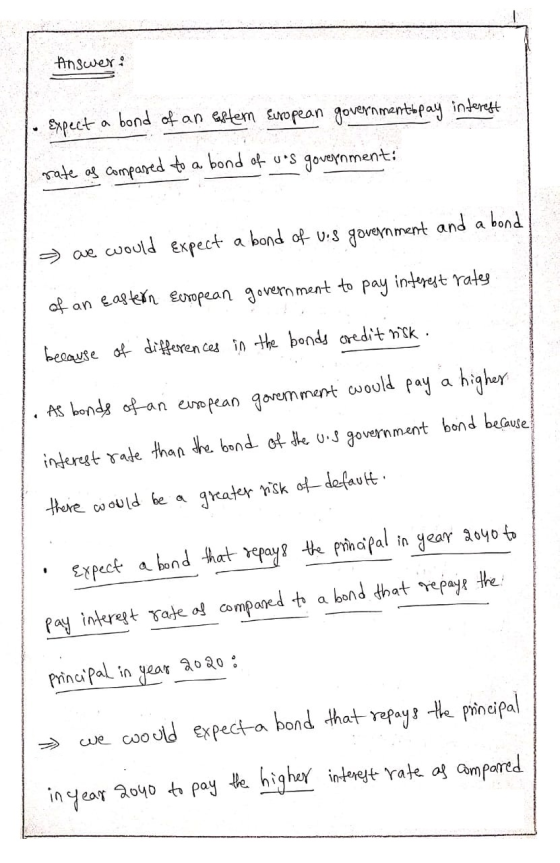
You would expect a bond of an Eastern European government to pay interest rate as compared...
You would expect a bond of an Eastern European government to pay interest rate as compared to a bond of the U.S. government.
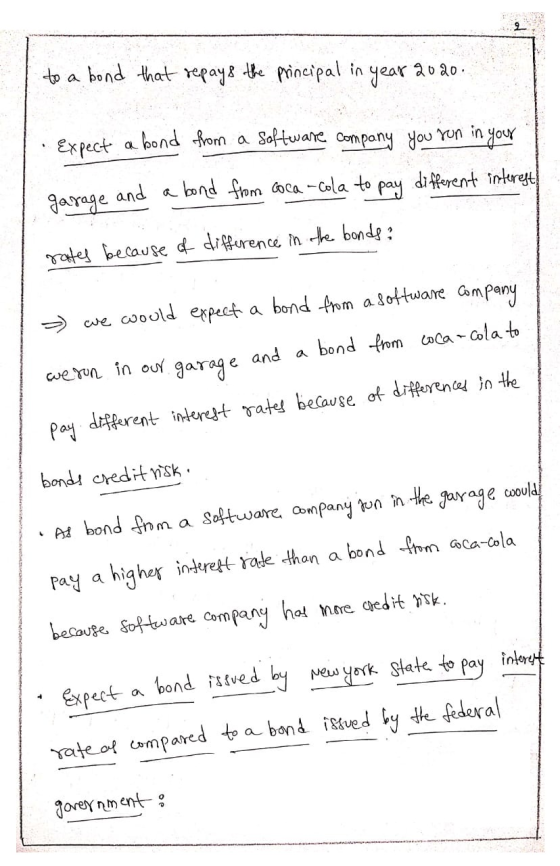
You would expect a bond that repays the principal in year 2040 to pay interest rate as compared to a bond that repays the principal in year 2020.
You would expect a bond from a software company you run in your garage and a bond from Coca-Cola to pay different interest rates because of differences in the bonds' .
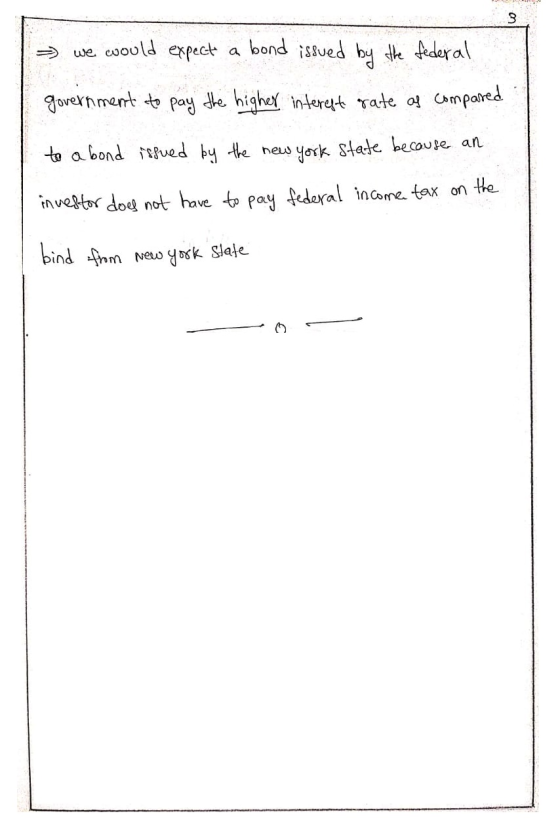
You would expect a bond issued by New York State to pay interest rate as compared to a bond issued by the federal government.
Homework Answers
There are many different bonds in the world economy, and these bonds differ according to three characteristics:
| Term to maturity: | Long-term bonds are riskier than short-term bonds because holders of long-term bonds have to wait longer for repayment of principal. To compensate for this risk, long-term bonds usually pay higher interest rates than short-term bonds. |
| Credit risk: | When bond buyers perceive that the probability of default is high, they demand a higher interest rate as compensation for this risk. |
| Tax treatment: | When state and local governments issue bonds, the bond owners are not required to pay federal income tax on the interest income. Because of this tax advantage, bonds issued by state and local governments typically pay a lower interest rate than bonds issued by corporations or the federal government. |
Given these characteristics, the bond of an Eastern European government would pay a higher interest rate than the bond of the U.S. government because there would be a greater risk of default. A bond that repays the principal in 2040 would pay a higher interest rate than a bond that repays the principal in 2020 because it has a longer term to maturity. A bond of a software company you run in your garage would pay a higher interest rate than a bond issued by Coca-Cola because your software company has greater credit risk. And a bond issued by the federal government would pay a higher interest rate than a bond issued by New York State because an investor does not have to pay federal income tax on the bond from New York State. See Section: Financial Markets.
Add Answer to:
You would expect a bond of an Eastern European government to pay
interest rate as compared...
Options are: 1. a lower/a higher/same 2. credit risks/tax treatments/terms to maturity 3. credit risks/tax treatments/terms...
 Options are: 1. a lower/a higher/same 2. credit risks/tax
treatments/terms to maturity 3. credit risks/tax treatments/terms
to maturity 4. credit risks/tax treatments/terms to
maturity
You would expect a bond of the U.S. government to pay interest rate as compared to a bond of an Eastern European government. You would expect a bond that repays the principal in year 2040 and a bond that repays the principal in year 2020 to pay different interest rates because of differences in the bonds'...
Options are: 1. a lower/a higher/same 2. credit risks/tax
treatments/terms to maturity 3. credit risks/tax treatments/terms
to maturity 4. credit risks/tax treatments/terms to
maturity
You would expect a bond of the U.S. government to pay interest rate as compared to a bond of an Eastern European government. You would expect a bond that repays the principal in year 2040 and a bond that repays the principal in year 2020 to pay different interest rates because of differences in the bonds'...
The options for a are "the same", "a higher", or "a lower" The options for b...
 The options for a are "the same", "a higher", or "a
lower"
The options for b are "the same", "a higher", or "a
lower"
The options for c are "terms to maturity", "credit
risks", or "tax treatment"
The options for d are "the same", "a higher",
or "a lower
You would expect a bond of an Eastern European government to pay the same interest rate as compared to a bond of the U.S. government interest rate as compared to a...
The options for a are "the same", "a higher", or "a
lower"
The options for b are "the same", "a higher", or "a
lower"
The options for c are "terms to maturity", "credit
risks", or "tax treatment"
The options for d are "the same", "a higher",
or "a lower
You would expect a bond of an Eastern European government to pay the same interest rate as compared to a bond of the U.S. government interest rate as compared to a...
WHY would I expect a US government agency bond (like Federal Home Loan Banks or Tennessee...
WHY would I expect a US government agency bond (like Federal Home Loan Banks or Tennessee Valley Authority) to carry a higher rate of return than I would a U.S. Treasury Bond of the same maturity?
3. The current interest rate on a one-year bond is 9%, and you expect the interest...
 3. The current interest rate on a one-year bond is 9%, and you expect the interest rate on the one-year bond next year to be 11%. What is the expected return over the two years?
You are considering a 20-year federal government bond with face value $10,000 and a coupon rate...
You are considering a 20-year federal government bond with face value $10,000 and a coupon rate of 4%. If you want the yield to maturity of the bond to be 7%, how much should you pay (in $) to purchase the bond?
HKUST Inc. issued a bond on January 1st, 2019 with a market interest rate (“yield”) of...
HKUST Inc. issued a bond on January 1st, 2019 with a market interest rate (“yield”) of 11%. However, HKUST Inc. decided to pay a coupon rate of 9%. The “face-value” of the bond was 10,000 dollars. This bond will be due on December, 31st, 2020 and will be paid semi-annually. Required: Record the above bond transaction with a) straight-line method and b) effective interest method. Explain their differences.
A high-yield bond has the following features: __________________________________________________ Principal amount: $1,000 Interest rate (the coupon): 11.50%...
A high-yield bond has the following features: __________________________________________________ Principal amount: $1,000 Interest rate (the coupon): 11.50% Maturity: 10 years Sinking fund: None Call feature: After two years Call penalty: One year’s interest ___________________________________________________ a.) If comparable yields are 12 percent, what should be the price of this bond? b.) Would you expect the firm to call the bond if yields are 12 percent? c.) If comparable yields are 8 percent, what should be the price of the bond? d.) Would...
How much would an investor expect to pay for a $1,000 par value bond with a...
 How much would an investor expect to pay for a $1,000 par value bond with a 9% semi-annual coupon that matures in 5 years if the interest rate is 7%? 3 pts $696.74 $1,083.17 $1,082.00 $1,123.01
Winnie is deciding between investing $100,000 in a state government bond (muni bond)that pays 5% interest...
Winnie is deciding between investing $100,000 in a state government bond (muni bond)that pays 5% interest compounded annually or a corporate bond that pays 6% interestcompounded annually. Winnie will be in the 24% marginal tax bracket in 2020 (assumet he bond interest will not push her into a higher marginal tax bracket). What interest rate would the corporate bond need to pay to provide the same after-taxincome as the state government bond?Note: enter your answer as a decimal rounded up...
Perpetuities. The Canadian Government has once again decided to issue a consol (a bond with a...
Perpetuities. The Canadian Government has once again decided to issue a consol (a bond with a never-ending interest payment and no maturity date). The bond will pay $70 in interest each year (at the end of the year), but it will never return the principal. A) If the current discount rate for Canadian government bonds is 10%, what should this bond sell for in the market? B) If the current discount rate for Canadian government bands would rise to 11%?...
 Options are: 1. a lower/a higher/same 2. credit risks/tax
treatments/terms to maturity 3. credit risks/tax treatments/terms
to maturity 4. credit risks/tax treatments/terms to
maturity
You would expect a bond of the U.S. government to pay interest rate as compared to a bond of an Eastern European government. You would expect a bond that repays the principal in year 2040 and a bond that repays the principal in year 2020 to pay different interest rates because of differences in the bonds'...
Options are: 1. a lower/a higher/same 2. credit risks/tax
treatments/terms to maturity 3. credit risks/tax treatments/terms
to maturity 4. credit risks/tax treatments/terms to
maturity
You would expect a bond of the U.S. government to pay interest rate as compared to a bond of an Eastern European government. You would expect a bond that repays the principal in year 2040 and a bond that repays the principal in year 2020 to pay different interest rates because of differences in the bonds'...
 The options for a are "the same", "a higher", or "a
lower"
The options for b are "the same", "a higher", or "a
lower"
The options for c are "terms to maturity", "credit
risks", or "tax treatment"
The options for d are "the same", "a higher",
or "a lower
You would expect a bond of an Eastern European government to pay the same interest rate as compared to a bond of the U.S. government interest rate as compared to a...
The options for a are "the same", "a higher", or "a
lower"
The options for b are "the same", "a higher", or "a
lower"
The options for c are "terms to maturity", "credit
risks", or "tax treatment"
The options for d are "the same", "a higher",
or "a lower
You would expect a bond of an Eastern European government to pay the same interest rate as compared to a bond of the U.S. government interest rate as compared to a...
 3. The current interest rate on a one-year bond is 9%, and you expect the interest rate on the one-year bond next year to be 11%. What is the expected return over the two years?
 How much would an investor expect to pay for a $1,000 par value bond with a 9% semi-annual coupon that matures in 5 years if the interest rate is 7%? 3 pts $696.74 $1,083.17 $1,082.00 $1,123.01
Most questions answered within 3 hours.
-
Where is the error in this code sequence?
String s1 = "Hello";
String s2 = "ello";...
asked 11 months ago -
Financial data for Joel de Paris, Inc., for last year
follow:
Joel de Paris, Inc.
Balance...
asked 11 months ago -
Consider this reaction:
Al2(SO4)3 (aq)+ BaCl3
(aq) Al2Cl6 (aq)- +
3BaSO4(s) . What is the...
asked 11 months ago -
Suppose that Savneet is considering increasing her
recent random sample from 20 car rentals to 40...
asked 11 months ago -
Trucks arrive at an unloading terminal at an average rate of 120
per hour.
Trucks arrive...
asked 11 months ago -
Why are methanol and ethanol completely soluble in water while
octanol is not very little soluble....
asked 11 months ago -
A facilities manager at a university reads in a research report
that the mean amount of...
asked 11 months ago -
When the CuSO4 is rehydrated by adding water to the anhydrous
compound, is this an endothermic...
asked 11 months ago -
A ray of sunlight is passing from diamond into crown glass; the
angle of incidence is...
asked 11 months ago -
A block of mass 0.249 kg is placed on top of a light, vertical
spring of...
asked 11 months ago -
how do the kidneys compensate in the presences of acidosis
a) trigger hyperventilate
b) reserve acid...
asked 11 months ago -
Question 501 pts
The rental rate of capital to the firm increases. Which of the
following...
asked 11 months ago