A 14C nucleus, initially at rest, emits a beta particle. The beta particle is an electron...
|
A 14C nucleus, initially at rest, emits a beta particle. The beta particle is an electron with 133 keV of kinetic energy. |
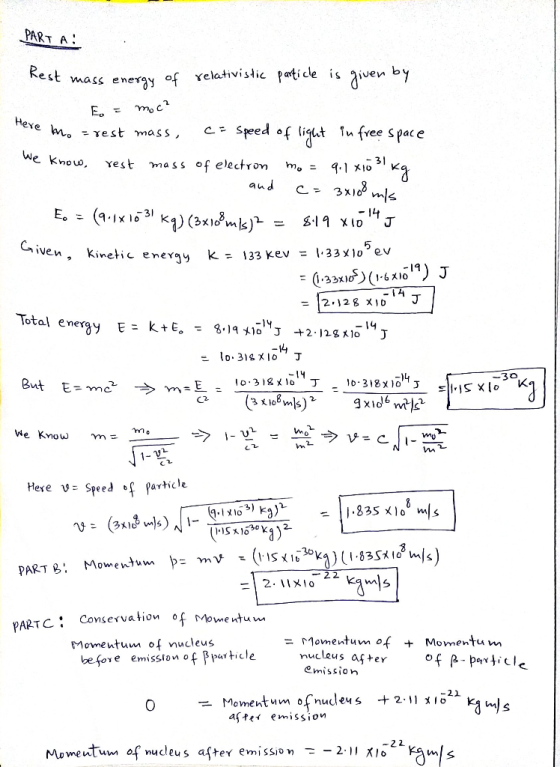
Part A What is the speed of the beta particle?
SubmitRequest Answer Part B What is the momentum of the beta particle?
SubmitRequest Answer Part C What is the momentum of the nucleus after it emits the beta particle?
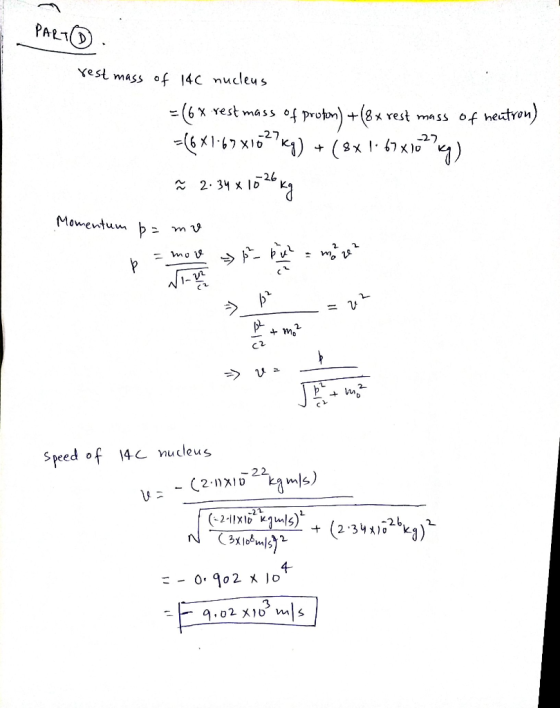
SubmitRequest Answer Part D What is the speed of the nucleus after it emits the beta particle?
|
Homework Answers
Add Answer to:
A 14C nucleus, initially at rest, emits a beta particle. The
beta particle is an electron...
A 14C nucleus, initially at rest, emits a beta particle. The beta particle is an electron...
A 14C nucleus, initially at rest, emits a beta particle. The beta particle is an electron with 138 keV of kinetic energy. A) What is the speed of the beta particle? [v=__c] B) What is the momentum of the beta particle? [P=__kg x m/s] C) What is the momentum of the nucleus after it emits the beta particle? [P=__kg x m/s] D) What is the speed of the nucleus after it emits the beta particle? [v=__m/s] **Please answer all parts...
An atomic nucleus initially moving at 390 m/s emits an alpha particle in the direction of...
An atomic nucleus initially moving at 390 m/s emits an alpha particle in the direction of its velocity, and the remaining nucleus slows to 250 m/s . Part A If the alpha particle has a mass of 4.0 u and the original nucleus has a mass of 222 u , what speed does the alpha particle have when it is emitted? Express your answer to two significant figures and include the appropriate units. v ′ α v α ′ =...
The carbon isotope 14C is used for carbon dating of archeological artifacts. 14C ( mass 2.34×10⁻²⁶kg)...
The carbon isotope 14C is used for carbon dating of archeological artifacts. 14C ( mass 2.34×10⁻²⁶kg) decays by the process known as beta decay in which the nucleus emits an electron (the beta particle) and a subatomic particle called a neutrino. In one such decay, the electron and the neutrino are emitted at right angles to each other. The electron ( mass 9.11×10⁻³¹kg ) has a speed of 5.7×10⁷ m/s and the neutrino has a momentum of 6.9×10⁻²⁴ kg⋅m/s ....
A single 224 U nucleus, initially at rest, emits an alpha particle as it decays into...
A single 224 U nucleus, initially at rest, emits an alpha particle as it decays into a 220 Th nucleus. There are no other decay products, and the kinetic energy of the alpha particle is measured to be 1.356 × 10 − 12 J . What is the total amount of nuclear potential energy PE nuclear , in joules, that is released in this process? PE nuclear = ___J What is the difference Δ m between the original mass of...
The carbon isotope 14C is used for carbon dating of objects. A 14C nucleus can change...
The carbon isotope 14C is used for carbon dating of objects. A 14C nucleus can change into a different kind of element, a neighbor on the periodic table with lower mass, by emitting a beta particle – an electron or positron – plus a neutrino or an anti-neutrino. Consider the scenario where 14C ( mass of 2.34 x 10 -26) decays by emitting an electron and anti neutrino. The electron has a mass of 9.11x 10⁻³¹ kg and a speed...
An alpha particle with kinetic energy 13.5 MeV makes a collision with lead nucleus, but it...
An alpha particle with kinetic energy 13.5 MeV makes a collision with lead nucleus, but it is not "aimed" at the center of the lead nucleus, and has an initial nonzero angular momentum (with respect to the stationary lead nucleus) of magnitude L= p 0 b , where p 0 is the magnitude of the initial momentum of the alpha particle and b =1.10×10⁻¹² m . (Assume that the lead nucleus remains stationary and that it may be treated as...
In certain radioactive beta decay processes, the beta particle (an electron) leaves the atomic nucleus with...
 In certain radioactive beta decay processes, the beta particle (an electron) leaves the atomic nucleus with a speed of99.95% the speed of light relative to the decaying nucleus. In the laboratory frame, the nucleus is moving at 75.00% the speed of light, and the electron is emitted in the same direction the nucleus is moving. Find the energy and momentum of the electron as measured in the laboratory frame and in the rest frame of the decaying nucleus.
The electron in a hydrogen atom makes a transition from the n = 4 state to...
The electron in a hydrogen atom makes a transition from the n = 4 state to the n = 2 state, as indicated in the image. (Figure 1) Figure 1 of 1The figure shows a model of an atom including a nucleus and four circular orbits around the nucleus. An electron jump occurs from the fourth to the second orbit from the center. A photon moves horizontally leftward. Momentum of the photon is directed horizontally rightward, and momentum of the...
An atomic nucleus initially moving at 390 m/s emits an alpha particle in the direction of...
An atomic nucleus initially moving at 390 m/s emits an alpha particle in the direction of its velocity, and the remaining nucleus slows to 280 m/s . If the alpha particle has a mass of 4.0 u and the original nucleus has a mass of 222 u, what speed does the alpha particle have when it is emitted? Express your answer to two significant figures and include the appropriate units.
An atomic nucleus initially moving at 360 m/s emits an alpha particle in the direction of...
An atomic nucleus initially moving at 360 m/s emits an alpha particle in the direction of its velocity, and the remaining nucleus slows to 260 m/s If the alpha particle has a mass of 4.0 u and the original nucleus has a mass of 222 u, what speed does the alpha particle have when it is emitted?
 In certain radioactive beta decay processes, the beta particle (an electron) leaves the atomic nucleus with a speed of99.95% the speed of light relative to the decaying nucleus. In the laboratory frame, the nucleus is moving at 75.00% the speed of light, and the electron is emitted in the same direction the nucleus is moving. Find the energy and momentum of the electron as measured in the laboratory frame and in the rest frame of the decaying nucleus.
Most questions answered within 3 hours.
-
Where is the error in this code sequence?
String s1 = "Hello";
String s2 = "ello";...
asked 10 months ago -
Financial data for Joel de Paris, Inc., for last year
follow:
Joel de Paris, Inc.
Balance...
asked 10 months ago -
Consider this reaction:
Al2(SO4)3 (aq)+ BaCl3
(aq) Al2Cl6 (aq)- +
3BaSO4(s) . What is the...
asked 10 months ago -
Suppose that Savneet is considering increasing her
recent random sample from 20 car rentals to 40...
asked 10 months ago -
Trucks arrive at an unloading terminal at an average rate of 120
per hour.
Trucks arrive...
asked 10 months ago -
Why are methanol and ethanol completely soluble in water while
octanol is not very little soluble....
asked 10 months ago -
A facilities manager at a university reads in a research report
that the mean amount of...
asked 10 months ago -
When the CuSO4 is rehydrated by adding water to the anhydrous
compound, is this an endothermic...
asked 10 months ago -
A ray of sunlight is passing from diamond into crown glass; the
angle of incidence is...
asked 10 months ago -
A block of mass 0.249 kg is placed on top of a light, vertical
spring of...
asked 10 months ago -
how do the kidneys compensate in the presences of acidosis
a) trigger hyperventilate
b) reserve acid...
asked 10 months ago -
Question 501 pts
The rental rate of capital to the firm increases. Which of the
following...
asked 10 months ago