
Homework Answers
Add Answer to:
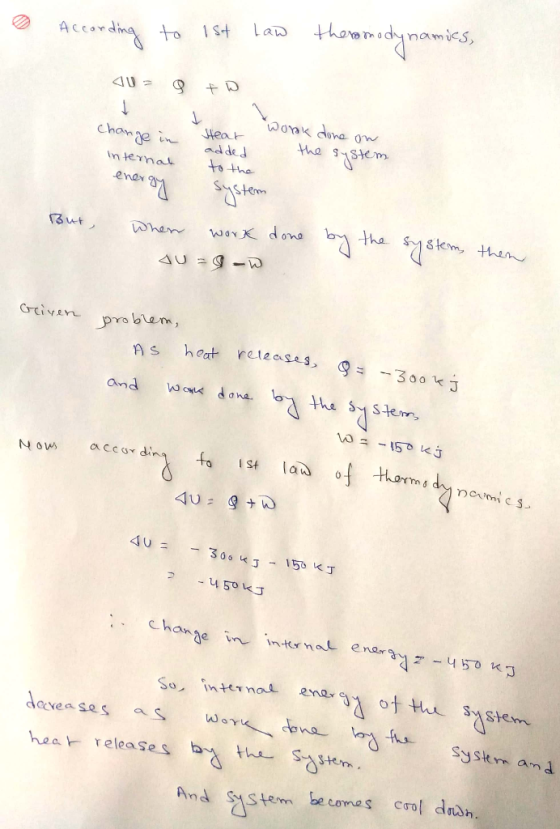
13. The mixture of gas and air inside a cylinder reacts, releasing 300 kJ of heat....
D) hegative and positive. 12. The mixture of gas and air inside a cylinder reacts, releasing...
 D) hegative and positive. 12. The mixture of gas and air inside a cylinder reacts, releasing 400 kJ of total energy. If the system does 250 kJ of work on the piston, how much energy is released as HEAT?
6. A sample of ammonium chloride dissolves in water, absorbing heat from the surrounding water and...
 6. A sample of ammonium chloride dissolves in water, absorbing heat from the surrounding water and causing the temperature to drop by 20 °C. If the heat change for the reaction is +300 J, what is the heat change for the surrounding water? 12. The mixture of gas and air inside a cylinder reacts, releasing 400 kJ of total energy. If the system does 250 kJ of work on the piston, how much energy is released as HEAT?
A sample of gas in a cylinder is provided with 628 kJ of heat. This causes...
A sample of gas in a cylinder is provided with 628 kJ of heat. This causes a piston to then compresses the gas by doing 432 kJ of work to the gas. What is the change in internal energy of the gas during this compression? Round to the nearest whole number.
1.) A system absorbs 1.56E+2 kJ of heat and the surroundings do 1.107E+2 kJ of work...
1.) A system absorbs 1.56E+2 kJ of heat and the surroundings do 1.107E+2 kJ of work on the system. What is the change in internal energy (in kJ) (ΔU) of the system? 2.) A sample of gas in a cylinder is provided with 6.221E+2 kJ of heat. This causes a piston to then compresses the gas by doing 4.343E+2 kJ of work to the gas. What is the change in internal energy of the gas during this compression? 3.)A gas...
Understanding the definitions of heat and work A mixture of gaseous reactants is put into a cylinder, where a chemic...
 Understanding the definitions of heat and work A mixture of gaseous reactants is put into a cylinder, where a chemical reaction turns them into gaseous products. The cylinder has a piston that moves in or out, as necessary, to keep a constant pressure on the mixture of 1 atm. The cylinder is also submerged in a large insulated water bath. (See sketch at night.) From previous experiments, this chemical reaction is known to absorb 239. LJ of energy. The temperature...
A mixture of gaseous reactants is put into a cylinder, where a chemical reaction turns them into ...
 A mixture of gaseous reactants is put into a cylinder, where a chemical reaction turns them into gaseous products. The cylinder has a piston that moves in or out, as necessary, to keep a constant pressure on the mixture of 1 atm. The cylinder is also submerged in a large insulated water bath. (See sketch at right.) 1 atm pressure piston cylinder From previous experiments, this chemical reaction is known to release 360. kJ of energy water bath gases The...
The gas in a piston expands after receiving 30 kJ of heat. If there is no...
The gas in a piston expands after receiving 30 kJ of heat. If there is no change in total internal energy, what is the amount of work done by the gas? The gas in a piston did 40 kJ of work while losing 3 kJ of heat to its surroundings. Find the change in total internal energy?
A mixture of gaseous reactants is put into a cylinder, where a chemical reaction turns them into gaseous products. The cylinder has a piston that moves in or out, as necessary, to keep a constant pre...
 A mixture of gaseous reactants is put into a cylinder, where a chemical reaction turns them into gaseous products. The cylinder has a piston that moves in or out, as necessary, to keep a constant pressure on the mixture of 1 atm. The cylinder is also submerged in a large insulated water bath. (See sketch at right.) 1 atm pressure piston cylinder From previous experiments, this chemical reaction is known to release 368. kJ of energy water bath gases The...
Thermodynamics: Work & Heat Transfer in Piston-Cylinder
 for part a) got W = 4kJ, dQ = 4.25 kJfor part b) got w = 2kJ...How do you find ΔPE without mass? Do you use the conservation of energy equation?As shown in Fig. P2.56, a gas contained within a piston–cylinder assembly, initially at a volume of 0.1 m3, undergoesa constant-pressure expansion at 2 bar to a final volume of0.12 m3, while being slowly heated through the base. Thechange in internal energy of the gas is 0.25 kJ. The pistonand...
An insulated piston-cylinder device contains 0.1m3 of air (ideal gas) at 400 kPa and 25℃. A...
An insulated piston-cylinder device contains 0.1m3 of air (ideal gas) at 400 kPa and 25℃. A paddle wheel within the cylinder is rotated until 15 kJ of work is done on the air while the pressure is held constant. Assuming the kinetic and potential energies are negligible and the gas constant and specific heat of air are ? = 0.287 kJ kg∙K and ?? = 1.005 kJ kg∙K . Tasks: ( a ) Determine the mass of air inside the...
 D) hegative and positive. 12. The mixture of gas and air inside a cylinder reacts, releasing 400 kJ of total energy. If the system does 250 kJ of work on the piston, how much energy is released as HEAT?
 6. A sample of ammonium chloride dissolves in water, absorbing heat from the surrounding water and causing the temperature to drop by 20 °C. If the heat change for the reaction is +300 J, what is the heat change for the surrounding water? 12. The mixture of gas and air inside a cylinder reacts, releasing 400 kJ of total energy. If the system does 250 kJ of work on the piston, how much energy is released as HEAT?
 Understanding the definitions of heat and work A mixture of gaseous reactants is put into a cylinder, where a chemical reaction turns them into gaseous products. The cylinder has a piston that moves in or out, as necessary, to keep a constant pressure on the mixture of 1 atm. The cylinder is also submerged in a large insulated water bath. (See sketch at night.) From previous experiments, this chemical reaction is known to absorb 239. LJ of energy. The temperature...
 A mixture of gaseous reactants is put into a cylinder, where a chemical reaction turns them into gaseous products. The cylinder has a piston that moves in or out, as necessary, to keep a constant pressure on the mixture of 1 atm. The cylinder is also submerged in a large insulated water bath. (See sketch at right.) 1 atm pressure piston cylinder From previous experiments, this chemical reaction is known to release 360. kJ of energy water bath gases The...
 A mixture of gaseous reactants is put into a cylinder, where a chemical reaction turns them into gaseous products. The cylinder has a piston that moves in or out, as necessary, to keep a constant pressure on the mixture of 1 atm. The cylinder is also submerged in a large insulated water bath. (See sketch at right.) 1 atm pressure piston cylinder From previous experiments, this chemical reaction is known to release 368. kJ of energy water bath gases The...
Most questions answered within 3 hours.
-
Where is the error in this code sequence?
String s1 = "Hello";
String s2 = "ello";...
asked 11 months ago -
Financial data for Joel de Paris, Inc., for last year
follow:
Joel de Paris, Inc.
Balance...
asked 11 months ago -
Consider this reaction:
Al2(SO4)3 (aq)+ BaCl3
(aq) Al2Cl6 (aq)- +
3BaSO4(s) . What is the...
asked 11 months ago -
Suppose that Savneet is considering increasing her
recent random sample from 20 car rentals to 40...
asked 11 months ago -
Trucks arrive at an unloading terminal at an average rate of 120
per hour.
Trucks arrive...
asked 11 months ago -
Why are methanol and ethanol completely soluble in water while
octanol is not very little soluble....
asked 11 months ago -
A facilities manager at a university reads in a research report
that the mean amount of...
asked 11 months ago -
When the CuSO4 is rehydrated by adding water to the anhydrous
compound, is this an endothermic...
asked 11 months ago -
A ray of sunlight is passing from diamond into crown glass; the
angle of incidence is...
asked 11 months ago -
A block of mass 0.249 kg is placed on top of a light, vertical
spring of...
asked 11 months ago -
how do the kidneys compensate in the presences of acidosis
a) trigger hyperventilate
b) reserve acid...
asked 11 months ago -
Question 501 pts
The rental rate of capital to the firm increases. Which of the
following...
asked 11 months ago