
Homework Answers
Add Answer to:
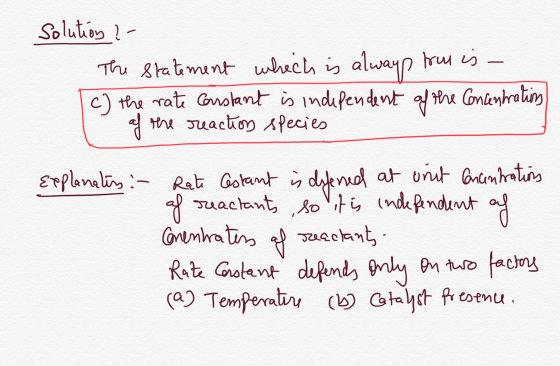
unich statement is always true? a) the role of a catalyzed reaction is depen of the...
Select the true statement regarding catalysis of chemical reactions. a) the catalyzed and uncatalyzed versions of...
Select the true statement regarding catalysis of chemical reactions. a) the catalyzed and uncatalyzed versions of a chemical reaction have the same mechanism b) catalysts decrease the activation energy c) catalysts decrease the reaction rate d) catalysts appear in the overall reaction equation e) catalysts decrease the reaction enthalpy
1. 2. 3. Select the true statement regarding thermodynamics. C) The △G" of a reaction is...
 1.
2.
3.
Select the true statement regarding thermodynamics. C) The △G" of a reaction is zero at equilibrium. 0 The standard state for solutes is 1.00 M The standard state for gases is 1 Torr. The ΔG of a reaction is independent of the equilibrium constant A reaction proceeds via the following equation A solution of A and B are allowed to react unti the reaction stops. The final concentrations of the reactants and products are 25 mM A...
1.
2.
3.
Select the true statement regarding thermodynamics. C) The △G" of a reaction is zero at equilibrium. 0 The standard state for solutes is 1.00 M The standard state for gases is 1 Torr. The ΔG of a reaction is independent of the equilibrium constant A reaction proceeds via the following equation A solution of A and B are allowed to react unti the reaction stops. The final concentrations of the reactants and products are 25 mM A...
10) Which of the following is always true for the oxidation numbers in an oxidation-reduction reaction?...
 10) Which of the following is always true for the oxidation numbers in an oxidation-reduction reaction? a) The value for the oxidation number for atoms of the element being oxidized must increase as we go from reactants to products b) The initial value for the oxidation number for atoms of the element being oxidized must be positive c) The final value for the oxidation number for atoms of the element being oxidized must be positive d) Both band c e)...
Section A. Decide whether the following statements are true or false. 1. The order n is...
 Section A. Decide whether the following statements are true or false. 1. The order n is always a positive integer. 2. If the reaction rate doubles as the concentration of [A] doubles, the reaction is first order with respect to A. 3. If the reaction rate is constant as the concentration of [A] doubles, the reaction is zero order with respect to A. 4. The rate law is an equation that shows the dependence of the reaction rate on the...
Question 10 Select the true statement. O O O O The rate-determining step in a reaction...
 Question 10 Select the true statement. O O O O The rate-determining step in a reaction mechanism is the fastest step. The catalyzed and uncatalyzed versions of a chemical reaction have different products. Intermediates should appear in the rate law for an overall reaction. Rate constants are affected by changes in temperature. Moving to another question will save this response. . esc 54 F2 3 A # 3 NO $ 4 % 5 & 7 00* 6 3 U E...
2) in a catalyzed chemical reaction, one function of a catalyst is to A) increase the...
 2) in a catalyzed chemical reaction, one function of a catalyst is to A) increase the number of successful reactant collisions. B) decrease the concentration of reactants. change the equilibrium concentrations of the products and react D) increase the energy given off during the reaction E) increase the temperature at which the reaction is carried out. 3) Refrigerating perishable foods affects biochemical reactions by A) increasing concentrations of antioxidants. B) removing bacteria. C) decreasing the rate of reactions affecting spoilage....
Which statement is false concerning elementary steps in a reaction mechanism? the rate law can be...
Which statement is false concerning elementary steps in a reaction mechanism? the rate law can be deduced from the stoichiometry of reactants for an elementary step the overall molecularity for an elementary step is the sum of the stoichiometric coefficients for all reactants in that step the rate law for an elementary step must be determined experimentally the rate law for the overall reaction is always the same as the rate law for the slowest elementary step both (c) and...
1. Which statement about a balanced chemical reaction equation is always correct? The total number of...
 1. Which statement about a balanced chemical reaction equation is always correct? The total number of moles of the products equals the total number of moles of the reactants. b. The sum of the masses of gaseous reactants equals the sum of the masses of gaseous products. The sum of the stoichiometric coefficients for the products equals the sum of the stoichiometric coefficients for the reactants. The number of atoms of the products is higher to the numbers of atoms...
INFORMATION reaction must also be perimental mea data are plotted in the sult means that the...
 INFORMATION reaction must also be perimental mea data are plotted in the sult means that the rate Because a reaction is faster at higher temperatures, the rate constant for the reaction m larger. The activation energy of a reaction can therefore be determined from experime surements of the rate constant at several temperatures. When the collected data are ple form In(k) vs T. as shown in Figure 2. a straight line is produced. This result means constant varies exponentially with...
Question 2 1 pts Which statement(s) concerning the reaction is/are true? 2ABig) Alg) + Bale) K-2.9...
 Question 2 1 pts Which statement(s) concerning the reaction is/are true? 2ABig) Alg) + Bale) K-2.9 x 10-85 There are fewer moles of reactants than products at equilibrium, because the equilibrium constant is small There are more moles of reactants than products at equilibrium, because the equilibrium constant is large. There are near equal amounts of reactants and products at equilibrium because the equilibrium constant is close to 1 There are more moles of reactants than products at equilibrium, because...
 1.
2.
3.
Select the true statement regarding thermodynamics. C) The △G" of a reaction is zero at equilibrium. 0 The standard state for solutes is 1.00 M The standard state for gases is 1 Torr. The ΔG of a reaction is independent of the equilibrium constant A reaction proceeds via the following equation A solution of A and B are allowed to react unti the reaction stops. The final concentrations of the reactants and products are 25 mM A...
1.
2.
3.
Select the true statement regarding thermodynamics. C) The △G" of a reaction is zero at equilibrium. 0 The standard state for solutes is 1.00 M The standard state for gases is 1 Torr. The ΔG of a reaction is independent of the equilibrium constant A reaction proceeds via the following equation A solution of A and B are allowed to react unti the reaction stops. The final concentrations of the reactants and products are 25 mM A...
 10) Which of the following is always true for the oxidation numbers in an oxidation-reduction reaction? a) The value for the oxidation number for atoms of the element being oxidized must increase as we go from reactants to products b) The initial value for the oxidation number for atoms of the element being oxidized must be positive c) The final value for the oxidation number for atoms of the element being oxidized must be positive d) Both band c e)...
 Section A. Decide whether the following statements are true or false. 1. The order n is always a positive integer. 2. If the reaction rate doubles as the concentration of [A] doubles, the reaction is first order with respect to A. 3. If the reaction rate is constant as the concentration of [A] doubles, the reaction is zero order with respect to A. 4. The rate law is an equation that shows the dependence of the reaction rate on the...
 Question 10 Select the true statement. O O O O The rate-determining step in a reaction mechanism is the fastest step. The catalyzed and uncatalyzed versions of a chemical reaction have different products. Intermediates should appear in the rate law for an overall reaction. Rate constants are affected by changes in temperature. Moving to another question will save this response. . esc 54 F2 3 A # 3 NO $ 4 % 5 & 7 00* 6 3 U E...
 2) in a catalyzed chemical reaction, one function of a catalyst is to A) increase the number of successful reactant collisions. B) decrease the concentration of reactants. change the equilibrium concentrations of the products and react D) increase the energy given off during the reaction E) increase the temperature at which the reaction is carried out. 3) Refrigerating perishable foods affects biochemical reactions by A) increasing concentrations of antioxidants. B) removing bacteria. C) decreasing the rate of reactions affecting spoilage....
 1. Which statement about a balanced chemical reaction equation is always correct? The total number of moles of the products equals the total number of moles of the reactants. b. The sum of the masses of gaseous reactants equals the sum of the masses of gaseous products. The sum of the stoichiometric coefficients for the products equals the sum of the stoichiometric coefficients for the reactants. The number of atoms of the products is higher to the numbers of atoms...
 INFORMATION reaction must also be perimental mea data are plotted in the sult means that the rate Because a reaction is faster at higher temperatures, the rate constant for the reaction m larger. The activation energy of a reaction can therefore be determined from experime surements of the rate constant at several temperatures. When the collected data are ple form In(k) vs T. as shown in Figure 2. a straight line is produced. This result means constant varies exponentially with...
 Question 2 1 pts Which statement(s) concerning the reaction is/are true? 2ABig) Alg) + Bale) K-2.9 x 10-85 There are fewer moles of reactants than products at equilibrium, because the equilibrium constant is small There are more moles of reactants than products at equilibrium, because the equilibrium constant is large. There are near equal amounts of reactants and products at equilibrium because the equilibrium constant is close to 1 There are more moles of reactants than products at equilibrium, because...
Most questions answered within 3 hours.
-
Where is the error in this code sequence?
String s1 = "Hello";
String s2 = "ello";...
asked 11 months ago -
Financial data for Joel de Paris, Inc., for last year
follow:
Joel de Paris, Inc.
Balance...
asked 11 months ago -
Consider this reaction:
Al2(SO4)3 (aq)+ BaCl3
(aq) Al2Cl6 (aq)- +
3BaSO4(s) . What is the...
asked 11 months ago -
Suppose that Savneet is considering increasing her
recent random sample from 20 car rentals to 40...
asked 11 months ago -
Trucks arrive at an unloading terminal at an average rate of 120
per hour.
Trucks arrive...
asked 11 months ago -
Why are methanol and ethanol completely soluble in water while
octanol is not very little soluble....
asked 11 months ago -
A facilities manager at a university reads in a research report
that the mean amount of...
asked 11 months ago -
When the CuSO4 is rehydrated by adding water to the anhydrous
compound, is this an endothermic...
asked 11 months ago -
A ray of sunlight is passing from diamond into crown glass; the
angle of incidence is...
asked 11 months ago -
A block of mass 0.249 kg is placed on top of a light, vertical
spring of...
asked 11 months ago -
how do the kidneys compensate in the presences of acidosis
a) trigger hyperventilate
b) reserve acid...
asked 11 months ago -
Question 501 pts
The rental rate of capital to the firm increases. Which of the
following...
asked 11 months ago