 Options for Part b : 1.) negative
2.) postive or 3.) nearly zero
Options for Part b : 1.) negative
2.) postive or 3.) nearly zero
Options for Part C: 1.) Not very extensive at low temps but more so at high temps or 2.) extensive at all temps with only slight variations in temperature 3.) extensive at low temps but more so at high temps or 4.) extensive and its extent would not vary much with temperature or 5.) extensive at low temps but less so at high temps or 6.) Not very extensive at low temps but even less so at high temps
Homework Answers

Add Answer to:
Options for Part b : 1.) negative
2.) postive or 3.) nearly zero
Options for Part C:...
Already posted this question but it was wrong the other times ;( Consider the following gas phase reaction. D B—A=A—B +...
 Already posted this question but it was
wrong the other times ;(
Consider the following gas phase reaction. D B—A=A—B + 2 D-D D CA + ť be B-B Consider the following bond energies. ASA: 600. kJ/mol ASA: 350. kJ/mol A-B: 150. kJ/mol A-D: 540. kJ/mol B-B: 380. kJ/mol D-D: 230. kJ/mol (a) What is the enthalpy of reaction? (Enter your answer to the nearest integer.) 49) kJ/mol (b) The entropy of reaction is ---Select--- 9. (c) The reaction is...
Already posted this question but it was
wrong the other times ;(
Consider the following gas phase reaction. D B—A=A—B + 2 D-D D CA + ť be B-B Consider the following bond energies. ASA: 600. kJ/mol ASA: 350. kJ/mol A-B: 150. kJ/mol A-D: 540. kJ/mol B-B: 380. kJ/mol D-D: 230. kJ/mol (a) What is the enthalpy of reaction? (Enter your answer to the nearest integer.) 49) kJ/mol (b) The entropy of reaction is ---Select--- 9. (c) The reaction is...
Predict whether AS will be positive or negative for reactions (a) and (b): a. 2 HgO(s)...
 Predict whether AS will be positive or negative for reactions (a) and (b): a. 2 HgO(s) → 2Hg(1) + O2(g) AS b. 2 CH (B) + 70(8) ► 4 CO2(g) + 6 H2O(1) AS Choose one of the above reactions a OR b. Calculate the AH® for your chosen reaction using information from the table below. AH = Using your answers above, predict under what temperature (temp) conditions (high temp or low temp) where this reaction will be spontaneous, or...
The correct answers for the problems are below. I am not sure how to work these out so help for these would be great. 1)...
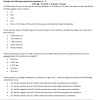 The correct answers for the problems are below. I am not sure
how to work these out so help for these would be great.
1) D
2)B
3)A
4) Delta S is Positive
5) 3*2*463 kj/mol
Consider the following reaction for questions 1-5: 3 Co2 (8)4 H20 ()->GHs(g) + 5 02 (g) If 0.650 moles of CH are formed in a reaction between 1.95 moles of CO2 and 2.95 moles of H2O, identify the limiting reagent in the reaction. а....
The correct answers for the problems are below. I am not sure
how to work these out so help for these would be great.
1) D
2)B
3)A
4) Delta S is Positive
5) 3*2*463 kj/mol
Consider the following reaction for questions 1-5: 3 Co2 (8)4 H20 ()->GHs(g) + 5 02 (g) If 0.650 moles of CH are formed in a reaction between 1.95 moles of CO2 and 2.95 moles of H2O, identify the limiting reagent in the reaction. а....
Consider the following reaction: C 2H 2( g) + 2H 2( g) C 2H 6( g)...
Consider the following reaction: C 2H 2( g) + 2H 2( g) C 2H 6( g) Δ H° rxn = –311 kJ Under which conditions would the product yield be at a maximum? A. high temperature, high pressure B. low temperature, high pressure C. high temperature, low pressure D. low temperature, low pressure \E. none of the above, unless a catalyst is present
Select the FALSE statement from the following options: Select one: a. Internal energy is the sum...
Select the FALSE statement from the following options: Select one: a. Internal energy is the sum of energies for all of the individual particles in a sample. b. Energy cannot be created or destroyed. c. Heat and temperature are two words that essentially mean the same thing. d. The statement, ‘the total energy of the universe (system + surroundings) is constant’, is a logical extension of the law of conservation of energy. e. Endothermic reactions can be spontaneous.\ If a...
use the following table for the reaction C2H2 (g) + 5/2 O2 (g) = 2CO2 (g)...
use the following table for the reaction C2H2 (g) + 5/2 O2 (g) = 2CO2 (g) + H2O (g) delta H = -1255.5 KJ/mol substance S (J. mol-1. K-1) C2H2 (g) 200.8 C2H4 (g) 219.5 CO (g) 197.6 CO2 (g) 213.6 CO2 (aq) 117.6 H2O (l) 69.91 H2O (g) 188.7 O2 (g) 205.0 O (g) 161.0 O3 (g) 238.8 a. Use the data to calculate delta S in J/K for this reaction b. Calculate delta G in KJ , since the...
3. Consider the decomposition reaction: 5A (g) 근 2 B(g) + C(g). You place 3.00 mol of A(g) in a reaction vessel mainta...
 3. Consider the decomposition reaction: 5A (g) 근 2 B(g) + C(g). You place 3.00 mol of A(g) in a reaction vessel maintained at P-2 bar and T-298.15 K. For this reaction, ΔGor-70.0 kJ/mol (a) Derive an exact expression for Kpin terms of the extent of reaction at equilibrium, ξeq (b) Calcaulate the value licatons you make.
3. Consider the decomposition reaction: 5A (g) 근 2 B(g) + C(g). You place 3.00 mol of A(g) in a reaction vessel maintained...
3. Consider the decomposition reaction: 5A (g) 근 2 B(g) + C(g). You place 3.00 mol of A(g) in a reaction vessel maintained at P-2 bar and T-298.15 K. For this reaction, ΔGor-70.0 kJ/mol (a) Derive an exact expression for Kpin terms of the extent of reaction at equilibrium, ξeq (b) Calcaulate the value licatons you make.
3. Consider the decomposition reaction: 5A (g) 근 2 B(g) + C(g). You place 3.00 mol of A(g) in a reaction vessel maintained...
Also Draw Product A and B Consider the reaction of 2-methyl-1,3-cyclohexadiene with HCl Intermediate A Intermediate...
 Also Draw Product A and B
Consider the reaction of 2-methyl-1,3-cyclohexadiene with HCl Intermediate A Intermediate B НCІ (Less stable resonance form) (More stable resonance form) CIT CI Product B Product A Assuming that the reaction takes place at a very low temperature, draw the intermediate and product structures, including any formal charges. Draw intermediate A Draw intermediate B Rings Select Draw More Select Draw Rings More Erase Erase Cl C н C н
Also Draw Product A and B
Consider the reaction of 2-methyl-1,3-cyclohexadiene with HCl Intermediate A Intermediate B НCІ (Less stable resonance form) (More stable resonance form) CIT CI Product B Product A Assuming that the reaction takes place at a very low temperature, draw the intermediate and product structures, including any formal charges. Draw intermediate A Draw intermediate B Rings Select Draw More Select Draw Rings More Erase Erase Cl C н C н
8) HY 8) Consider a reaction that has a negative AH and a positive AS. Which...
 8) HY 8) Consider a reaction that has a negative AH and a positive AS. Which of the following statements is true? A) This reaction will be spontaneous only at high temperatures. B) This reaction will be spontaneous at all temperatures C) This reaction will be nonspontaneous at all temperatures. D) This reaction will be nonspontaneous only at high temperatures. E) It is not possible to determine without more information 9) What is the volume of 5.60 g of O2...
2. Consider the reaction energy diagram below, assuming that both the reactions are reversible. List ALL...
 2. Consider the reaction energy diagram below, assuming that both the reactions are reversible. List ALL the statements that are TRUE. Use the process of elimination to help you here. TS2 TS1 EA2 EA1 Energy a) Product Pl is formed faster b) Product P2 is formed faster c) Product thermodynamically stable d) Product thermodynamically stable e) Performing the reaction at low carefully controlled temperature will favor the formation of product P. SM P1 P1 is more is P2 P2 more...
 Already posted this question but it was
wrong the other times ;(
Consider the following gas phase reaction. D B—A=A—B + 2 D-D D CA + ť be B-B Consider the following bond energies. ASA: 600. kJ/mol ASA: 350. kJ/mol A-B: 150. kJ/mol A-D: 540. kJ/mol B-B: 380. kJ/mol D-D: 230. kJ/mol (a) What is the enthalpy of reaction? (Enter your answer to the nearest integer.) 49) kJ/mol (b) The entropy of reaction is ---Select--- 9. (c) The reaction is...
Already posted this question but it was
wrong the other times ;(
Consider the following gas phase reaction. D B—A=A—B + 2 D-D D CA + ť be B-B Consider the following bond energies. ASA: 600. kJ/mol ASA: 350. kJ/mol A-B: 150. kJ/mol A-D: 540. kJ/mol B-B: 380. kJ/mol D-D: 230. kJ/mol (a) What is the enthalpy of reaction? (Enter your answer to the nearest integer.) 49) kJ/mol (b) The entropy of reaction is ---Select--- 9. (c) The reaction is...
 Predict whether AS will be positive or negative for reactions (a) and (b): a. 2 HgO(s) → 2Hg(1) + O2(g) AS b. 2 CH (B) + 70(8) ► 4 CO2(g) + 6 H2O(1) AS Choose one of the above reactions a OR b. Calculate the AH® for your chosen reaction using information from the table below. AH = Using your answers above, predict under what temperature (temp) conditions (high temp or low temp) where this reaction will be spontaneous, or...
 The correct answers for the problems are below. I am not sure
how to work these out so help for these would be great.
1) D
2)B
3)A
4) Delta S is Positive
5) 3*2*463 kj/mol
Consider the following reaction for questions 1-5: 3 Co2 (8)4 H20 ()->GHs(g) + 5 02 (g) If 0.650 moles of CH are formed in a reaction between 1.95 moles of CO2 and 2.95 moles of H2O, identify the limiting reagent in the reaction. а....
The correct answers for the problems are below. I am not sure
how to work these out so help for these would be great.
1) D
2)B
3)A
4) Delta S is Positive
5) 3*2*463 kj/mol
Consider the following reaction for questions 1-5: 3 Co2 (8)4 H20 ()->GHs(g) + 5 02 (g) If 0.650 moles of CH are formed in a reaction between 1.95 moles of CO2 and 2.95 moles of H2O, identify the limiting reagent in the reaction. а....
 3. Consider the decomposition reaction: 5A (g) 근 2 B(g) + C(g). You place 3.00 mol of A(g) in a reaction vessel maintained at P-2 bar and T-298.15 K. For this reaction, ΔGor-70.0 kJ/mol (a) Derive an exact expression for Kpin terms of the extent of reaction at equilibrium, ξeq (b) Calcaulate the value licatons you make.
3. Consider the decomposition reaction: 5A (g) 근 2 B(g) + C(g). You place 3.00 mol of A(g) in a reaction vessel maintained...
3. Consider the decomposition reaction: 5A (g) 근 2 B(g) + C(g). You place 3.00 mol of A(g) in a reaction vessel maintained at P-2 bar and T-298.15 K. For this reaction, ΔGor-70.0 kJ/mol (a) Derive an exact expression for Kpin terms of the extent of reaction at equilibrium, ξeq (b) Calcaulate the value licatons you make.
3. Consider the decomposition reaction: 5A (g) 근 2 B(g) + C(g). You place 3.00 mol of A(g) in a reaction vessel maintained...
 Also Draw Product A and B
Consider the reaction of 2-methyl-1,3-cyclohexadiene with HCl Intermediate A Intermediate B НCІ (Less stable resonance form) (More stable resonance form) CIT CI Product B Product A Assuming that the reaction takes place at a very low temperature, draw the intermediate and product structures, including any formal charges. Draw intermediate A Draw intermediate B Rings Select Draw More Select Draw Rings More Erase Erase Cl C н C н
Also Draw Product A and B
Consider the reaction of 2-methyl-1,3-cyclohexadiene with HCl Intermediate A Intermediate B НCІ (Less stable resonance form) (More stable resonance form) CIT CI Product B Product A Assuming that the reaction takes place at a very low temperature, draw the intermediate and product structures, including any formal charges. Draw intermediate A Draw intermediate B Rings Select Draw More Select Draw Rings More Erase Erase Cl C н C н
 8) HY 8) Consider a reaction that has a negative AH and a positive AS. Which of the following statements is true? A) This reaction will be spontaneous only at high temperatures. B) This reaction will be spontaneous at all temperatures C) This reaction will be nonspontaneous at all temperatures. D) This reaction will be nonspontaneous only at high temperatures. E) It is not possible to determine without more information 9) What is the volume of 5.60 g of O2...
 2. Consider the reaction energy diagram below, assuming that both the reactions are reversible. List ALL the statements that are TRUE. Use the process of elimination to help you here. TS2 TS1 EA2 EA1 Energy a) Product Pl is formed faster b) Product P2 is formed faster c) Product thermodynamically stable d) Product thermodynamically stable e) Performing the reaction at low carefully controlled temperature will favor the formation of product P. SM P1 P1 is more is P2 P2 more...
Most questions answered within 3 hours.
-
Where is the error in this code sequence?
String s1 = "Hello";
String s2 = "ello";...
asked 10 months ago -
Financial data for Joel de Paris, Inc., for last year
follow:
Joel de Paris, Inc.
Balance...
asked 10 months ago -
Consider this reaction:
Al2(SO4)3 (aq)+ BaCl3
(aq) Al2Cl6 (aq)- +
3BaSO4(s) . What is the...
asked 10 months ago -
Suppose that Savneet is considering increasing her
recent random sample from 20 car rentals to 40...
asked 10 months ago -
Trucks arrive at an unloading terminal at an average rate of 120
per hour.
Trucks arrive...
asked 10 months ago -
Why are methanol and ethanol completely soluble in water while
octanol is not very little soluble....
asked 10 months ago -
A facilities manager at a university reads in a research report
that the mean amount of...
asked 10 months ago -
When the CuSO4 is rehydrated by adding water to the anhydrous
compound, is this an endothermic...
asked 10 months ago -
A ray of sunlight is passing from diamond into crown glass; the
angle of incidence is...
asked 10 months ago -
A block of mass 0.249 kg is placed on top of a light, vertical
spring of...
asked 10 months ago -
how do the kidneys compensate in the presences of acidosis
a) trigger hyperventilate
b) reserve acid...
asked 10 months ago -
Question 501 pts
The rental rate of capital to the firm increases. Which of the
following...
asked 10 months ago