

Homework Answers
Add Answer to:
D 1. The mechanistic steps that are commonly seen in polar acidic reactions are: (check all...
the mechanistic steps that are commonly seen in polar acidic reactions are: (Check all that apply)...
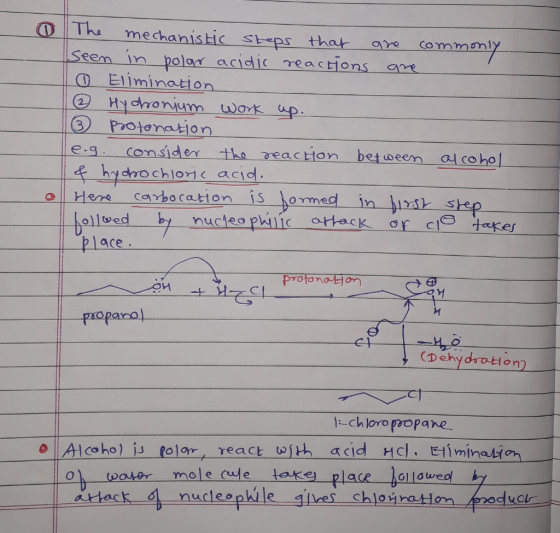
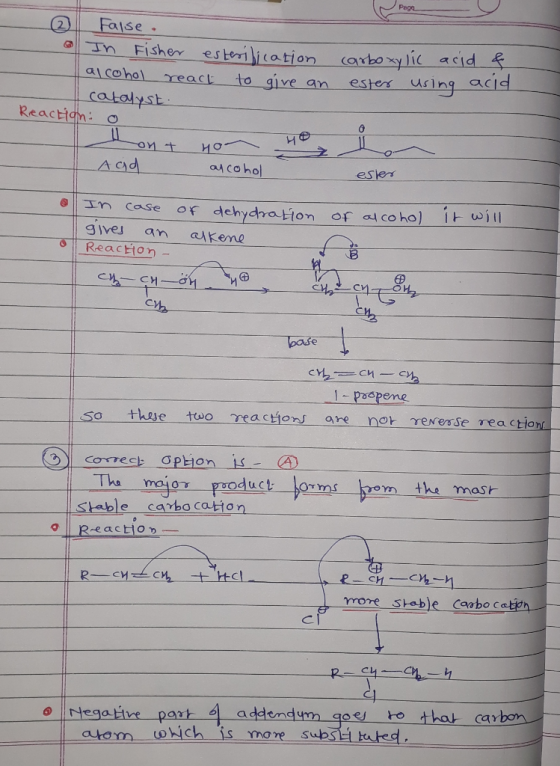
the mechanistic steps that are commonly seen in polar acidic reactions are: (Check all that apply) 1. Hydronium workup 2. Deprotonation 3. Protonation 4. Formation of an anionic tetrahedral intermediate 5. Elimination 6. Intramolecular Proton transfer 7. Nucleophilic Addition
For letters h & i : For each of the following reactions, predict the major mechanistic pathway (SN1/SN2/E1/E2...
 For
letters h & i :
For each of the following reactions, predict the major
mechanistic pathway (SN1/SN2/E1/E2) and the major organic
products
1. (cont.) (h) НСОН CHB -CHBr HCOH - (0) CH,CH,CH,CH,Br- NH 2. For each of the following indicate which reaction will occur faster. Explain your reasoning. (No credit will be given for guesses) (a) The reaction of (CH),CBr with 0.001M aqueous NaOH or 0.10M aqueous NaOH (b) The reaction of 2-bromobutane with NaOH in DMSO or NaSH...
For
letters h & i :
For each of the following reactions, predict the major
mechanistic pathway (SN1/SN2/E1/E2) and the major organic
products
1. (cont.) (h) НСОН CHB -CHBr HCOH - (0) CH,CH,CH,CH,Br- NH 2. For each of the following indicate which reaction will occur faster. Explain your reasoning. (No credit will be given for guesses) (a) The reaction of (CH),CBr with 0.001M aqueous NaOH or 0.10M aqueous NaOH (b) The reaction of 2-bromobutane with NaOH in DMSO or NaSH...
please answer all parts, thanks! 1. More substituted alkenes are more stable than less substituted alkenes....
 please answer all parts, thanks!
1. More substituted alkenes are more stable than less substituted alkenes. Show the orbital overlap that helps to explain this observation. 2. Why is the heat of hydrogenation for an alkene exothermic? Analyze the bonds that are changing. AH = -30 kcal/mol Explain: + H2 3. Treating alkene "A" below with HBr can lead to a number of products. "A" SM + H-Br A bunch of products. For real, hella products. 3.A. Label the stereocenters...
please answer all parts, thanks!
1. More substituted alkenes are more stable than less substituted alkenes. Show the orbital overlap that helps to explain this observation. 2. Why is the heat of hydrogenation for an alkene exothermic? Analyze the bonds that are changing. AH = -30 kcal/mol Explain: + H2 3. Treating alkene "A" below with HBr can lead to a number of products. "A" SM + H-Br A bunch of products. For real, hella products. 3.A. Label the stereocenters...
Challenge CH 235R F 2019 Week 11 Problem #2 1. Predicting Major and Minor elimination products...
 Challenge CH 235R F 2019 Week 11 Problem #2 1. Predicting Major and Minor elimination products For each of the following alkenes, draw all possible elimination products for the following molecules, ignoring the mechanism. Indicate the major alkene product. noted II. E2 Eliminations on substituted cyclohexane halides Consider the two isomeric compounds below. a) Draw each in a chair conformation, b) Show the mechanism and final alkene product(s) that form from an E2 reaction with CH,O/CH,OH. c) If more than...
СО cat. H + NH2CH3 + H2CO2C CO2CH3 CO CHE Cocaine has been prepared by a...
 СО cat. H + NH2CH3 + H2CO2C CO2CH3 CO CHE Cocaine has been prepared by a sequence beginning with a Mannich reaction between dimethyl acetonedicarboxylate, methylamine, and butanedial. The mechanism involves the following steps: 1. Following initial protonation of the carbonyl oxygen, nucleophilic attack by the amine forms carbinolamine 1; 2. Proton transfer and elimination of water forms iminium ion 2; he enol form of the dicarboxylate ester attacks the iminium ion to form adduct 3; 4. Adduct 3 tautomerizes...
need help with 1-21 1) Label the steps below as "slow" and "fast". HCH 013 10...
 need help with 1-21
1) Label the steps below as "slow" and "fast". HCH 013 10 = H. C + + H-LG H-LG 2) Why are they slow/fast? Explain using chemical terms. Stereochemistry of the Sn1 reaction 3) What type of intermediate does the Sn1 reaction proceed through? 4) What is the geometry of the carbon that the nucleophile coordinates to in the 2 step? 5) From how many directions would it be reasonable for the nucleophile to approach the...
need help with 1-21
1) Label the steps below as "slow" and "fast". HCH 013 10 = H. C + + H-LG H-LG 2) Why are they slow/fast? Explain using chemical terms. Stereochemistry of the Sn1 reaction 3) What type of intermediate does the Sn1 reaction proceed through? 4) What is the geometry of the carbon that the nucleophile coordinates to in the 2 step? 5) From how many directions would it be reasonable for the nucleophile to approach the...
Please, make the answer clear and reable. BrEtOH a OEt Hace H2C Alkyl halides undergo nucleophilic...
 Please, make the answer clear
and reable.
BrEtOH a OEt Hace H2C Alkyl halides undergo nucleophilic substitution and elimination reactions. When the kinetics of the reaction are measured, if the rate of the reaction is found to be dependent only upon the concentration of the alkyl halide the reaction is first order. The substitution reaction is thus termed ction is termed E1. These reactions are unimolecular and occur in two steps. The first step is rate-limiting and involves the loss...
Please, make the answer clear
and reable.
BrEtOH a OEt Hace H2C Alkyl halides undergo nucleophilic substitution and elimination reactions. When the kinetics of the reaction are measured, if the rate of the reaction is found to be dependent only upon the concentration of the alkyl halide the reaction is first order. The substitution reaction is thus termed ction is termed E1. These reactions are unimolecular and occur in two steps. The first step is rate-limiting and involves the loss...
Chapter 11: 1. What is a prime rule in naming alkenes? a. Find the longest carbon...
Chapter 11: 1. What is a prime rule in naming alkenes? a. Find the longest carbon chain. b.Find the longest carbon chain containing the alkene. c. Find whether the alkene has a cis- or trans- configuration. d.Find how far the alkene functionality is from either end. 2. What is the IUPAC name of the following alkene? a. cis-5-methyl-2-heptene b. trans-2-ethyl-4-hexene c. trans-5-methyl-2-heptene d. trans-3-methyl-5-heptene 3. What is the hybridization, geometry, and bond angle of the carbon marked by an asterisk?...
1. [10 pts] Consider the elimination reaction for the following alkyl halide with sodium methoxide in...
 1. [10 pts] Consider the elimination reaction for the following alkyl halide with sodium methoxide in methanol (Na* OCH, CH,OH). CH NaOme MeOH CH Compound A Problem 2c Draw the major expected organic product (a) Redraw Compound A as seen in Viewpoint I below left as a Newman projection on the template provided in Problem 2a (below). Hint: Fill in missing Hs ar C2 and C3 to help you get started! (b) Rotate the C2 C3 bond to obtain the...
1-24 need help really lost Proton Transfer: deprotonation D. 1) Add the appropriate curved arrows for...
 1-24 need help really lost
Proton Transfer: deprotonation D. 1) Add the appropriate curved arrows for the following deprotonation step. Also add the other product notice how the Tema s can be converted to this by use of a strong base such as sodium a sodium ion (Na) is not drawn, in this case it is just a spectatorio PCW27 - Mechanistic steps - Part Name: Time spent 2) Label the above compounds with the appropriate name from the previous...
1-24 need help really lost
Proton Transfer: deprotonation D. 1) Add the appropriate curved arrows for the following deprotonation step. Also add the other product notice how the Tema s can be converted to this by use of a strong base such as sodium a sodium ion (Na) is not drawn, in this case it is just a spectatorio PCW27 - Mechanistic steps - Part Name: Time spent 2) Label the above compounds with the appropriate name from the previous...
 For
letters h & i :
For each of the following reactions, predict the major
mechanistic pathway (SN1/SN2/E1/E2) and the major organic
products
1. (cont.) (h) НСОН CHB -CHBr HCOH - (0) CH,CH,CH,CH,Br- NH 2. For each of the following indicate which reaction will occur faster. Explain your reasoning. (No credit will be given for guesses) (a) The reaction of (CH),CBr with 0.001M aqueous NaOH or 0.10M aqueous NaOH (b) The reaction of 2-bromobutane with NaOH in DMSO or NaSH...
For
letters h & i :
For each of the following reactions, predict the major
mechanistic pathway (SN1/SN2/E1/E2) and the major organic
products
1. (cont.) (h) НСОН CHB -CHBr HCOH - (0) CH,CH,CH,CH,Br- NH 2. For each of the following indicate which reaction will occur faster. Explain your reasoning. (No credit will be given for guesses) (a) The reaction of (CH),CBr with 0.001M aqueous NaOH or 0.10M aqueous NaOH (b) The reaction of 2-bromobutane with NaOH in DMSO or NaSH...
 please answer all parts, thanks!
1. More substituted alkenes are more stable than less substituted alkenes. Show the orbital overlap that helps to explain this observation. 2. Why is the heat of hydrogenation for an alkene exothermic? Analyze the bonds that are changing. AH = -30 kcal/mol Explain: + H2 3. Treating alkene "A" below with HBr can lead to a number of products. "A" SM + H-Br A bunch of products. For real, hella products. 3.A. Label the stereocenters...
please answer all parts, thanks!
1. More substituted alkenes are more stable than less substituted alkenes. Show the orbital overlap that helps to explain this observation. 2. Why is the heat of hydrogenation for an alkene exothermic? Analyze the bonds that are changing. AH = -30 kcal/mol Explain: + H2 3. Treating alkene "A" below with HBr can lead to a number of products. "A" SM + H-Br A bunch of products. For real, hella products. 3.A. Label the stereocenters...
 Challenge CH 235R F 2019 Week 11 Problem #2 1. Predicting Major and Minor elimination products For each of the following alkenes, draw all possible elimination products for the following molecules, ignoring the mechanism. Indicate the major alkene product. noted II. E2 Eliminations on substituted cyclohexane halides Consider the two isomeric compounds below. a) Draw each in a chair conformation, b) Show the mechanism and final alkene product(s) that form from an E2 reaction with CH,O/CH,OH. c) If more than...
 СО cat. H + NH2CH3 + H2CO2C CO2CH3 CO CHE Cocaine has been prepared by a sequence beginning with a Mannich reaction between dimethyl acetonedicarboxylate, methylamine, and butanedial. The mechanism involves the following steps: 1. Following initial protonation of the carbonyl oxygen, nucleophilic attack by the amine forms carbinolamine 1; 2. Proton transfer and elimination of water forms iminium ion 2; he enol form of the dicarboxylate ester attacks the iminium ion to form adduct 3; 4. Adduct 3 tautomerizes...
 need help with 1-21
1) Label the steps below as "slow" and "fast". HCH 013 10 = H. C + + H-LG H-LG 2) Why are they slow/fast? Explain using chemical terms. Stereochemistry of the Sn1 reaction 3) What type of intermediate does the Sn1 reaction proceed through? 4) What is the geometry of the carbon that the nucleophile coordinates to in the 2 step? 5) From how many directions would it be reasonable for the nucleophile to approach the...
need help with 1-21
1) Label the steps below as "slow" and "fast". HCH 013 10 = H. C + + H-LG H-LG 2) Why are they slow/fast? Explain using chemical terms. Stereochemistry of the Sn1 reaction 3) What type of intermediate does the Sn1 reaction proceed through? 4) What is the geometry of the carbon that the nucleophile coordinates to in the 2 step? 5) From how many directions would it be reasonable for the nucleophile to approach the...
 Please, make the answer clear
and reable.
BrEtOH a OEt Hace H2C Alkyl halides undergo nucleophilic substitution and elimination reactions. When the kinetics of the reaction are measured, if the rate of the reaction is found to be dependent only upon the concentration of the alkyl halide the reaction is first order. The substitution reaction is thus termed ction is termed E1. These reactions are unimolecular and occur in two steps. The first step is rate-limiting and involves the loss...
Please, make the answer clear
and reable.
BrEtOH a OEt Hace H2C Alkyl halides undergo nucleophilic substitution and elimination reactions. When the kinetics of the reaction are measured, if the rate of the reaction is found to be dependent only upon the concentration of the alkyl halide the reaction is first order. The substitution reaction is thus termed ction is termed E1. These reactions are unimolecular and occur in two steps. The first step is rate-limiting and involves the loss...
 1. [10 pts] Consider the elimination reaction for the following alkyl halide with sodium methoxide in methanol (Na* OCH, CH,OH). CH NaOme MeOH CH Compound A Problem 2c Draw the major expected organic product (a) Redraw Compound A as seen in Viewpoint I below left as a Newman projection on the template provided in Problem 2a (below). Hint: Fill in missing Hs ar C2 and C3 to help you get started! (b) Rotate the C2 C3 bond to obtain the...
 1-24 need help really lost
Proton Transfer: deprotonation D. 1) Add the appropriate curved arrows for the following deprotonation step. Also add the other product notice how the Tema s can be converted to this by use of a strong base such as sodium a sodium ion (Na) is not drawn, in this case it is just a spectatorio PCW27 - Mechanistic steps - Part Name: Time spent 2) Label the above compounds with the appropriate name from the previous...
1-24 need help really lost
Proton Transfer: deprotonation D. 1) Add the appropriate curved arrows for the following deprotonation step. Also add the other product notice how the Tema s can be converted to this by use of a strong base such as sodium a sodium ion (Na) is not drawn, in this case it is just a spectatorio PCW27 - Mechanistic steps - Part Name: Time spent 2) Label the above compounds with the appropriate name from the previous...
Most questions answered within 3 hours.
-
Where is the error in this code sequence?
String s1 = "Hello";
String s2 = "ello";...
asked 10 months ago -
Financial data for Joel de Paris, Inc., for last year
follow:
Joel de Paris, Inc.
Balance...
asked 10 months ago -
Consider this reaction:
Al2(SO4)3 (aq)+ BaCl3
(aq) Al2Cl6 (aq)- +
3BaSO4(s) . What is the...
asked 10 months ago -
Suppose that Savneet is considering increasing her
recent random sample from 20 car rentals to 40...
asked 10 months ago -
Trucks arrive at an unloading terminal at an average rate of 120
per hour.
Trucks arrive...
asked 10 months ago -
Why are methanol and ethanol completely soluble in water while
octanol is not very little soluble....
asked 10 months ago -
A facilities manager at a university reads in a research report
that the mean amount of...
asked 10 months ago -
When the CuSO4 is rehydrated by adding water to the anhydrous
compound, is this an endothermic...
asked 10 months ago -
A ray of sunlight is passing from diamond into crown glass; the
angle of incidence is...
asked 10 months ago -
A block of mass 0.249 kg is placed on top of a light, vertical
spring of...
asked 10 months ago -
how do the kidneys compensate in the presences of acidosis
a) trigger hyperventilate
b) reserve acid...
asked 10 months ago -
Question 501 pts
The rental rate of capital to the firm increases. Which of the
following...
asked 10 months ago