Problem 1 A block of mass m is sliding on a frictionless, horizontal surface, with a...
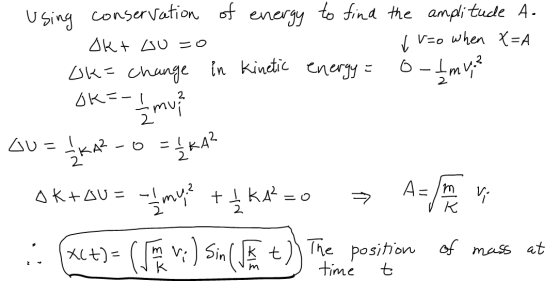
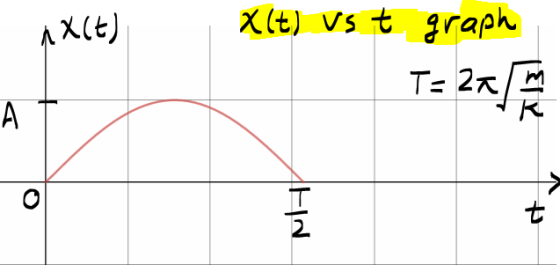
Problem 1 A block of mass m is sliding on a frictionless, horizontal surface, with a velocity vi . It hits an ideal spring, of spring constant k, which is attached to the wall. The spring compresses until the block momentarily stops, and then starts expanding again, so the block ultimately bounces off (see Example 5.6.2). (a) Write down an equation of motion (a function x(t)) for the block, which is valid for as long as it is in contact with the spring. For simplicity, assume the block is initially moving to the right, take the time when it first makes contact with the spring to be t = 0, and let the position of the block at that time to be x = 0. Make sure that you express any constants in your equation (such as A or ω) in terms of the given data, namely, m, vi , and k. (b) Sketch the function x(t) for the relevant time interval.
Homework Answers
![Let X(t)= A Sin (wt+d) be the position of of the block. A= amplitude, w= angular frequency X(0)= 0 [The position at tro] : 0=](http://img.homeworklib.com/questions/d33a69d0-7037-11ea-9068-6d71b7ad877c.png?x-oss-process=image/resize,w_560)
Add Answer to:
Problem 1 A block of mass m is sliding on a frictionless,
horizontal surface, with a...
Problem 1 A block of mass m is sliding on a frictionless, horizontal surface, with a...
Problem 1 A block of mass m is sliding on a frictionless, horizontal surface, with a velocity vi . It hits an ideal spring, of spring constant k, which is attached to the wall. The spring compresses until the block momentarily stops, and then starts expanding again, so the block ultimately bounces off (see Example 5.6.2). (a) Write down an equation of motion (a function x(t)) for the block, which is valid for as long as it is in contact...
2. Starting from rest, a block of mass m slides down a frictionless incline at angle...
2. Starting from rest, a block of mass m slides down a frictionless incline at angle θ(0◦ < θ < 90◦) where it runs into a spring of spring constant k. When the block momentarily stops, it has compressed the spring by distance x. Find expressions for (a) the distance the block slides down the incline from when it is released to when it momentarily stops (b) the distance between the point of the first block-spring contact and the point...
A 0.505-kg block slides on a frictionless horizontal surface with a speed of 1.18 m>s. The...
A 0.505-kg block slides on a frictionless horizontal surface with a speed of 1.18 m>s. The block encounters an unstretched spring and compresses it 23.2 cm before coming to rest. (b) For what length of time is the block in contact with the spring before it comes to rest? (c) If the force constant of the spring is increased, does the time required to stop the block increase, decrease, or stay the same? Explain.
PROBLEM THREE (25 1 A 3.0 kg block sliding on a horizontal frictionless surface is attached...
 PROBLEM THREE (25 1 A 3.0 kg block sliding on a horizontal frictionless surface is attached to one end of a horizontal spring (k 250 N/m) which has the other end fixed. If the block has a speed of 5.0 m/s as it passes through equilibrium, what is its speed when it is 15 cm from the equilibrium postion?
A block of mass 2.0 kg sliding on a horizontal frictionless surface is attached to one...
 A block of mass 2.0 kg sliding on a horizontal frictionless surface is attached to one end of a horizontal spring (k = 800 N/m) which has its other end fixed. If the speed of the block as it passes through the equilibrium position is 4.0 m/s, what is its speed when it is a distance of 10 cm from the equilibrium position? a) 3.2 m/s b) 3.5 m/s c) 2.9 m/s d) 2.4 m/s
1. A block of mass 6.00kg is connected to a spring on a horizontal frictionless surface....
1. A block of mass 6.00kg is connected to a spring on a horizontal frictionless surface. The spring constant is 280N/m. The block-spring system undergoes simple harmonic motion. At a time t=0s, the position of the block x= +A and its velocity vx= 0. At t=2.50s the position x = -12.0 cm No credit awarded without correct units! a. Determine the angular frequency and period of the motion b. Determine the amplitude c. Determine the phase angle d. Write the...
A 1.05 kg block slides on a frictionless, horizontal surface with an speed of 1.45 m/sec....
A 1.05 kg block slides on a frictionless, horizontal surface with an speed of 1.45 m/sec. The block encounters an unstretched spring with a spring constant of 285 N/m. 1)What is the initial kinetic energy of the block before it hits the spring? KE0 = 2)What is the potential energy of the mass and spring system when the spring is at its point of maximum compression? Umax = 3)How far is the spring compress before the block comes to rest?...
A mass of 1 kg and initial speed 10 m/s slides across a horizontal frictionless surface...
A mass of 1 kg and initial speed 10 m/s slides across a horizontal frictionless surface and hits a spring of force constant 200 N/m. How much will the spring be compressed from its relaxed length when the block will be at rest momentarily?
A 1.0-kg block (Block 1) at rest on a horizontal frictionless surface is connected to unstretched...
 A 1.0-kg block (Block 1) at rest on a horizontal frictionless surface is connected to unstretched spring Ck 400 N/m) whose other end is fixed. A 2.0-kg block (Block 2) moving at 4.0 m/s collides with Block 1. Block 2 is found to move leftward with a speed of 1 m/s after collision. (1) What is the speed of Block 1 after collision? (6 pts) (2) What maximum compression of the spring occurs when Block I momentarily stops? (6 pts)...
3./ A 1.2 kg block sliding at 6.0 m/s on a frictionless surface runs into and...
 3./ A 1.2 kg block sliding at 6.0 m/s on a frictionless surface runs into and sticks to a spring. The spring is compressed 0.10 m before stopping the block and starting its motion back in the opposite direction. a. Calculate the energy of vibration. b. Calculate the force constant of the spring. c. Calculate the period of vibration of the system. d. Write the equation of motion of the block when its oscillating.
 PROBLEM THREE (25 1 A 3.0 kg block sliding on a horizontal frictionless surface is attached to one end of a horizontal spring (k 250 N/m) which has the other end fixed. If the block has a speed of 5.0 m/s as it passes through equilibrium, what is its speed when it is 15 cm from the equilibrium postion?
 A block of mass 2.0 kg sliding on a horizontal frictionless surface is attached to one end of a horizontal spring (k = 800 N/m) which has its other end fixed. If the speed of the block as it passes through the equilibrium position is 4.0 m/s, what is its speed when it is a distance of 10 cm from the equilibrium position? a) 3.2 m/s b) 3.5 m/s c) 2.9 m/s d) 2.4 m/s
 A 1.0-kg block (Block 1) at rest on a horizontal frictionless surface is connected to unstretched spring Ck 400 N/m) whose other end is fixed. A 2.0-kg block (Block 2) moving at 4.0 m/s collides with Block 1. Block 2 is found to move leftward with a speed of 1 m/s after collision. (1) What is the speed of Block 1 after collision? (6 pts) (2) What maximum compression of the spring occurs when Block I momentarily stops? (6 pts)...
 3./ A 1.2 kg block sliding at 6.0 m/s on a frictionless surface runs into and sticks to a spring. The spring is compressed 0.10 m before stopping the block and starting its motion back in the opposite direction. a. Calculate the energy of vibration. b. Calculate the force constant of the spring. c. Calculate the period of vibration of the system. d. Write the equation of motion of the block when its oscillating.
Most questions answered within 3 hours.
-
Where is the error in this code sequence?
String s1 = "Hello";
String s2 = "ello";...
asked 11 months ago -
Financial data for Joel de Paris, Inc., for last year
follow:
Joel de Paris, Inc.
Balance...
asked 11 months ago -
Consider this reaction:
Al2(SO4)3 (aq)+ BaCl3
(aq) Al2Cl6 (aq)- +
3BaSO4(s) . What is the...
asked 11 months ago -
Suppose that Savneet is considering increasing her
recent random sample from 20 car rentals to 40...
asked 11 months ago -
Trucks arrive at an unloading terminal at an average rate of 120
per hour.
Trucks arrive...
asked 11 months ago -
Why are methanol and ethanol completely soluble in water while
octanol is not very little soluble....
asked 11 months ago -
A facilities manager at a university reads in a research report
that the mean amount of...
asked 11 months ago -
When the CuSO4 is rehydrated by adding water to the anhydrous
compound, is this an endothermic...
asked 11 months ago -
A ray of sunlight is passing from diamond into crown glass; the
angle of incidence is...
asked 11 months ago -
A block of mass 0.249 kg is placed on top of a light, vertical
spring of...
asked 11 months ago -
how do the kidneys compensate in the presences of acidosis
a) trigger hyperventilate
b) reserve acid...
asked 11 months ago -
Question 501 pts
The rental rate of capital to the firm increases. Which of the
following...
asked 11 months ago