
Homework Answers
Add Answer to:
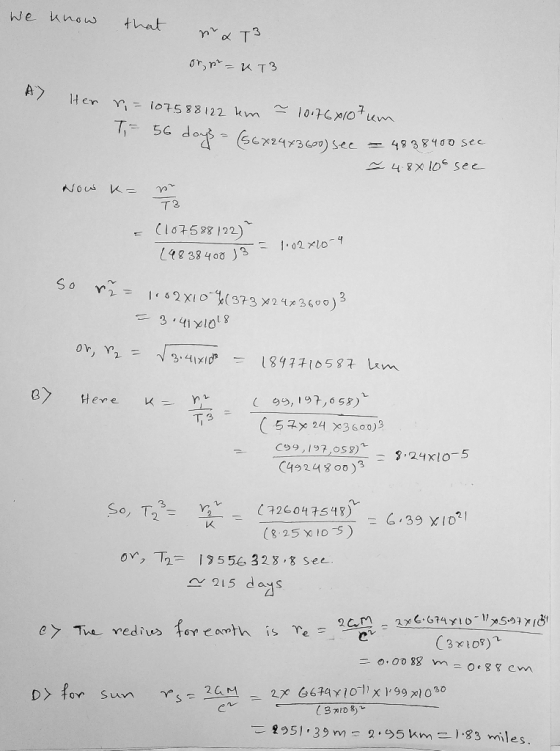
In a newly discovered exoplanetary system one planet orbits its star in 56 days with an...
A newly discovered planet orbits a distant star with the same mass as the Sun at...
A newly discovered planet orbits a distant star with the same mass as the Sun at an average distance of 109 million kilometers. Its orbital eccentricity is 0.5. Find the planet's orbital period. Find the planet's nearest orbital distance from its star. Find the planet's farthest orbital distance from its star.
A comet orbits the Sun in 4,063 years. What is its average orbital distance from the...
 A comet orbits the Sun in 4,063 years. What is its average orbital distance from the Sun? Express your answer in AU (enter "AU" for units) and round it to the nearest integer А. An asteroid orbits the Sun at an average orbital distance of 3.12 AU. What is its average orbital period? Express your answer in years (enter "years" for units) and round it to two decimals. В. A moon orbits a planet in 1.5 days. What is the...
points A newly discovered planet is in a circular orbit around a distant star with an...
 points A newly discovered planet is in a circular orbit around a distant star with an orbital period of 400 Earth days. The planet also rotates on its axis, making one full rotation every 4.00 Earth days. The radius of the planet is rp = 7.00 × 10⁶ m and the radius of the planet's orbit about the star is r 7.00×10¹¹ m. My Notes Ask Your Tea Determine the ratio of the radial acceleration, due to the rotation of...
Schwarzschild radius (sometimes referred to as the gravitational radius) is the distance from the center of...
 Schwarzschild radius (sometimes referred to as the gravitational radius) is the distance from the center of an object such that, if all the mass of the object were compressed within a sphere of such radius, the escape speed from the surface would equal the speed of light. It, thus, defines a spherical boundary called the event horizon, commonly associated with black holes, beyond which the events cannot affect an outside observer. Theoretically, any amount of matter will become a black...
Schwarzschild radius (sometimes referred to as the gravitational radius) is the distance from the center of...
 Schwarzschild radius (sometimes referred to as the gravitational radius) is the distance from the center of an object such that, if all the mass of the object were compressed within a sphere of such radius, the escape speed from the surface would equal the speed of light. It, thus, defines a spherical boundary called the event horizon, commonly associated with black holes, beyond which the events cannot affect an outside observer. Theoretically, any amount of matter will become a black...
Two newly discovered planets follow circular orbits around a star in a distant part of the...
Two newly discovered planets follow circular orbits around a star in a distant part of the galaxy. The orbital speeds of the planets are determined to be 45.2 km/s and 55.1 km/s. The slower planet's orbital period is 6.27 years. (a) What is the mass of the star? (b) What is the orbital period of the faster planet, in years?
Two newly discovered planets follow circular orbits around a star in a distant part of the...
Two newly discovered planets follow circular orbits around a star in a distant part of the galaxy. The orbital speeds of the planets are determined to be 42.6 km/s and 64.2 km/s. The slower planet's orbital period is 6.93 years. (a) What is the mass of the star? (b) What is the orbital period of the faster planet, in years?
Two newly discovered planets follow circular orbits around a star in a distant part of the...
Two newly discovered planets follow circular orbits around a star in a distant part of the galaxy. The orbital speeds of the planets are determined to be 35.0 km/s and 51.0 km/s. The slower planet's orbital period is 7.80 years. (a) What is the mass of the star? (b) What is the orbital period of the faster planet, in years?
Two newly discovered planets follow circular orbits around a star in a distant part of the...
Two newly discovered planets follow circular orbits around a star in a distant part of the galaxy. The orbital speeds of the planets are determined to be 44.7 km/s and 55.5 km/s. The slower planet's orbital period is 6.33 years. (a) What is the mass of the star? (b) What is the orbital period of the faster planet, in years?
Two newly discovered planets follow circular orbits around a star in a distant part of the...
Two newly discovered planets follow circular orbits around a star in a distant part of the galaxy. The orbital speeds of the planets are determined to be 43.4 km/s and 57.2 km/s. The slower planet's orbital period is 7.50 years. (a) What is the mass of the star? ______ kg (b) What is the orbital period of the faster planet, in years? _______yr
 A comet orbits the Sun in 4,063 years. What is its average orbital distance from the Sun? Express your answer in AU (enter "AU" for units) and round it to the nearest integer А. An asteroid orbits the Sun at an average orbital distance of 3.12 AU. What is its average orbital period? Express your answer in years (enter "years" for units) and round it to two decimals. В. A moon orbits a planet in 1.5 days. What is the...
 points A newly discovered planet is in a circular orbit around a distant star with an orbital period of 400 Earth days. The planet also rotates on its axis, making one full rotation every 4.00 Earth days. The radius of the planet is rp = 7.00 × 10⁶ m and the radius of the planet's orbit about the star is r 7.00×10¹¹ m. My Notes Ask Your Tea Determine the ratio of the radial acceleration, due to the rotation of...
 Schwarzschild radius (sometimes referred to as the gravitational radius) is the distance from the center of an object such that, if all the mass of the object were compressed within a sphere of such radius, the escape speed from the surface would equal the speed of light. It, thus, defines a spherical boundary called the event horizon, commonly associated with black holes, beyond which the events cannot affect an outside observer. Theoretically, any amount of matter will become a black...
 Schwarzschild radius (sometimes referred to as the gravitational radius) is the distance from the center of an object such that, if all the mass of the object were compressed within a sphere of such radius, the escape speed from the surface would equal the speed of light. It, thus, defines a spherical boundary called the event horizon, commonly associated with black holes, beyond which the events cannot affect an outside observer. Theoretically, any amount of matter will become a black...
Most questions answered within 3 hours.
-
Where is the error in this code sequence?
String s1 = "Hello";
String s2 = "ello";...
asked 11 months ago -
Financial data for Joel de Paris, Inc., for last year
follow:
Joel de Paris, Inc.
Balance...
asked 11 months ago -
Consider this reaction:
Al2(SO4)3 (aq)+ BaCl3
(aq) Al2Cl6 (aq)- +
3BaSO4(s) . What is the...
asked 11 months ago -
Suppose that Savneet is considering increasing her
recent random sample from 20 car rentals to 40...
asked 11 months ago -
Trucks arrive at an unloading terminal at an average rate of 120
per hour.
Trucks arrive...
asked 11 months ago -
Why are methanol and ethanol completely soluble in water while
octanol is not very little soluble....
asked 11 months ago -
A facilities manager at a university reads in a research report
that the mean amount of...
asked 11 months ago -
When the CuSO4 is rehydrated by adding water to the anhydrous
compound, is this an endothermic...
asked 11 months ago -
A ray of sunlight is passing from diamond into crown glass; the
angle of incidence is...
asked 11 months ago -
A block of mass 0.249 kg is placed on top of a light, vertical
spring of...
asked 11 months ago -
how do the kidneys compensate in the presences of acidosis
a) trigger hyperventilate
b) reserve acid...
asked 11 months ago -
Question 501 pts
The rental rate of capital to the firm increases. Which of the
following...
asked 11 months ago