
Homework Answers
Add Answer to:
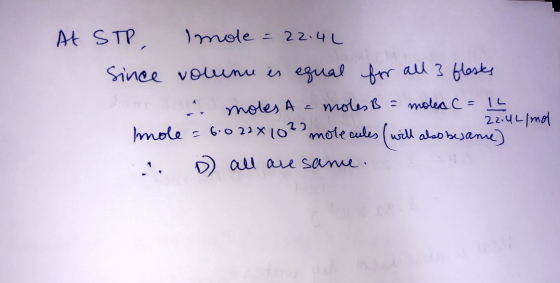
Use the following to answer questions 8-9: Consider three 1-L flasks at STP. Flask A contains...
I just need help with #9 thanks! Use the following to answer questions 8-9: Consider three...
 I
just need help with #9 thanks!
Use the following to answer questions 8-9: Consider three 1-L flasks at STP. Flask A contains NH, gas, flask C contains N, gas. I STP. Flask A contains NH, gas, flask B contains NO, gas, and flask 8. Which contains the largest number of molecules? A) flask A B) flask B C) flask C D) all are the same E) none 9. In which flask do the molecules have the highest average velocity?...
I
just need help with #9 thanks!
Use the following to answer questions 8-9: Consider three 1-L flasks at STP. Flask A contains NH, gas, flask C contains N, gas. I STP. Flask A contains NH, gas, flask B contains NO, gas, and flask 8. Which contains the largest number of molecules? A) flask A B) flask B C) flask C D) all are the same E) none 9. In which flask do the molecules have the highest average velocity?...
Three identical flasks contain three different gases at standard temperature and pressure. Flask A contains C2H6,...
 Three identical flasks contain three different gases at standard temperature and pressure. Flask A contains C2H6, flask B contains O2, and flask C contains NH3. Which flask contains the largest number of molecules? O flask A flask B flask C O All contain same number of molecules. Submit Request Answer
Three identical flasks contain three different gases at standard temperature and pressure. Flask A contains C4H10,...
Three identical flasks contain three different gases at standard temperature and pressure. Flask A contains C4H10, flask B contains SO2, and flask C contains He. Which flask contains the largest number of molecules?
Consider two 1 L flasks, one containing O2, the other containing He, each at STP. Which...
 Consider two 1 L flasks, one containing O2, the other containing He, each at STP. Which one of the following statements is false regarding these gases? O Each flask contains the same number of atoms or molecules. O The gases in each flask have the same average kinetic energy O The gases in each flask have the same density. O The pressure in each flask is the same O The temperature of the gases in each fask is 273.15 K
For questions 2 to 4 d, consider two 2.00 L flasks, one of which contains 0.250...
For questions 2 to 4 d, consider two 2.00 L flasks, one of which contains 0.250 mole of O2 gas at 50.0 deg C and the other of which contains 0.500 mole of H2 gas at 50.0 deg C. 4. a. In which flask is the ratio of molecular volume (volume occupied by the molecules touching one another in a condensed state) to gaseous sample volume (volume occupied by the entire gaseous sample) greater? (2 pt) b. ...
Be sure to answer all parts. Three 8−L flasks, fixed with pressure gauges and small valves,...
Be sure to answer all parts. Three 8−L flasks, fixed with pressure gauges and small valves, each contain 5 g of gas at 273 K. Flask A contains He, flask B contains H2, and flask C contains CH4. Rank the flask contents in terms of: (a) pressure. A > B > C A > C > B B > C > A B > A > C C > B > A C > A > B A = B...
Page 2 5. How many grams of NaCl are contained in 300 mL of a 0.250...
 Page 2 5. How many grams of NaCl are contained in 300 mL of a 0.250 M solution of sodium chloride? a) 3.65 g b) 4.38 8 c) 10.4 g d) 14.6 g e) 29.9 g 6. Consider three identical 1 L flasks at STP. Flask A contains NH3 gas, flask B contains NO2 gas, flask C contains N2 gas. Which contains the largest number of molecules a) flask A b) flask B c) flask C d) each flask contains...
I just need help with #4 in the photo thanks! Use the following to answer questions 3-4: Four identical 1.0-L flas...
 I
just need help with #4 in the photo thanks!
Use the following to answer questions 3-4: Four identical 1.0-L flasks contain the gases He, C1, CH, and NH,, each at 0°C and 1 atm pressure. 3. For which gas are the molecules diatomic? A) He B) CI, C) CH, D) NHÀ E) all gases the same 4. Which gas has the highest density? A) He B) CI C) CH. D) NHÀ E) all gases the same
I
just need help with #4 in the photo thanks!
Use the following to answer questions 3-4: Four identical 1.0-L flasks contain the gases He, C1, CH, and NH,, each at 0°C and 1 atm pressure. 3. For which gas are the molecules diatomic? A) He B) CI, C) CH, D) NHÀ E) all gases the same 4. Which gas has the highest density? A) He B) CI C) CH. D) NHÀ E) all gases the same
You have two flasks of equal volume. Flask A contains hydrogen gas (H2) at 0°C and...
You have two flasks of equal volume. Flask A contains hydrogen gas (H2) at 0°C and 1 atm of pressure. Flask B contains CO2 gas at 25°C and 2 atm pressure. a) What is the ratio of the average kinetic energy per molecule of H2/CO2? b) What is the ratio of the average kinetic velocity of H2/CO2 molecules? c) What is the ratio of the number of molecules of CO2/H2? d) What is the mass ratio of CO2/H2?
three 6-L flasks filled with pressure gauges and small valves each contain 2 g of gas...
three 6-L flasks filled with pressure gauges and small valves each contain 2 g of gas at 268K. Flask A contains H2 flask B contains CH4 and flask C contains He. Rank the flask contents in terms of : pressure average molecular kinetic energy diffusion rate after valve is opened total kinetic energy of the molecules density collision frequency (please do in form of A>B>C)
 I
just need help with #9 thanks!
Use the following to answer questions 8-9: Consider three 1-L flasks at STP. Flask A contains NH, gas, flask C contains N, gas. I STP. Flask A contains NH, gas, flask B contains NO, gas, and flask 8. Which contains the largest number of molecules? A) flask A B) flask B C) flask C D) all are the same E) none 9. In which flask do the molecules have the highest average velocity?...
I
just need help with #9 thanks!
Use the following to answer questions 8-9: Consider three 1-L flasks at STP. Flask A contains NH, gas, flask C contains N, gas. I STP. Flask A contains NH, gas, flask B contains NO, gas, and flask 8. Which contains the largest number of molecules? A) flask A B) flask B C) flask C D) all are the same E) none 9. In which flask do the molecules have the highest average velocity?...
 Three identical flasks contain three different gases at standard temperature and pressure. Flask A contains C2H6, flask B contains O2, and flask C contains NH3. Which flask contains the largest number of molecules? O flask A flask B flask C O All contain same number of molecules. Submit Request Answer
 Consider two 1 L flasks, one containing O2, the other containing He, each at STP. Which one of the following statements is false regarding these gases? O Each flask contains the same number of atoms or molecules. O The gases in each flask have the same average kinetic energy O The gases in each flask have the same density. O The pressure in each flask is the same O The temperature of the gases in each fask is 273.15 K
 Page 2 5. How many grams of NaCl are contained in 300 mL of a 0.250 M solution of sodium chloride? a) 3.65 g b) 4.38 8 c) 10.4 g d) 14.6 g e) 29.9 g 6. Consider three identical 1 L flasks at STP. Flask A contains NH3 gas, flask B contains NO2 gas, flask C contains N2 gas. Which contains the largest number of molecules a) flask A b) flask B c) flask C d) each flask contains...
 I
just need help with #4 in the photo thanks!
Use the following to answer questions 3-4: Four identical 1.0-L flasks contain the gases He, C1, CH, and NH,, each at 0°C and 1 atm pressure. 3. For which gas are the molecules diatomic? A) He B) CI, C) CH, D) NHÀ E) all gases the same 4. Which gas has the highest density? A) He B) CI C) CH. D) NHÀ E) all gases the same
I
just need help with #4 in the photo thanks!
Use the following to answer questions 3-4: Four identical 1.0-L flasks contain the gases He, C1, CH, and NH,, each at 0°C and 1 atm pressure. 3. For which gas are the molecules diatomic? A) He B) CI, C) CH, D) NHÀ E) all gases the same 4. Which gas has the highest density? A) He B) CI C) CH. D) NHÀ E) all gases the same
Most questions answered within 3 hours.
-
Where is the error in this code sequence?
String s1 = "Hello";
String s2 = "ello";...
asked 10 months ago -
Financial data for Joel de Paris, Inc., for last year
follow:
Joel de Paris, Inc.
Balance...
asked 10 months ago -
Consider this reaction:
Al2(SO4)3 (aq)+ BaCl3
(aq) Al2Cl6 (aq)- +
3BaSO4(s) . What is the...
asked 10 months ago -
Suppose that Savneet is considering increasing her
recent random sample from 20 car rentals to 40...
asked 10 months ago -
Trucks arrive at an unloading terminal at an average rate of 120
per hour.
Trucks arrive...
asked 10 months ago -
Why are methanol and ethanol completely soluble in water while
octanol is not very little soluble....
asked 10 months ago -
A facilities manager at a university reads in a research report
that the mean amount of...
asked 10 months ago -
When the CuSO4 is rehydrated by adding water to the anhydrous
compound, is this an endothermic...
asked 10 months ago -
A ray of sunlight is passing from diamond into crown glass; the
angle of incidence is...
asked 10 months ago -
A block of mass 0.249 kg is placed on top of a light, vertical
spring of...
asked 10 months ago -
how do the kidneys compensate in the presences of acidosis
a) trigger hyperventilate
b) reserve acid...
asked 10 months ago -
Question 501 pts
The rental rate of capital to the firm increases. Which of the
following...
asked 10 months ago