
Homework Answers
Add Answer to:
of mass 1.00 kg moves East at 5.00 mts collides with another ball, of mass 2.00...
A ball of mass 2.00 kg is traveling east at 5.00 m/s. Another ball of mass...
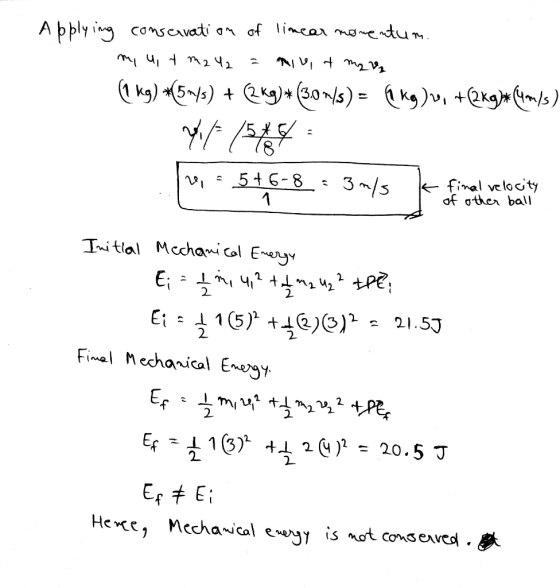
A ball of mass 2.00 kg is traveling east at 5.00 m/s. Another ball of mass 4.00kg is traveling west at 2.00 m/s. The two balls meet in a head-on-perfectly elastic collision. If the collision is perfectly (completely) elastic, what is the velocity (magnitude and direction) of each ball after the collision?
A 2.0 kg ball moving east with a velocity of 5.0 m/s collides with a 8.0...
A 2.0 kg ball moving east with a velocity of 5.0 m/s collides with a 8.0 kg ball moving west with velocity 2.0 m/s. After collision, the ball of mass 2.0 kg moves with a velocity of 2.0 m/s towards east, what is the velocity of the second ball?
1. A ball with a mass of 2.00 kg and an initial velocity of ?⃗1 =...
1. A ball with a mass of 2.00 kg and an initial velocity of ?⃗1 = 30.0m/s ?̂ collides with another ball of mass 1 kg which is initially sitting still. After the collision, the second mass has a velocity of ?⃗2f = 25.0m/s ?̂. What is the velocity of the first mass after the collision? 2. Two billiard balls with identical masses of 1 kg move toward each other. The initial velocity of ball 1 is +30 cm/s and...
a 5.00 kg ball moving to the right at a velocity of + 2.00 m /...
a 5.00 kg ball moving to the right at a velocity of + 2.00 m / son a frictionless table collides head on withg a stationary with a7.50 kg ball find the velocites of the balls if the collision is(a) elastic and (b) completely inelastic Please use the Vapproach=Vseperate way instead of Kinetic Energy.
A ball of mass 0.442 kg moving east (+x direction) with a speed of 3.72 m/s...
A ball of mass 0.442 kg moving east (+x direction) with a speed of 3.72 m/s collides head-on with a 0.221 kg ball at rest. Assume that the collision is perfectly elastic. a) What is be the speed of the 0.442-kg ball after the collision? b) What is be the direction of the velocity of the 0.442-kg ball after the collision? to the east or to the west c)What is the speed of the 0.221-kg ball after the collision? d)What...
A ball of mass 0.265 kg that is moving with a speed of 5.1 m/s collides...
A ball of mass 0.265 kg that is moving with a speed of 5.1 m/s collides head-on and elastically with another ball initially at rest. Immediately after the collision, the incoming ball bounces backward with a speed of 3.3 m/s . a) Calculate the velocity of the target ball after the collision. b) Calculate the mass of the target ball. Solve using conservation of momentum and conservation of energy.
Ball A with a mass of 50 kg moving 10 m/s east collides with Ball B...
Ball A with a mass of 50 kg moving 10 m/s east collides with Ball B (a stationary 25 kg ball). What would be the resulting velocity after impact if Ball A and Ball B were to stick together?
7.25 A ball of mass 0.608 kg moving east (+x direction) with a speed of 3.78...
7.25 A ball of mass 0.608 kg moving east (+x direction) with a speed of 3.78 m/s collides head-on with a 0.304 kg ball at rest. Assume that the collision is perfectly elastic. What is be the speed of the 0.608-kg ball after the collision? What is be the direction of the velocity of the 0.608-kg ball after the collision?
A 0.190 kg plastic ball moves with a velocity of 0.30 m/s. It collides with a...
A 0.190 kg plastic ball moves with a velocity of 0.30 m/s. It collides with a second plastic ball of mass 0.107 kg, which is moving along the same line at a speed of 0.10 m/s. After the collision, both balls continue moving in the same, original direction, and the speed of the 0.107 kg ball is 0.26 m/s. What is the new velocity of the first ball?
8. (9 pts.) A 4.00-kg ball, moving to the right at a velocity of +2.00 mis...
 8. (9 pts.) A 4.00-kg ball, moving to the right at a velocity of +2.00 mis on a frictionless table, collides head-on with a stationary 6.50-kg ball. Find the final velocities of the balls if the collision is completely inelastic (the balls stick together). 9. (12 pts.) A 2.5-kg ball and a 5.0-kg ball have an elastic collision. Before the collision, the 2.5-kg ball was at rest and the other ball had a speed of 3.5 m/s. (a) What is...
 8. (9 pts.) A 4.00-kg ball, moving to the right at a velocity of +2.00 mis on a frictionless table, collides head-on with a stationary 6.50-kg ball. Find the final velocities of the balls if the collision is completely inelastic (the balls stick together). 9. (12 pts.) A 2.5-kg ball and a 5.0-kg ball have an elastic collision. Before the collision, the 2.5-kg ball was at rest and the other ball had a speed of 3.5 m/s. (a) What is...
Most questions answered within 3 hours.
-
Where is the error in this code sequence?
String s1 = "Hello";
String s2 = "ello";...
asked 11 months ago -
Financial data for Joel de Paris, Inc., for last year
follow:
Joel de Paris, Inc.
Balance...
asked 11 months ago -
Consider this reaction:
Al2(SO4)3 (aq)+ BaCl3
(aq) Al2Cl6 (aq)- +
3BaSO4(s) . What is the...
asked 11 months ago -
Suppose that Savneet is considering increasing her
recent random sample from 20 car rentals to 40...
asked 11 months ago -
Trucks arrive at an unloading terminal at an average rate of 120
per hour.
Trucks arrive...
asked 11 months ago -
Why are methanol and ethanol completely soluble in water while
octanol is not very little soluble....
asked 11 months ago -
A facilities manager at a university reads in a research report
that the mean amount of...
asked 11 months ago -
When the CuSO4 is rehydrated by adding water to the anhydrous
compound, is this an endothermic...
asked 11 months ago -
A ray of sunlight is passing from diamond into crown glass; the
angle of incidence is...
asked 11 months ago -
A block of mass 0.249 kg is placed on top of a light, vertical
spring of...
asked 11 months ago -
how do the kidneys compensate in the presences of acidosis
a) trigger hyperventilate
b) reserve acid...
asked 11 months ago -
Question 501 pts
The rental rate of capital to the firm increases. Which of the
following...
asked 11 months ago