A firework is launched straight upward from a height of 1 meter. The acceleration function for...
A firework is launched straight upward from a height of 1 meter.
The
acceleration function for the firework is given below:
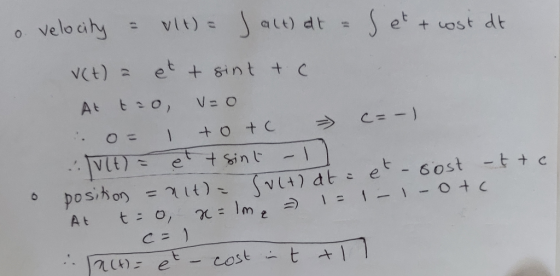
a(t) = e^t + cos(t) meters per second squared
where t is time since thefirework launched.
(a) Find the velocity and position functions for the
firework.
(b) What is the net change of thefirework's position after 3
seconds?
Homework Answers
 kindly give rating
Add Answer to:
A firework is launched straight upward from a height of 1 meter.
The
acceleration function for...
a model rocket is launched straight upward. It’s altitude y as a function is given by...
 a model rocket is launched straight upward. It’s altitude y as
a function is given by y=bt-ct^2, where b= 81 m/s, c=4.9 m/s ^2, t
is the time in seconds, and y is in meters
Exercise 2.21 Constants 1 Periodic Table Part A A modei rocket is launched straight upward Its alt tude y as a unction of time is given by ybt -ct, where b81 m/s Use difterentiation to find a general expression for the rocket's velocity as a...
a model rocket is launched straight upward. It’s altitude y as
a function is given by y=bt-ct^2, where b= 81 m/s, c=4.9 m/s ^2, t
is the time in seconds, and y is in meters
Exercise 2.21 Constants 1 Periodic Table Part A A modei rocket is launched straight upward Its alt tude y as a unction of time is given by ybt -ct, where b81 m/s Use difterentiation to find a general expression for the rocket's velocity as a...
A 7.7 kg firework is launched straight up and at its maximum height 13 m it...
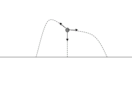 A 7.7 kg firework is launched straight up and at its maximum
height 13 m it explodes into three parts. Part A (1.5 kg) moves
straight down and lands 0.23 seconds after the explosion. Part B (2
kg) moves horizontally to the right and lands 6.5 meters from Part
A. Part C moves to the left at some angle. How far from Part A does
Part C land ?(no direction needed)
A 7.7 kg firework is launched straight up and at its maximum
height 13 m it explodes into three parts. Part A (1.5 kg) moves
straight down and lands 0.23 seconds after the explosion. Part B (2
kg) moves horizontally to the right and lands 6.5 meters from Part
A. Part C moves to the left at some angle. How far from Part A does
Part C land ?(no direction needed)
A 7.7 kg firework is launched straight up and at its maximum height 13 m it...
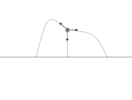 A 7.7 kg firework is
launched straight up and at its maximum height 13 m it explodes
into three parts. Part A (1.5 kg) moves straight down and lands
0.23 seconds after the explosion. Part B (2 kg) moves horizontally
to the right and lands 6.5 meters from Part A. Part C moves to the
left at some angle. How far from Part A does Part C land ?(no
direction needed)
A 7.7 kg firework is
launched straight up and at its maximum height 13 m it explodes
into three parts. Part A (1.5 kg) moves straight down and lands
0.23 seconds after the explosion. Part B (2 kg) moves horizontally
to the right and lands 6.5 meters from Part A. Part C moves to the
left at some angle. How far from Part A does Part C land ?(no
direction needed)
A projectile is launched straight up in the air. Its height (in feet) t seconds after...
 A projectile is launched straight up in the air. Its height (in feet) t seconds after launch is given by the function () - 162? + 3021 5. Find its velocity 0.9 seconds after it is launched Its velocity is If necessary, round to two decimal places. Do not include units.
Use a quadratic function to model projectile motion Question A model rocket is launched directly upward...
 Use a quadratic function to model projectile motion Question A model rocket is launched directly upward at a speed of 28 meters per second from a height of 12 meters. The function f(t) = -4.96 +28+12, models the relationship between the height of the rocket and the time after launch, t, in seconds. When, in seconds after launch, will the rocket hit the ground? Do not round until the final answer. Then round your answer to two decimal places. Provide...
(1 point) A water balloon of mass 380 grams is launched with an initial (vertical) velocity...
 (1 point) A water balloon of mass 380 grams is launched with an initial (vertical) velocity of 43 meters per second. Assume air resistance is proportional to velocity with coefficient 5 grams per second, and use 9.81 meters per second squared for the acceleration due to gravity. (a) Find the height of the balloon as a function of time. h(t) = (b) What is the terminal velocity of the balloon? (Enter your answer as a positive velocity.) The terminal velocity...
17. A baseball was launched from a pitching machine that was placed on a platform The...
 17. A baseball was launched from a pitching machine that was placed on a platform The height of the ball in feet, h, is given by the equation h-16t2 +85t+9, where t is the time in seconds since the ball was launched. What is the meaning of the term 85t? The platform was 85 feet high. The ball was launched with an initial upward velocity of 85 feet per second The ball was launched with an initial upward velocity of...
A toy rocket is launched upward with an initial velocity of 64ft/s from a platform that...
 A toy rocket is launched upward with an initial velocity of 64ft/s from a platform that is 80ft. above the ground. The acceleration of the rocket is a(t) = -32ft. Find the height of the rocket after t seconds. When does it hit the ground? Use calculus methods to solve the problem.
show clear work plz A ball is thrown upward from a height of 1000 feet above...
 show clear work plz
A ball is thrown upward from a height of 1000 feet above the ground, with an initial velocity of 80 feet per second. From physics it is known that the acceleration at time t is a(t) = -32 feet per second squared. Use antiderivatives to find s(t), the function giving the height of the ball at timet.
show clear work plz
A ball is thrown upward from a height of 1000 feet above the ground, with an initial velocity of 80 feet per second. From physics it is known that the acceleration at time t is a(t) = -32 feet per second squared. Use antiderivatives to find s(t), the function giving the height of the ball at timet.
Can someone please break down this question for me into parts? I’m having an extremely hard...
 Can
someone please break down this question for me into parts? I’m
having an extremely hard time visualizing everything happening
(20 points) Take a ball, with a fan attached to it pointing downward, with a total mass (ball + fan) of 1/5 Kg. This whole arrangement is thrown vertically upward from the edge of a building 50 meters high with an initial velocity of 30 meters/second, with the fan turned on The fan exerts an upward force of (1-e-3) Kg...
Can
someone please break down this question for me into parts? I’m
having an extremely hard time visualizing everything happening
(20 points) Take a ball, with a fan attached to it pointing downward, with a total mass (ball + fan) of 1/5 Kg. This whole arrangement is thrown vertically upward from the edge of a building 50 meters high with an initial velocity of 30 meters/second, with the fan turned on The fan exerts an upward force of (1-e-3) Kg...
 a model rocket is launched straight upward. It’s altitude y as
a function is given by y=bt-ct^2, where b= 81 m/s, c=4.9 m/s ^2, t
is the time in seconds, and y is in meters
Exercise 2.21 Constants 1 Periodic Table Part A A modei rocket is launched straight upward Its alt tude y as a unction of time is given by ybt -ct, where b81 m/s Use difterentiation to find a general expression for the rocket's velocity as a...
a model rocket is launched straight upward. It’s altitude y as
a function is given by y=bt-ct^2, where b= 81 m/s, c=4.9 m/s ^2, t
is the time in seconds, and y is in meters
Exercise 2.21 Constants 1 Periodic Table Part A A modei rocket is launched straight upward Its alt tude y as a unction of time is given by ybt -ct, where b81 m/s Use difterentiation to find a general expression for the rocket's velocity as a...
 A 7.7 kg firework is launched straight up and at its maximum
height 13 m it explodes into three parts. Part A (1.5 kg) moves
straight down and lands 0.23 seconds after the explosion. Part B (2
kg) moves horizontally to the right and lands 6.5 meters from Part
A. Part C moves to the left at some angle. How far from Part A does
Part C land ?(no direction needed)
A 7.7 kg firework is launched straight up and at its maximum
height 13 m it explodes into three parts. Part A (1.5 kg) moves
straight down and lands 0.23 seconds after the explosion. Part B (2
kg) moves horizontally to the right and lands 6.5 meters from Part
A. Part C moves to the left at some angle. How far from Part A does
Part C land ?(no direction needed)
 A 7.7 kg firework is
launched straight up and at its maximum height 13 m it explodes
into three parts. Part A (1.5 kg) moves straight down and lands
0.23 seconds after the explosion. Part B (2 kg) moves horizontally
to the right and lands 6.5 meters from Part A. Part C moves to the
left at some angle. How far from Part A does Part C land ?(no
direction needed)
A 7.7 kg firework is
launched straight up and at its maximum height 13 m it explodes
into three parts. Part A (1.5 kg) moves straight down and lands
0.23 seconds after the explosion. Part B (2 kg) moves horizontally
to the right and lands 6.5 meters from Part A. Part C moves to the
left at some angle. How far from Part A does Part C land ?(no
direction needed)
 A projectile is launched straight up in the air. Its height (in feet) t seconds after launch is given by the function () - 162? + 3021 5. Find its velocity 0.9 seconds after it is launched Its velocity is If necessary, round to two decimal places. Do not include units.
 Use a quadratic function to model projectile motion Question A model rocket is launched directly upward at a speed of 28 meters per second from a height of 12 meters. The function f(t) = -4.96 +28+12, models the relationship between the height of the rocket and the time after launch, t, in seconds. When, in seconds after launch, will the rocket hit the ground? Do not round until the final answer. Then round your answer to two decimal places. Provide...
 (1 point) A water balloon of mass 380 grams is launched with an initial (vertical) velocity of 43 meters per second. Assume air resistance is proportional to velocity with coefficient 5 grams per second, and use 9.81 meters per second squared for the acceleration due to gravity. (a) Find the height of the balloon as a function of time. h(t) = (b) What is the terminal velocity of the balloon? (Enter your answer as a positive velocity.) The terminal velocity...
 17. A baseball was launched from a pitching machine that was placed on a platform The height of the ball in feet, h, is given by the equation h-16t2 +85t+9, where t is the time in seconds since the ball was launched. What is the meaning of the term 85t? The platform was 85 feet high. The ball was launched with an initial upward velocity of 85 feet per second The ball was launched with an initial upward velocity of...
 A toy rocket is launched upward with an initial velocity of 64ft/s from a platform that is 80ft. above the ground. The acceleration of the rocket is a(t) = -32ft. Find the height of the rocket after t seconds. When does it hit the ground? Use calculus methods to solve the problem.
 show clear work plz
A ball is thrown upward from a height of 1000 feet above the ground, with an initial velocity of 80 feet per second. From physics it is known that the acceleration at time t is a(t) = -32 feet per second squared. Use antiderivatives to find s(t), the function giving the height of the ball at timet.
show clear work plz
A ball is thrown upward from a height of 1000 feet above the ground, with an initial velocity of 80 feet per second. From physics it is known that the acceleration at time t is a(t) = -32 feet per second squared. Use antiderivatives to find s(t), the function giving the height of the ball at timet.
 Can
someone please break down this question for me into parts? I’m
having an extremely hard time visualizing everything happening
(20 points) Take a ball, with a fan attached to it pointing downward, with a total mass (ball + fan) of 1/5 Kg. This whole arrangement is thrown vertically upward from the edge of a building 50 meters high with an initial velocity of 30 meters/second, with the fan turned on The fan exerts an upward force of (1-e-3) Kg...
Can
someone please break down this question for me into parts? I’m
having an extremely hard time visualizing everything happening
(20 points) Take a ball, with a fan attached to it pointing downward, with a total mass (ball + fan) of 1/5 Kg. This whole arrangement is thrown vertically upward from the edge of a building 50 meters high with an initial velocity of 30 meters/second, with the fan turned on The fan exerts an upward force of (1-e-3) Kg...
Most questions answered within 3 hours.
-
Where is the error in this code sequence?
String s1 = "Hello";
String s2 = "ello";...
asked 10 months ago -
Financial data for Joel de Paris, Inc., for last year
follow:
Joel de Paris, Inc.
Balance...
asked 10 months ago -
Consider this reaction:
Al2(SO4)3 (aq)+ BaCl3
(aq) Al2Cl6 (aq)- +
3BaSO4(s) . What is the...
asked 10 months ago -
Suppose that Savneet is considering increasing her
recent random sample from 20 car rentals to 40...
asked 10 months ago -
Trucks arrive at an unloading terminal at an average rate of 120
per hour.
Trucks arrive...
asked 10 months ago -
Why are methanol and ethanol completely soluble in water while
octanol is not very little soluble....
asked 10 months ago -
A facilities manager at a university reads in a research report
that the mean amount of...
asked 10 months ago -
When the CuSO4 is rehydrated by adding water to the anhydrous
compound, is this an endothermic...
asked 10 months ago -
A ray of sunlight is passing from diamond into crown glass; the
angle of incidence is...
asked 10 months ago -
A block of mass 0.249 kg is placed on top of a light, vertical
spring of...
asked 10 months ago -
how do the kidneys compensate in the presences of acidosis
a) trigger hyperventilate
b) reserve acid...
asked 10 months ago -
Question 501 pts
The rental rate of capital to the firm increases. Which of the
following...
asked 10 months ago