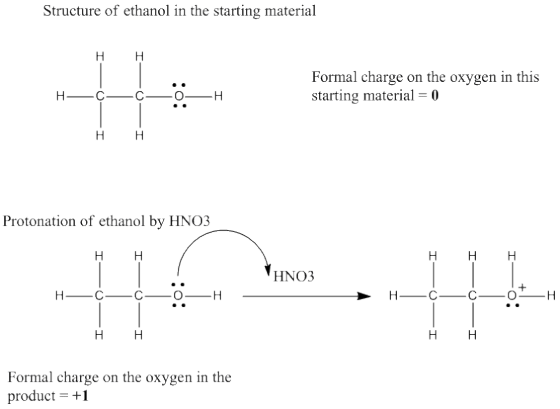
In the protonation reaction of ethanol with nitric acid, what are the formal charges on the...
In the protonation reaction of ethanol with nitric acid, what are the formal charges on the oxygen atom of ethanol in the starting material and product?
Homework Answers
Add Answer to:
In the protonation reaction of ethanol with nitric acid, what
are the formal charges on the...
?? Draw the structure of the major nitration product from the reaction of nitric acid with...
 ??
Draw the structure of the major nitration product from the reaction of nitric acid with 1,3-dimethylbenzene. Show all formal charges.
??
Draw the structure of the major nitration product from the reaction of nitric acid with 1,3-dimethylbenzene. Show all formal charges.
Draw the structure of the major nitration product from the reaction of nitric acid with 1,3-dimethylbenzene....
 Draw the structure of the major nitration product from the
reaction of nitric acid with 1,3-dimethylbenzene. Show all formal
charges.
Draw the structure of the major nitration product from the
reaction of nitric acid with 1,3-dimethylbenzene. Show all formal
charges.
Determine the products for the acid base reactions (include lone pairs and formal charges) indicate whether...
 Determine the products for the acid base reactions
(include lone pairs and formal charges) indicate whether each is a
protonation or deprotonation. then rewrite the first 2 and include
mechanistic arrows to form the products
9. Determine the products for the acid-base reactions show below charges!). Indicate whether each reaction is a protonation or a the products of these acid base reactions have in common? NH HCI OH NaOH OH NaHCO3 OH NaOH 10. Rewrite the first 2 reactions above...
Determine the products for the acid base reactions
(include lone pairs and formal charges) indicate whether each is a
protonation or deprotonation. then rewrite the first 2 and include
mechanistic arrows to form the products
9. Determine the products for the acid-base reactions show below charges!). Indicate whether each reaction is a protonation or a the products of these acid base reactions have in common? NH HCI OH NaOH OH NaHCO3 OH NaOH 10. Rewrite the first 2 reactions above...
Draw the product of the following reaction between propanoyl chloride and p-methoxynitrobenzene. Include all formal charges....
 Draw the product of the following reaction between propanoyl chloride and p-methoxynitrobenzene. Include all formal charges. Keep the starting material substituents in the same spots respectively when you draw the product. To avoid getting problems wrong, always draw the aromatic ring double bonds in the same position as they are in the starting material.
Draw the acid-base reaction showing protonation of acetic anhydride by phosphoric acid (a strong acid). Pay...
Draw the acid-base reaction showing protonation of acetic anhydride by phosphoric acid (a strong acid). Pay attention to which atom is most basic.
In the mechanism for formation of acetylsalicylic acid via reaction of salicylic acid with acetic anhydride,...
 In the mechanism for formation of acetylsalicylic acid via reaction of salicylic acid with acetic anhydride, phosphoric acid acts as a catalyst by O cleaving an acetyl group from acetic anhydride via protonation of the bridging oxygen O neutralizing the hydroxide ion side product protonating the carbonyl oxygen in the acetic anhydride protonating the phenolic oxygen of salicylic acid Question 10 (3 points) What would be the predicted major product from the thermodynamically controlled dehydration of the following material OH
Nitric acid, HNO3, produces nitronium ion, NO2, by O A) loss of H20 after protonation by...
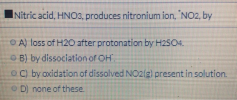 Nitric acid, HNO3, produces nitronium ion, NO2, by O A) loss of H20 after protonation by H2SO4. O B) by dissociation of OH'. 0 C) by oxidation of dissolved NO2(g) present in solution OD) none of these
Nitrogen reacts with oxygen in water to produce nitric acid (MW 63.01 amu). In a particular...
Nitrogen reacts with oxygen in water to produce nitric acid (MW 63.01 amu). In a particular experiment, 1.35 g of product is produced by the reaction of 10.35 g of oxygen with 12.33 g of nitrogen. What is the percent yield of nitric acid?
p-Fluoroanisole reacts with concentrated sulfuric acid. Draw the major product of this substitution reaction; if applicable,...
 p-Fluoroanisole reacts with concentrated sulfuric acid. Draw the major product of this substitution reaction; if applicable, minimize formal charges via expanded octets.e. draw the substituent as a structure with minimal formal charges- all the atoms should have a formal charge of zero). Assume the reagent adds once. Draw the starting material substituents in the same place on the product. If drawing a substituent, always draw heteroatom-hydrogen bonds (i.e. OH) with the "H arrow" key. Do not draw an O-H bond....
Question 3 1 pts What are the formal charges on phosphorus and the starred oxygen atom...
 Question 3 1 pts What are the formal charges on phosphorus and the starred oxygen atom in the following molecule? H-O-P-O: OP-O, O =-1
 ??
Draw the structure of the major nitration product from the reaction of nitric acid with 1,3-dimethylbenzene. Show all formal charges.
??
Draw the structure of the major nitration product from the reaction of nitric acid with 1,3-dimethylbenzene. Show all formal charges.
 Draw the structure of the major nitration product from the
reaction of nitric acid with 1,3-dimethylbenzene. Show all formal
charges.
Draw the structure of the major nitration product from the
reaction of nitric acid with 1,3-dimethylbenzene. Show all formal
charges.
 Determine the products for the acid base reactions
(include lone pairs and formal charges) indicate whether each is a
protonation or deprotonation. then rewrite the first 2 and include
mechanistic arrows to form the products
9. Determine the products for the acid-base reactions show below charges!). Indicate whether each reaction is a protonation or a the products of these acid base reactions have in common? NH HCI OH NaOH OH NaHCO3 OH NaOH 10. Rewrite the first 2 reactions above...
Determine the products for the acid base reactions
(include lone pairs and formal charges) indicate whether each is a
protonation or deprotonation. then rewrite the first 2 and include
mechanistic arrows to form the products
9. Determine the products for the acid-base reactions show below charges!). Indicate whether each reaction is a protonation or a the products of these acid base reactions have in common? NH HCI OH NaOH OH NaHCO3 OH NaOH 10. Rewrite the first 2 reactions above...
 Draw the product of the following reaction between propanoyl chloride and p-methoxynitrobenzene. Include all formal charges. Keep the starting material substituents in the same spots respectively when you draw the product. To avoid getting problems wrong, always draw the aromatic ring double bonds in the same position as they are in the starting material.
 In the mechanism for formation of acetylsalicylic acid via reaction of salicylic acid with acetic anhydride, phosphoric acid acts as a catalyst by O cleaving an acetyl group from acetic anhydride via protonation of the bridging oxygen O neutralizing the hydroxide ion side product protonating the carbonyl oxygen in the acetic anhydride protonating the phenolic oxygen of salicylic acid Question 10 (3 points) What would be the predicted major product from the thermodynamically controlled dehydration of the following material OH
 Nitric acid, HNO3, produces nitronium ion, NO2, by O A) loss of H20 after protonation by H2SO4. O B) by dissociation of OH'. 0 C) by oxidation of dissolved NO2(g) present in solution OD) none of these
 p-Fluoroanisole reacts with concentrated sulfuric acid. Draw the major product of this substitution reaction; if applicable, minimize formal charges via expanded octets.e. draw the substituent as a structure with minimal formal charges- all the atoms should have a formal charge of zero). Assume the reagent adds once. Draw the starting material substituents in the same place on the product. If drawing a substituent, always draw heteroatom-hydrogen bonds (i.e. OH) with the "H arrow" key. Do not draw an O-H bond....
 Question 3 1 pts What are the formal charges on phosphorus and the starred oxygen atom in the following molecule? H-O-P-O: OP-O, O =-1
Most questions answered within 3 hours.
-
Where is the error in this code sequence?
String s1 = "Hello";
String s2 = "ello";...
asked 11 months ago -
Financial data for Joel de Paris, Inc., for last year
follow:
Joel de Paris, Inc.
Balance...
asked 11 months ago -
Consider this reaction:
Al2(SO4)3 (aq)+ BaCl3
(aq) Al2Cl6 (aq)- +
3BaSO4(s) . What is the...
asked 11 months ago -
Suppose that Savneet is considering increasing her
recent random sample from 20 car rentals to 40...
asked 11 months ago -
Trucks arrive at an unloading terminal at an average rate of 120
per hour.
Trucks arrive...
asked 11 months ago -
Why are methanol and ethanol completely soluble in water while
octanol is not very little soluble....
asked 11 months ago -
A facilities manager at a university reads in a research report
that the mean amount of...
asked 11 months ago -
When the CuSO4 is rehydrated by adding water to the anhydrous
compound, is this an endothermic...
asked 11 months ago -
A ray of sunlight is passing from diamond into crown glass; the
angle of incidence is...
asked 11 months ago -
A block of mass 0.249 kg is placed on top of a light, vertical
spring of...
asked 11 months ago -
how do the kidneys compensate in the presences of acidosis
a) trigger hyperventilate
b) reserve acid...
asked 11 months ago -
Question 501 pts
The rental rate of capital to the firm increases. Which of the
following...
asked 11 months ago