


Homework Answers
Solution:
We are given the following cost curves: Marginal Cost (MC), Average variable cost (AVC), and Average total cost (ATC). Also, these all are same for all firms in this industry. Let's denote price by P.
For a firm in perfectly competitive market structure:
1) Profit maximizing condition is P = MC. So, upward sloping part of MC curve represents the supply curve of a firm in competitive market and thus, at all points on the curve MC = P.
2) A firm does not produce if P < AVC (shut-down condition), or below the output level when AVC achieves its minimum (as the minimum is achieved when AVC = MC).
The profit maximizing output and shut-down output level will be same for all firms in this industry, as all firms are given to be identical. So, shut down point where MC = AVC, clearly from the graph is at quantity, Q = 30 thousands of pounds of titanium (at this point price, P = MC = $15 per pound). So, no firm will produce below 30 thousands of pounds of titanium (thus, disregarding this portion of supply/MC curve of the firms). Let's see how a single firm supplies in this market: Going along the MC curve:
It starts with 30 thousands of pounds at price level of $15 per ton. So, first point is (Q, P) = (30, 15)
Second point: At P = $30 per pound, 40 thousands of pounds is supplied: (40, 30)
3rd point: P = 40, Q = 45 so (45, 40); 4th point: (Q, P) = (55, 70); 5th point: (Q, P) = (60, 90)
Now, the supply schedule we derived above is for a single firm. Moreover, all firms follow the same supply schedule at given price levels (since all conditions are same for all the firms). Thus, if at Price P, a single firm supplies Q (thousands of tons) level of output, then 'n' firms in this industry will supply a total of Q*n level of output at price P.
So, now we are ready to form the short-run industry supply curves:
A. Orange line: when n = 10
Point 1- at P = 15, Q = 30*10 = 300. So, (Q, P) = (300, 15)
Point 2- at P = 30, Q = 40*10 = 400. So, (Q, P) = (400, 30)
Point 3- at P = 40, Q = 45*10 = 450. So, (Q, P) = (450, 40)
Point 4- at P = 70, Q = 55*10 = 550. So, (Q, P) = (550, 70)
Point 5- at P = 90, Q = 60*10 = 600. So, (Q, P) = (600, 90)
B. Purple line: when n = 15
Point 1- at P = 15, Q = 30*15 = 450. So, (Q, P) = (450, 15)
Point 2- at P = 30, Q = 40*15 = 600. So, (Q, P) = (600, 30)
Point 3- at P = 40, Q = 45*15 = 675. So, (Q, P) = (675, 40)
Point 4- at P = 70, Q = 55*15 = 825. So, (Q, P) = (825, 70)
Point 5- at P = 90, Q = 60*15 = 900. So, (Q, P) = (900, 90)
C. Green line: when n = 20
Point 1- at P = 15, Q = 30*20 = 600. So, (Q, P) = (600, 15)
Point 2- at P = 30, Q = 40*20 = 800. So, (Q, P) = (800, 30)
Point 3- at P = 40, Q = 45*20 = 900. So, (Q, P) = (900, 40)
Point 4- at P = 70, Q = 55*20 = 1100. So, (Q, P) = (1100, 70)
Point 5- at P = 90, Q = 60*20 = 1200. So, (Q, P) = (1200, 90)
Now, plotting these curves along with the demand curve, we get,
Intercepts of the demand curve seem to be (0, 70) and (1050, 0). Graph as follows:
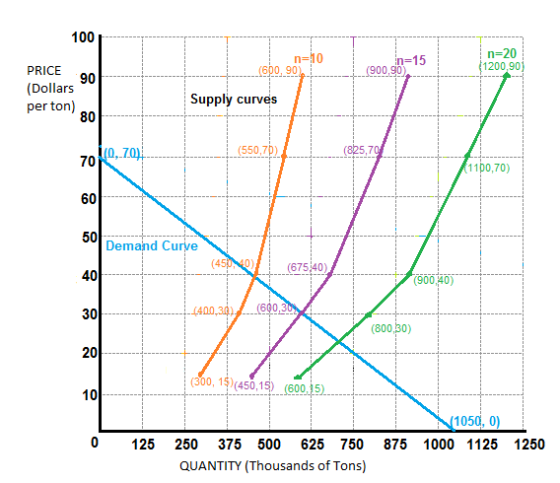
Short-run equilibrium occurs where short-run supply curve intersects the demand curve. For case of 10 firms, we see where orange line (short-run supply) intersects the blue line (demand). It happens for (nearly) P = 39, Q = 465 thousands of pounds of titanium. So, $39 per pound is the equilibrium price in this case.
At this price, a single firm produce (465/10=) 46.5 thousands of pounds. So, firms earn revenue = P*Q = 39*46.5 = $1,813.5 thousands. They incur cost of = ATC*Q (for Q =46.5, ATC = $32 (nearly)) = 32*46.5 = $1,488 thousands. So, profit of a firm = 1813.5 - 1488 = $325.5 thousands. So, at P =$39 per pound, firms in this industry would earn a positive profit. Therefore, in the long run, firms would enter the titanium market.
Because we know that competitive firms earn zero economic profit in the long run, long-run equilibrium price, P should be equal to ATC, (since, economic profit = 0 implies revenue = total cost. P*Q = ATC*Q, So, P = ATC) which happens at point (40, 30) clearly, from the cost curves diagram. (third point that we obtained above). So, equilibrium price must be $30 per pound. From the graph, clearly this means that 15 firms must operate in the market (since at P = 30, only purple (n=20) line intersects the blue (demand) line.)
Economic profits take both, implicit and explicit costs into account, while accounting profits only consider explicit costs. Thus, with positive implicit costs, economic profits (EP) are generally lower than the accounting profits (AP). So, in this case, in the long run, if economic profits earned is 0, accounting profits must be positive (and not negative). (Since, AP > EP = 0, implying AP > 0). So, given statement is False.
Add Answer to:
7. Short-run supply and long-run equilibrium Consider the competitive market for titanium. Assume that, regardless of...
7. Short-run supply and long-run equilibrium Consider the competitive market for titanium. Assume that, regardless of...
 7. Short-run supply and long-run equilibrium Consider the competitive market for titanium. Assume that, regardless of how many firms are in the industry, every firm in the industry is identical and faces the marginal cost (MC), average total cost (ATC), and average variable cost (AVC) curves shown on the following graph. COSTS (Dollars per pound) + MC O AVC 0 5 45 50 10 15 20 25 30 35 40 QUANTITY (Thousands of pounds) The following diagram shows the market...
5. Short-run supply and long-run equilibrium Consider the competitive market for titanium. Assume that, regardless of...
 5. Short-run supply and long-run
equilibrium
Consider the competitive market for titanium. Assume that,
regardless of how many firms are in the industry, every firm in the
industry is identical and faces the marginal cost (MC), average
total cost (ATC), and average variable cost (AVC) curves shown on
the following graph.
Consider the competitive market for titanium. Assume that, regardless of how many firms are in the industry, every firm in the industry is identical and faces the marginal cost...
5. Short-run supply and long-run
equilibrium
Consider the competitive market for titanium. Assume that,
regardless of how many firms are in the industry, every firm in the
industry is identical and faces the marginal cost (MC), average
total cost (ATC), and average variable cost (AVC) curves shown on
the following graph.
Consider the competitive market for titanium. Assume that, regardless of how many firms are in the industry, every firm in the industry is identical and faces the marginal cost...
7. Short-run supply and long-run equilibrium Consider the competitive market for titanium. Assume that, regardless of...
 7. Short-run supply and long-run equilibrium Consider the competitive market for titanium. Assume that, regardless of how many firms are in the industry, every firm in the industry is identical and faces the marginal cost (MC), average total cost (ATC), and average variable cost (AVC) curves shown on the following graph. 100 T 90 - 80 60 50 40 30 20 0 5 10 15 20 25 30 35 4045 50 QUANTITY (Thousands of pounds) The following diagram shows the...
7. Short-run supply and long-run equilibrium Consider the competitive market for titanium. Assume that, regardless of...
 7. Short-run supply and long-run equilibrium Consider the competitive market for titanium. Assume that, regardless of how many firms are in the industry, every firm in the industry is identi and faces the marginal cost (MC), average total cost (ATC), and average variable cost (AVC) curves shown on the following graph. COSTS (Dollars per pound) AVC мс о OFFFFF 0 3 6 9 12 15 18 21 24 QUANTITY (Thousands of pounds) 27 30 The following diagram shows the market...
5. Short-run supply and long-run equilibrium Consider the competitive market for titanium. Assume that, regardless of...
 5. Short-run supply and long-run equilibrium Consider the competitive market for titanium. Assume that, regardless of how many firms are in the industry, every firm in the industry is identical and faces the marginal cost (MC), average total cost (ATC), and average variable cost (AVC) curves shown on the following graph. 16, 52 COSTS (Dollars per pound) AVC + D + 0 + 3 MC D + + + + + + + 6 9 12 15 18 21 24...
7. Short-run supply and long-run equilibrium Consider the competitive market for copper. Assume that, regardless of...
 7. Short-run supply and long-run equilibrium Consider the competitive market for copper. Assume that, regardless of how many firms are in the industry, every firm in the industry is identical and faces the marginal cost (MC), average total cost (ATC), and average variable cost (AVC) curves shown on the following graph. COSTS (Dollars per pound) MC D AVC 0 + 0 + 10 + + + + + + + 20 30 40 50 60 70 80 QUANTITY (Thousands of...
Please help!!! 7. Short-run supply and long-run equilibrium Consider the competitive market for titanlum. Assume that,...
 Please help!!!
7. Short-run supply and long-run equilibrium Consider the competitive market for titanlum. Assume that, regardless of how many firms are in the Industry, every firm in the industry is identical and faces the marginal cost (MC), average total cost (ATC), and average variable cost (AVC) curves shown on the following graph. 100 T 90 80 70 50 40 30 20 AVC 10 0 10 20 30 40 0 70 80 0 100 The following diagram shows the market...
Please help!!!
7. Short-run supply and long-run equilibrium Consider the competitive market for titanlum. Assume that, regardless of how many firms are in the Industry, every firm in the industry is identical and faces the marginal cost (MC), average total cost (ATC), and average variable cost (AVC) curves shown on the following graph. 100 T 90 80 70 50 40 30 20 AVC 10 0 10 20 30 40 0 70 80 0 100 The following diagram shows the market...
Short-run supply and long-run equilibrium, please and thank you Consider the competitive market for titanium. Assume...
 Short-run supply and long-run equilibrium, please and
thank you
Consider the competitive market for titanium. Assume that, regardless of how many firms are in the industry, every firm in the industry is identical and faces the marginal cost (MC), average total cost (ATC), and average variable cost (AVC) curves shown on the following graph. COSTS (Dollars per kilogram) ATC + MC O AVC ott 0 5 10 15 20 25 30 35 40 QUANTITY (Thousands of kilograms) 45 50 The...
Short-run supply and long-run equilibrium, please and
thank you
Consider the competitive market for titanium. Assume that, regardless of how many firms are in the industry, every firm in the industry is identical and faces the marginal cost (MC), average total cost (ATC), and average variable cost (AVC) curves shown on the following graph. COSTS (Dollars per kilogram) ATC + MC O AVC ott 0 5 10 15 20 25 30 35 40 QUANTITY (Thousands of kilograms) 45 50 The...
5. Short-run supply and long-run equilibrium Consider the competitive market for copper. Assume that, regardless of...
 5. Short-run supply and long-run equilibrium Consider the competitive market for copper. Assume that, regardless of how many firms are in the industry, every firm in the industry is identical and faces the marginal cost (MC), average total cost (ATC), and average variable cost (AVC) curves shown on the following graph. COSTS (Dollars per pound) AVC MC O 0 3 27 30 6 9 12 15 18 21 24 QUANTITY (Thousands of pounds) The following diagram shows the market demand...
5. Short-run supply and long-run equilibrium Consider the perfectly competitive market for steel. Assume that, regardless...
 5. Short-run supply and long-run equilibrium Consider the perfectly competitive market for steel. Assume that, regardless of how many firms are in the industry, every firm in the industry is identical and faces the marginal cost (MC), average total cost (ATC), and average variable cost (AVC) curves shown on the following graph. COSTS (Dollars per ton) + MC D AVC 0 10 90 100 20 30 40 50 60 70 80 QUANTITY (Thousands of tons) The following diagram shows the...
 7. Short-run supply and long-run equilibrium Consider the competitive market for titanium. Assume that, regardless of how many firms are in the industry, every firm in the industry is identical and faces the marginal cost (MC), average total cost (ATC), and average variable cost (AVC) curves shown on the following graph. COSTS (Dollars per pound) + MC O AVC 0 5 45 50 10 15 20 25 30 35 40 QUANTITY (Thousands of pounds) The following diagram shows the market...
 5. Short-run supply and long-run
equilibrium
Consider the competitive market for titanium. Assume that,
regardless of how many firms are in the industry, every firm in the
industry is identical and faces the marginal cost (MC), average
total cost (ATC), and average variable cost (AVC) curves shown on
the following graph.
Consider the competitive market for titanium. Assume that, regardless of how many firms are in the industry, every firm in the industry is identical and faces the marginal cost...
5. Short-run supply and long-run
equilibrium
Consider the competitive market for titanium. Assume that,
regardless of how many firms are in the industry, every firm in the
industry is identical and faces the marginal cost (MC), average
total cost (ATC), and average variable cost (AVC) curves shown on
the following graph.
Consider the competitive market for titanium. Assume that, regardless of how many firms are in the industry, every firm in the industry is identical and faces the marginal cost...
 7. Short-run supply and long-run equilibrium Consider the competitive market for titanium. Assume that, regardless of how many firms are in the industry, every firm in the industry is identical and faces the marginal cost (MC), average total cost (ATC), and average variable cost (AVC) curves shown on the following graph. 100 T 90 - 80 60 50 40 30 20 0 5 10 15 20 25 30 35 4045 50 QUANTITY (Thousands of pounds) The following diagram shows the...
 7. Short-run supply and long-run equilibrium Consider the competitive market for titanium. Assume that, regardless of how many firms are in the industry, every firm in the industry is identi and faces the marginal cost (MC), average total cost (ATC), and average variable cost (AVC) curves shown on the following graph. COSTS (Dollars per pound) AVC мс о OFFFFF 0 3 6 9 12 15 18 21 24 QUANTITY (Thousands of pounds) 27 30 The following diagram shows the market...
 5. Short-run supply and long-run equilibrium Consider the competitive market for titanium. Assume that, regardless of how many firms are in the industry, every firm in the industry is identical and faces the marginal cost (MC), average total cost (ATC), and average variable cost (AVC) curves shown on the following graph. 16, 52 COSTS (Dollars per pound) AVC + D + 0 + 3 MC D + + + + + + + 6 9 12 15 18 21 24...
 7. Short-run supply and long-run equilibrium Consider the competitive market for copper. Assume that, regardless of how many firms are in the industry, every firm in the industry is identical and faces the marginal cost (MC), average total cost (ATC), and average variable cost (AVC) curves shown on the following graph. COSTS (Dollars per pound) MC D AVC 0 + 0 + 10 + + + + + + + 20 30 40 50 60 70 80 QUANTITY (Thousands of...
 Please help!!!
7. Short-run supply and long-run equilibrium Consider the competitive market for titanlum. Assume that, regardless of how many firms are in the Industry, every firm in the industry is identical and faces the marginal cost (MC), average total cost (ATC), and average variable cost (AVC) curves shown on the following graph. 100 T 90 80 70 50 40 30 20 AVC 10 0 10 20 30 40 0 70 80 0 100 The following diagram shows the market...
Please help!!!
7. Short-run supply and long-run equilibrium Consider the competitive market for titanlum. Assume that, regardless of how many firms are in the Industry, every firm in the industry is identical and faces the marginal cost (MC), average total cost (ATC), and average variable cost (AVC) curves shown on the following graph. 100 T 90 80 70 50 40 30 20 AVC 10 0 10 20 30 40 0 70 80 0 100 The following diagram shows the market...
 Short-run supply and long-run equilibrium, please and
thank you
Consider the competitive market for titanium. Assume that, regardless of how many firms are in the industry, every firm in the industry is identical and faces the marginal cost (MC), average total cost (ATC), and average variable cost (AVC) curves shown on the following graph. COSTS (Dollars per kilogram) ATC + MC O AVC ott 0 5 10 15 20 25 30 35 40 QUANTITY (Thousands of kilograms) 45 50 The...
Short-run supply and long-run equilibrium, please and
thank you
Consider the competitive market for titanium. Assume that, regardless of how many firms are in the industry, every firm in the industry is identical and faces the marginal cost (MC), average total cost (ATC), and average variable cost (AVC) curves shown on the following graph. COSTS (Dollars per kilogram) ATC + MC O AVC ott 0 5 10 15 20 25 30 35 40 QUANTITY (Thousands of kilograms) 45 50 The...
 5. Short-run supply and long-run equilibrium Consider the competitive market for copper. Assume that, regardless of how many firms are in the industry, every firm in the industry is identical and faces the marginal cost (MC), average total cost (ATC), and average variable cost (AVC) curves shown on the following graph. COSTS (Dollars per pound) AVC MC O 0 3 27 30 6 9 12 15 18 21 24 QUANTITY (Thousands of pounds) The following diagram shows the market demand...
 5. Short-run supply and long-run equilibrium Consider the perfectly competitive market for steel. Assume that, regardless of how many firms are in the industry, every firm in the industry is identical and faces the marginal cost (MC), average total cost (ATC), and average variable cost (AVC) curves shown on the following graph. COSTS (Dollars per ton) + MC D AVC 0 10 90 100 20 30 40 50 60 70 80 QUANTITY (Thousands of tons) The following diagram shows the...
Most questions answered within 3 hours.
-
Where is the error in this code sequence?
String s1 = "Hello";
String s2 = "ello";...
asked 10 months ago -
Financial data for Joel de Paris, Inc., for last year
follow:
Joel de Paris, Inc.
Balance...
asked 10 months ago -
Consider this reaction:
Al2(SO4)3 (aq)+ BaCl3
(aq) Al2Cl6 (aq)- +
3BaSO4(s) . What is the...
asked 10 months ago -
Suppose that Savneet is considering increasing her
recent random sample from 20 car rentals to 40...
asked 10 months ago -
Trucks arrive at an unloading terminal at an average rate of 120
per hour.
Trucks arrive...
asked 10 months ago -
Why are methanol and ethanol completely soluble in water while
octanol is not very little soluble....
asked 10 months ago -
A facilities manager at a university reads in a research report
that the mean amount of...
asked 10 months ago -
When the CuSO4 is rehydrated by adding water to the anhydrous
compound, is this an endothermic...
asked 10 months ago -
A ray of sunlight is passing from diamond into crown glass; the
angle of incidence is...
asked 10 months ago -
A block of mass 0.249 kg is placed on top of a light, vertical
spring of...
asked 10 months ago -
how do the kidneys compensate in the presences of acidosis
a) trigger hyperventilate
b) reserve acid...
asked 10 months ago -
Question 501 pts
The rental rate of capital to the firm increases. Which of the
following...
asked 10 months ago