
Homework Answers
Add Answer to:
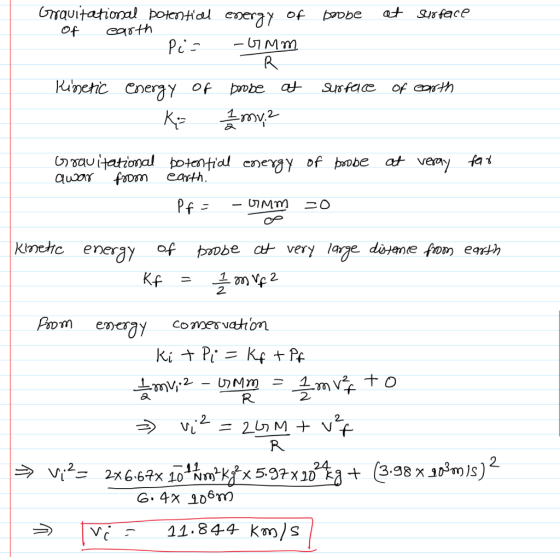
(1 point) At what speed should a space probe be fired from the earth if it...
A space probe is fired as a projectile from the Earth’s surface with an initial speed...
A space probe is fired as a projectile from the Earth’s surface with an initial speed of 1.75*10^ 4 m/s . What will its speed be when it is very far from the Earth? Ignore atmospheric friction and the rotation of the Earth
(a) Imagine that a space probe could be fired as a projectile from the Earth's surface...
(a) Imagine that a space probe could be fired as a projectile from the Earth's surface with an initial speed of 4.98 104 m/s relative to the Sun. What would its speed be when it is very far from the Earth (in m/s)? Ignore atmospheric friction, the effects of other planets, and the rotation of the Earth. (Consider the mass of the Sun in your calculations.) (b) What If? The speed provided in part (a) is very difficult to achieve...
A space probe on the surface of Mars sends a radio signal back to the Earth,...
A space probe on the surface of Mars sends a radio signal back to the Earth, a distance of 7.03 x 10⁷ km. Radio waves travel at the speed of light (3.00 108 m/s). How many seconds does it take for the signal to reach the Earth?
A space probe is to travel from Earth to a refueling station 5.05 ly away. At...
A space probe is to travel from Earth to a refueling station 5.05 ly away. At what speed must the probe travel in order for the Earth–station distance to be 2.45 ly, when measured in the reference frame of the probe? Express your answer as a multiple of c, the speed of light in a perfect vacuum. c
Question 2 A space agency plans to send a probe to the Sun by launching it...
 Question 2 A space agency plans to send a probe to the Sun by launching it into an elliptical orbit with apoapsis at the Earth, which orbits a distance ae = 150 x 10km from the Sun. The probe is designed to withstand temperatures at a periapsis equal to ten times the Sun's radius Rs, where Rs = 696 x 10'km. a) Calculate the eccentricity of the elliptical orbit. (3 marks) (b) Assume that the probe is placed into the...
1. An 8000 kg satellite is launched from the surface of the Earth into outer space....
1. An 8000 kg satellite is launched from the surface of the Earth into outer space. What initial speed is needed by the satellite in order to reach a great (i.e., infinite) distance from the Earth, neglecting the effects of air resistance in the atmosphere? (G = 6.67 × 10⁻¹¹ N·m2/kg2, ME = 5.97 × 1024 kg, RE = 6.37 × 10⁶ m.) A)9,200 m/s. B)18,900 m/s. C)11,180 m/s. D)25,200 m/s. E)8,450 m/s.
10-69 part A only! dynamics problem the ans should be 20.2Mm the earth 10.69 A spacecraft...
 10-69 part A only!
dynamics problem
the ans should be 20.2Mm
the earth 10.69 A spacecraft is describing a circular orbit of 12-Mm radius around tbe earth when its rockets are fired momentarily to increase the speed of the spacecraft by 1 km/s. The spacecraft is thus inserted into an elliptic orbit as shown. For the spacecraft in this elliptic orbit, determine (a) the 12 Mm ximum altitude, (b) its period of orbit, 10.70 A spacecraft coasting along a parabolic...
10-69 part A only!
dynamics problem
the ans should be 20.2Mm
the earth 10.69 A spacecraft is describing a circular orbit of 12-Mm radius around tbe earth when its rockets are fired momentarily to increase the speed of the spacecraft by 1 km/s. The spacecraft is thus inserted into an elliptic orbit as shown. For the spacecraft in this elliptic orbit, determine (a) the 12 Mm ximum altitude, (b) its period of orbit, 10.70 A spacecraft coasting along a parabolic...
please show every detail. thanks Chapter 26: (HI-6) deep-space probe moves away from Earth with a...
 please show every detail. thanks
Chapter 26: (HI-6) deep-space probe moves away from Earth with a speed of v. The probe measures a time duration, , required to rotate its antenna through exactly one complete rotation. (a) In the form of an equation, how much time is required for exactly one complete rotation of the probe's antenna according to an observer on Earth? (b) Use your equation from part (a) to calculate the time as measured by the Earth observer...
please show every detail. thanks
Chapter 26: (HI-6) deep-space probe moves away from Earth with a speed of v. The probe measures a time duration, , required to rotate its antenna through exactly one complete rotation. (a) In the form of an equation, how much time is required for exactly one complete rotation of the probe's antenna according to an observer on Earth? (b) Use your equation from part (a) to calculate the time as measured by the Earth observer...
the spacecraft traveling at 0.99c continues on to space station positioned 1.5x10^9km from earth(according to earth...
the spacecraft traveling at 0.99c continues on to space station positioned 1.5x10^9km from earth(according to earth measurements). how many hours, as measured on earth and as measured on the spaceship of food and air would the astronauts in the spacecraft need if the continue at a speed of 0.99c need to get there? 1. how far would the astronauts on the moving space ship think the distance from earth to the space station was? 2.suppose a light beam from earth...
80.A spacecraft is approaching Mars after a long trip from the Earth. Its velocity is such...
 80.A spacecraft is approaching Mars after a long trip from the Earth. Its velocity is such that it is traveling along a parabolic trajectory under the influence of the gravitational force from Mars. The distance of closest approach will be 300 km above the Martian surface. At this point of closest approach, the engines will be fired to slow down the spacecraft and place it in a circular orbit 300 km above the surface. (a) By what percentage must the...
 Question 2 A space agency plans to send a probe to the Sun by launching it into an elliptical orbit with apoapsis at the Earth, which orbits a distance ae = 150 x 10km from the Sun. The probe is designed to withstand temperatures at a periapsis equal to ten times the Sun's radius Rs, where Rs = 696 x 10'km. a) Calculate the eccentricity of the elliptical orbit. (3 marks) (b) Assume that the probe is placed into the...
 10-69 part A only!
dynamics problem
the ans should be 20.2Mm
the earth 10.69 A spacecraft is describing a circular orbit of 12-Mm radius around tbe earth when its rockets are fired momentarily to increase the speed of the spacecraft by 1 km/s. The spacecraft is thus inserted into an elliptic orbit as shown. For the spacecraft in this elliptic orbit, determine (a) the 12 Mm ximum altitude, (b) its period of orbit, 10.70 A spacecraft coasting along a parabolic...
10-69 part A only!
dynamics problem
the ans should be 20.2Mm
the earth 10.69 A spacecraft is describing a circular orbit of 12-Mm radius around tbe earth when its rockets are fired momentarily to increase the speed of the spacecraft by 1 km/s. The spacecraft is thus inserted into an elliptic orbit as shown. For the spacecraft in this elliptic orbit, determine (a) the 12 Mm ximum altitude, (b) its period of orbit, 10.70 A spacecraft coasting along a parabolic...
 please show every detail. thanks
Chapter 26: (HI-6) deep-space probe moves away from Earth with a speed of v. The probe measures a time duration, , required to rotate its antenna through exactly one complete rotation. (a) In the form of an equation, how much time is required for exactly one complete rotation of the probe's antenna according to an observer on Earth? (b) Use your equation from part (a) to calculate the time as measured by the Earth observer...
please show every detail. thanks
Chapter 26: (HI-6) deep-space probe moves away from Earth with a speed of v. The probe measures a time duration, , required to rotate its antenna through exactly one complete rotation. (a) In the form of an equation, how much time is required for exactly one complete rotation of the probe's antenna according to an observer on Earth? (b) Use your equation from part (a) to calculate the time as measured by the Earth observer...
 80.A spacecraft is approaching Mars after a long trip from the Earth. Its velocity is such that it is traveling along a parabolic trajectory under the influence of the gravitational force from Mars. The distance of closest approach will be 300 km above the Martian surface. At this point of closest approach, the engines will be fired to slow down the spacecraft and place it in a circular orbit 300 km above the surface. (a) By what percentage must the...
Most questions answered within 3 hours.
-
Where is the error in this code sequence?
String s1 = "Hello";
String s2 = "ello";...
asked 10 months ago -
Financial data for Joel de Paris, Inc., for last year
follow:
Joel de Paris, Inc.
Balance...
asked 10 months ago -
Consider this reaction:
Al2(SO4)3 (aq)+ BaCl3
(aq) Al2Cl6 (aq)- +
3BaSO4(s) . What is the...
asked 10 months ago -
Suppose that Savneet is considering increasing her
recent random sample from 20 car rentals to 40...
asked 10 months ago -
Trucks arrive at an unloading terminal at an average rate of 120
per hour.
Trucks arrive...
asked 10 months ago -
Why are methanol and ethanol completely soluble in water while
octanol is not very little soluble....
asked 10 months ago -
A facilities manager at a university reads in a research report
that the mean amount of...
asked 10 months ago -
When the CuSO4 is rehydrated by adding water to the anhydrous
compound, is this an endothermic...
asked 10 months ago -
A ray of sunlight is passing from diamond into crown glass; the
angle of incidence is...
asked 10 months ago -
A block of mass 0.249 kg is placed on top of a light, vertical
spring of...
asked 10 months ago -
how do the kidneys compensate in the presences of acidosis
a) trigger hyperventilate
b) reserve acid...
asked 10 months ago -
Question 501 pts
The rental rate of capital to the firm increases. Which of the
following...
asked 10 months ago