 please show work for the answer
Homework Answers
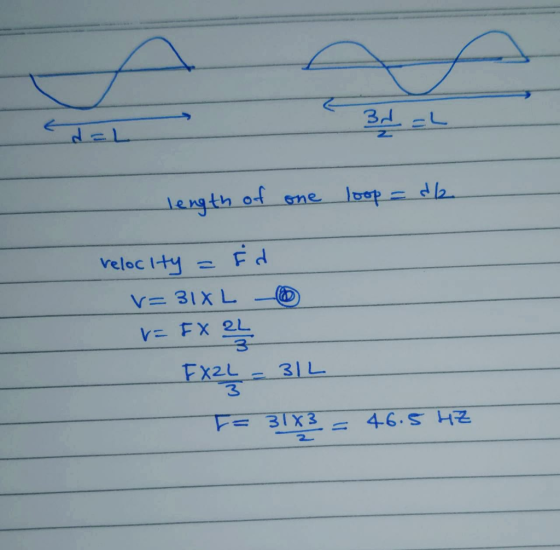
Add Answer to:
please show work for the answer
The standing wave shown below is created on a string...
A standing wave pattern is created on a string with mass density μ = 3.1 ×...
A standing wave pattern is created on a string with mass density μ = 3.1 × 10⁻⁴ kg/m. A wave generator with frequency f = 68 Hz is attached to one end of the string and the other end goes over a pulley and is connected to a mass (ignore the weight of the string between the pulley and mass). The distance between the generator and pulley is L = 0.62 m. Initially the 3rd harmonic wave pattern is formed....
A standing wave pattern is created on a string with mass density u- 3x 10 kg/m....
 A standing wave pattern is created on a string with mass density u- 3x 10 kg/m. A wave generator with frequency f- 65 Hz is attached to one end of the string and the other end goes over a pulley and is connected to a mass (ignore the weight of the string between the pulley and mass). The distance between the generator and pulley is L- 0.74 m. Initially the 3rd harmonic wave pattern is formed. What is the wavelength...
An electromagnet is used to create the standing wave pattern shown below. The string of 6...
 An electromagnet is used to create the standing wave pattern shown below. The string of 6 grams and a length of 150 cm. The tension in the string is created by the 250 gram hanging a) Determine the wavelength lambda of the travelling waves. b) Determine the speed of the travelling waves. c) Determine the frequency f and period of the travelling waves.
Part B & C please. A standing wave is set up in a 200-cm string fixed...
 Part B & C please.
A standing wave is set up in a 200-cm string fixed at both ends. The string vibrates in 5 distinct segments when driven by a 120-Hz source. (a) What is the wavelength of the wave? a. 10 cm b. 20 cm c. 40 cm d. 80 cm e. 100 cm What is the fundamental frequency for this string? a. 48 Hz b. 12 Hz c. 24 Hz d. 86 Hz e. 240 Hz
Part B & C please.
A standing wave is set up in a 200-cm string fixed at both ends. The string vibrates in 5 distinct segments when driven by a 120-Hz source. (a) What is the wavelength of the wave? a. 10 cm b. 20 cm c. 40 cm d. 80 cm e. 100 cm What is the fundamental frequency for this string? a. 48 Hz b. 12 Hz c. 24 Hz d. 86 Hz e. 240 Hz
Question 17 (1 point) Consider the standing wave pattern below created by a string fixed at...
 Question 17 (1 point) Consider the standing wave pattern below created by a string fixed at both ends. The string is under a tension of 0.98 N and has a mass of 2.0 grams. What is the frequency of the standing wave? y (m) =>*(m) o 1.0 2.0 3.0 O 1.2 Hz O 38 Hz O 78 Hz O 0.60 Hz O 19 Hz Question 18 (1 point) The below positively charged particle passes through a region containing uniform electric...
A 3.00 meter long string oscillates in the standing wave pattern shown to the right with...
 A 3.00 meter long string oscillates in the standing wave pattern shown to the right with a wave speed of 100 m/s. What is the fundamental frequency for this string? 8.33 Hz 16.7 Hz 25 Hz 1.67 Hz 3.38 Hz
A 3.00 meter long string oscillates in the standing wave pattern shown to the right with...
 A 3.00 meter long string oscillates in the standing wave pattern shown to the right with a wave speed of 100 m/s. What is the fundamental frequency for this string? 8.33 Hz O 16.7 Hz 25 Hz 1.67 Hz O 3.38 Hz
part 1. A 9.00-m long string sustains a three-loop standing wave pattern as shown. The string...
part 1. A 9.00-m long string sustains a three-loop standing wave pattern as shown. The string has a mass of 45 g and under a tension of 50 N. a. What is the frequency of vibration? b. At the same frequency, you wish to see four loops, what tension you need to use. Part 2. a. Determine the shortest length of pipe, open at both ends, which will resonate at 256 Hz (so the first harmonics is 256Hz). The speed...
1. How many wavelengths are shown in the standing wave pattern pictured below? 2. If the...
 1. How many wavelengths are shown in the standing wave pattern pictured below? 2. If the standing wave in question 1 is created using a string with linear mass density of 0.0003 kg/m and under tension of 5 N, what is the speed of the wave? 3. If the length of the string in questions 1 and 2 is 1 m, what is the frequency of the wave? 4. A standing wave is produced in a hollow tube as shown...
please show reasoning and work for the answer. The fundamental (n = 1 harmonic or mode)...
 please show reasoning and work for the answer.
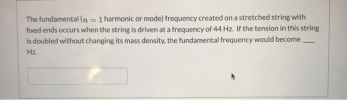
The fundamental (n = 1 harmonic or mode) frequency created on a stretched string with fixed ends occurs when the string is driven at a frequency of 44 Hz. If the tension in this string is doubled without changing its mass density, the fundamental frequency would become Hz.
please show reasoning and work for the answer.
The fundamental (n = 1 harmonic or mode) frequency created on a stretched string with fixed ends occurs when the string is driven at a frequency of 44 Hz. If the tension in this string is doubled without changing its mass density, the fundamental frequency would become Hz.
 A standing wave pattern is created on a string with mass density u- 3x 10 kg/m. A wave generator with frequency f- 65 Hz is attached to one end of the string and the other end goes over a pulley and is connected to a mass (ignore the weight of the string between the pulley and mass). The distance between the generator and pulley is L- 0.74 m. Initially the 3rd harmonic wave pattern is formed. What is the wavelength...
 An electromagnet is used to create the standing wave pattern shown below. The string of 6 grams and a length of 150 cm. The tension in the string is created by the 250 gram hanging a) Determine the wavelength lambda of the travelling waves. b) Determine the speed of the travelling waves. c) Determine the frequency f and period of the travelling waves.
 Part B & C please.
A standing wave is set up in a 200-cm string fixed at both ends. The string vibrates in 5 distinct segments when driven by a 120-Hz source. (a) What is the wavelength of the wave? a. 10 cm b. 20 cm c. 40 cm d. 80 cm e. 100 cm What is the fundamental frequency for this string? a. 48 Hz b. 12 Hz c. 24 Hz d. 86 Hz e. 240 Hz
Part B & C please.
A standing wave is set up in a 200-cm string fixed at both ends. The string vibrates in 5 distinct segments when driven by a 120-Hz source. (a) What is the wavelength of the wave? a. 10 cm b. 20 cm c. 40 cm d. 80 cm e. 100 cm What is the fundamental frequency for this string? a. 48 Hz b. 12 Hz c. 24 Hz d. 86 Hz e. 240 Hz
 Question 17 (1 point) Consider the standing wave pattern below created by a string fixed at both ends. The string is under a tension of 0.98 N and has a mass of 2.0 grams. What is the frequency of the standing wave? y (m) =>*(m) o 1.0 2.0 3.0 O 1.2 Hz O 38 Hz O 78 Hz O 0.60 Hz O 19 Hz Question 18 (1 point) The below positively charged particle passes through a region containing uniform electric...
 A 3.00 meter long string oscillates in the standing wave pattern shown to the right with a wave speed of 100 m/s. What is the fundamental frequency for this string? 8.33 Hz 16.7 Hz 25 Hz 1.67 Hz 3.38 Hz
 A 3.00 meter long string oscillates in the standing wave pattern shown to the right with a wave speed of 100 m/s. What is the fundamental frequency for this string? 8.33 Hz O 16.7 Hz 25 Hz 1.67 Hz O 3.38 Hz
 1. How many wavelengths are shown in the standing wave pattern pictured below? 2. If the standing wave in question 1 is created using a string with linear mass density of 0.0003 kg/m and under tension of 5 N, what is the speed of the wave? 3. If the length of the string in questions 1 and 2 is 1 m, what is the frequency of the wave? 4. A standing wave is produced in a hollow tube as shown...
 please show reasoning and work for the answer.
The fundamental (n = 1 harmonic or mode) frequency created on a stretched string with fixed ends occurs when the string is driven at a frequency of 44 Hz. If the tension in this string is doubled without changing its mass density, the fundamental frequency would become Hz.
please show reasoning and work for the answer.
The fundamental (n = 1 harmonic or mode) frequency created on a stretched string with fixed ends occurs when the string is driven at a frequency of 44 Hz. If the tension in this string is doubled without changing its mass density, the fundamental frequency would become Hz.
Most questions answered within 3 hours.
-
Where is the error in this code sequence?
String s1 = "Hello";
String s2 = "ello";...
asked 10 months ago -
Financial data for Joel de Paris, Inc., for last year
follow:
Joel de Paris, Inc.
Balance...
asked 10 months ago -
Consider this reaction:
Al2(SO4)3 (aq)+ BaCl3
(aq) Al2Cl6 (aq)- +
3BaSO4(s) . What is the...
asked 10 months ago -
Suppose that Savneet is considering increasing her
recent random sample from 20 car rentals to 40...
asked 10 months ago -
Trucks arrive at an unloading terminal at an average rate of 120
per hour.
Trucks arrive...
asked 10 months ago -
Why are methanol and ethanol completely soluble in water while
octanol is not very little soluble....
asked 10 months ago -
A facilities manager at a university reads in a research report
that the mean amount of...
asked 10 months ago -
When the CuSO4 is rehydrated by adding water to the anhydrous
compound, is this an endothermic...
asked 10 months ago -
A ray of sunlight is passing from diamond into crown glass; the
angle of incidence is...
asked 10 months ago -
A block of mass 0.249 kg is placed on top of a light, vertical
spring of...
asked 10 months ago -
how do the kidneys compensate in the presences of acidosis
a) trigger hyperventilate
b) reserve acid...
asked 10 months ago -
Question 501 pts
The rental rate of capital to the firm increases. Which of the
following...
asked 10 months ago