A firm is engaged in the production and packaging of sausages. The possibility of expanding its...
A firm is engaged in the production and packaging of
sausages. The possibility of expanding its
production facilities through a total investment of € 1,200,000
with a 5-years duration is being
considered. The characteristics of financing this investment are
presented as follows:
i. The 300,000€ is extracted from the company's increase in share
capital. The share price is
5€, the current dividend is 0.25€ and the annual growth rate of
these shares is estimated
at 8%. The valuation model is this of stable dividend growth.
ii. The € 600,000 is extracted from a 5-year bond loan, with a face
value of € 1,000 and an
interest rate of 8% on issue. At the time of issue, the bond price
was 1,000 euro.
iii. The rest amount will be covered by a 5-year bank loan with a
fixed interest rate of 6%. The
tax rate is 29%.
Α. Considering that the new investment belongs to the same risk
category as the existing firm’s assets
and that the market is in equilibrium, calculate:
A1. The cost of the equity.
Α2. The pre-tax cost of the bond loan.
Α3. The Weighted Average Cost of Capital of the investment
(WACC).
Β. In the above investment, at the beginning of the third year, the
share price is € 3, the dividend of
the current year is 0.2€, with 7% growth rate in the future, while
the bond price in the secondary
market is €948. Calculate the new (at the beginning of the third
year):
B1. Cost of the equity.
B2. Pre-tax cost of the bond loan.
B3. The Weighted Average Cost of Capital of the investment
(WACC)
C. In another scenario, assume that ABC has set a target of 9%
weighted average cost of capital
(WACC). We assume that Company has two sources of funding: equity
and debt. In addition, we
assume that the company displays before tax 7% cost of debt and 11%
cost of equity. The tax rate is
29%. Estimate which percentage of total capital should be equity
and which percentage should be debt
in order the company to achieve the desired WACC.
Homework Answers
| A | Total Capital Required for Expanding Production Facilities | € 1,200,000.00 |
| Source of finance - | ||
| New Share Capital | € 300,000.00 | |
| Bond Issue , 5 year | € 600,000.00 | |
| Bank Loan | € 300,000.00 | |
| Share Price (Po) | € 5.00 | |
| Current Dividend (D) | € 0.25 | |
| Annual growth rate (g) | 8.00% | |
| Bond Face value | € 1,000.00 | |
| Bond Price at the time of issue | € 1,000.00 | |
| Interest rate of Bond | 8.00% | |
| Fixed Interest rate-Bank Loan | 6.00% | |
| Tax rate | 29% | |
| A1 | Cost of Equity | |
|
According to Gordon's Model, Cost of Equity(Ke) can be calculated with following formula Ke = 0.25/5 + 0.08 |
Where, D = Dividend Po = Share price g = growth rate |
|
| Cost of Equity (Ke) | 13.00% |
| A2 | Pre-tax cost of Bond Loan | |
| Yield rate is cost of bond for company and when Face value and Price of Bond is equal then Yield rate also equal to interest (coupon) rate of Bond. Therefore, | ||
| Pre-tax cost of Bond Loan | 8.00% |
| A3 | Weighted Average cost of Capital (WACC) | |||
|
Post-tax WACC = |
Where, W = Weights Kd = post tax cost of Loan Kb = post tax cost of Bond |
|||
| Post-tax cost of Bond = Kb(1-t) | 5.68% | |||
| Post-tax cost of Loan = Kd(1-t) | 4.26% | |||
| Source of Finance | Weight(W) | Cost(C) | W*C | |
| Equity | 0.25 | 13.00% | 0.0325 | |
| Bond | 0.5 | 5.68% | 0.0284 | |
| Bank Loan | 0.25 | 4.26% | 0.0107 | |
| Post-tax WACC | 7.16% |
| B | At the beginning of third year | |
| Price of share (P) | 3 | |
| Dividend (D) | 0.2 | |
| Growth rate (g) | 7% | |
| Bond Price in secondary market | 948 | |
| Maturity of bond | 5 years | |
| At the Beginning of 3rd year | ||
| B1 | Cost of Equity | |
|
According to Gordon's Model, Cost of Equity(Ke) can be calculated with following formula Ke = 0.2/3 + 0.07 |
||
| Cost of Equity (Ke) | 13.67% | |
| B2 | Pre-tax cost of Bond Loan (Kb) | |
|
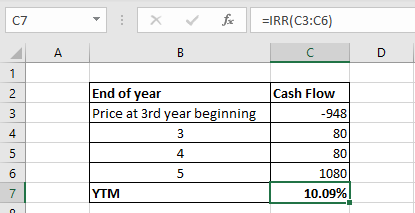
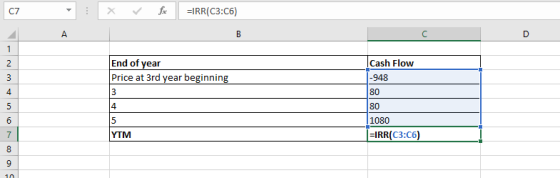
Yield rate is cost of bond for company .Yield to Maturity (YTM) is rate at which Present value of future cash flow equals to current bond price. We can calculate Yield rate with following formula Alternatively, can be calculated with "=irr" formula in excel. Please refer below image for calculation of yield rate. |
||
| Pre-tax cost of Bond Loan | 10.09% |
Formula reference -
| B3 | Weighted Average cost of Capital (WACC) | |||
|
Post-tax WACC = |
||||
| Post-tax cost of Bond = Kb(1-t) | 7.17% | |||
| Post-tax cost of Loan = Kd(1-t) | 4.26% | |||
| Source of Finance | Weight(W) | Cost(C) | W*C | |
| Equity | 0.25 | 13.67% | 0.0342 | |
| Bond | 0.5 | 7.17% | 0.0358 | |
| Bank Loan | 0.25 | 4.26% | 0.0107 | |
| Post-tax WACC | 8.07% |
| C | Target WACC | 9% | |
| Cost of Equity (ke) | 11% | ||
| post-tax cost of debt (kd) = 7%(1-0.29) | 4.97% | ||
| Weight of Equity | W1 | ||
| Weigh of Debt | (1-W1) | ||
|
Target WACC = Ke*W1 + Kd*(1-W1) 0.09 = 0.11*W1 + 0.0497(1-W1) 0.09 = 0.11W1 + 0.0497% - 0.0497W1 0.0603W1 = 0.0403 W1 = 0.0403/0.0603 W1 = 0.67 |
|||
| W1 | 0.67 | ||
| W2 | 0.33 |
ePo 80 1080 80 Priceo fBond C7 End of year Price at 3rd year beginning Cash Flow 948 80 80 1080 4 4 10.09%)
Add Answer to:
A firm is engaged in the production and packaging of
sausages. The possibility of expanding its...
Your firm is considering a new investment proposal and would like to calculate its weighted average...
Your firm is considering a new investment proposal and would like to calculate its weighted average cost of capital. To help in this, compute the cost of capital for the firm for the following: a. A bond that has a $1,000 par value (face value) and a contract or coupon interest rate of 11.4 percent that is paid semiannually. The bond is currently selling for a price of $1,129 and will mature in 10 years. The firm's tax rate is...
Subject 1 (30%) A. (20%) During the past years, ABG had limited its investment plans due...
 Subject 1 (30%) A. (20%) During the past years, ABG had limited its investment plans due to high cost of capital. Recently, however, the cost of capital seems to have fallen, and the management of the company is seriously considering the implementation of two major investment plans. Assume that you are the assistant of the ABG's financial director, who has assigned you to calculate the company's cost of capital. Your financial manager has provided the following information: 1. The corporate...
During the past years, ABG had limited its investment plans due to high cost of capital....
During the past years, ABG had limited its investment plans due to high cost of capital. Recently, however, the cost of capital seems to have fallen, and the management of the company is seriously considering the implementation of two major investment plans. Assume that you are the assistant of the ABG's financial director, who has assigned you to calculate the company's cost of capital. Your financial manager has provided the following information: 1. The corporate tax rate is 20%. 2....
During the past years, ABG had limited its investment plans due to high cost of capital....
During the past years, ABG had limited its investment plans due to high cost of capital. Recently, however, the cost of capital seems to have fallen, and the management of the company is seriously considering the implementation of two major investment plans. Assume that you are the assistant of the ABG's financial director, who has assigned you to calculate the company's cost of capital. Your financial manager has provided the following information: 1. The corporate tax rate is 20%. 2....
Exercise III Calculate Weighted average Cost of Capital. The company is financing its investments by bank...
 Exercise III Calculate Weighted average Cost of Capital. The company is financing its investments by bank loans (data given below). Additionally the external capital is being added by long term financing through bond issue with fixed coupon payments. Corporate tax rate is equal 19%. Based on these data please calculate WARD. Loan 1 Interest rate for loan 1 4600000 $ Loan 2 7,0% 3300000 $ Interest rate for loan 2 6,0% Total value of the bond 10 000 000 $...
Exercise III Calculate Weighted average Cost of Capital. The company is financing its investments by bank loans (dat...
 Exercise III Calculate Weighted average Cost of Capital. The company is financing its investments by bank loans (data given below). Additionally the external capital is being added by long term financing through bond issue with fixed coupon payments. Corporate tax rate is equal 19% . Based on these data please calculate WARD. Loan 1 4000000 $ Interest rate for loan 1 8.0% oan 2 2700000 $ Interest rate for loan 2 Total value of the bond 7.0% 10 000 000...
Valvano Publishing Company is trying to calculate its cost of capital for use in a capital...
Valvano Publishing Company is trying to calculate its cost of capital for use in a capital budgeting decision. Mr. Washburn, the vice-president of finance, has given you the following information and asked you to compute the weighted average cost of capital. The company currently has outstanding a bond with an 8.5 percent coupon rate and a convertible bond with a 5.4 percent rate. The firm has been informed by its investment dealer, Dean, Smith, and Company, that bonds of equal...
“BLACKFRIDAY” company is planning an expansion of its existing production capacity. The firm hired you as...
“BLACKFRIDAY” company is planning an expansion of its existing production capacity. The firm hired you as a consultant for the expansion project. Since you are a savvy project manager, you first decided to estimate the firm’s cost of capital based on the available data. Data: Tax Rate: 40% Bond: Coupon rate 12%, Maturity Years 15, Present value $1150 Preferred Stock: Dividend rate 10%, Par Value $100, Present Value $111 Common Stock: Market price $50, D0=$4.20, Dividend growth 5%, Beta 1.2,...
(Individual or component costs of capital) Your firm is considering a new investment proposal and would...
 (Individual or component costs of capital) Your firm is considering a new investment proposal and would like to calculate its weighted average cost of capital. To help in this, compute the cost of capital for the firm for the following: a. A bond that has a $1,000 par value (face value) and a contract or coupon interest rate of 12.1 percent that is paid semiannually. The bond is currently selling for a price of $1,123 and will mature in 10...
Brook's Window Shields Inc. is trying to calculate its cost of capital for use in a...
 Brook's Window Shields Inc. is trying to calculate its cost of capital for use in a capital budgeting decision Mr Glass, the vice-president of finance, has given you the following information and has asked you to compute the weighted average cost of capital The company currently has outstanding a bond with a 11.2 percent coupon rate and another bond with a 72 percent coupon rate. The firm has been informed by its investment banker that bonds of equal risk and...
 Subject 1 (30%) A. (20%) During the past years, ABG had limited its investment plans due to high cost of capital. Recently, however, the cost of capital seems to have fallen, and the management of the company is seriously considering the implementation of two major investment plans. Assume that you are the assistant of the ABG's financial director, who has assigned you to calculate the company's cost of capital. Your financial manager has provided the following information: 1. The corporate...
 Exercise III Calculate Weighted average Cost of Capital. The company is financing its investments by bank loans (data given below). Additionally the external capital is being added by long term financing through bond issue with fixed coupon payments. Corporate tax rate is equal 19%. Based on these data please calculate WARD. Loan 1 Interest rate for loan 1 4600000 $ Loan 2 7,0% 3300000 $ Interest rate for loan 2 6,0% Total value of the bond 10 000 000 $...
 Exercise III Calculate Weighted average Cost of Capital. The company is financing its investments by bank loans (data given below). Additionally the external capital is being added by long term financing through bond issue with fixed coupon payments. Corporate tax rate is equal 19% . Based on these data please calculate WARD. Loan 1 4000000 $ Interest rate for loan 1 8.0% oan 2 2700000 $ Interest rate for loan 2 Total value of the bond 7.0% 10 000 000...
 (Individual or component costs of capital) Your firm is considering a new investment proposal and would like to calculate its weighted average cost of capital. To help in this, compute the cost of capital for the firm for the following: a. A bond that has a $1,000 par value (face value) and a contract or coupon interest rate of 12.1 percent that is paid semiannually. The bond is currently selling for a price of $1,123 and will mature in 10...
 Brook's Window Shields Inc. is trying to calculate its cost of capital for use in a capital budgeting decision Mr Glass, the vice-president of finance, has given you the following information and has asked you to compute the weighted average cost of capital The company currently has outstanding a bond with a 11.2 percent coupon rate and another bond with a 72 percent coupon rate. The firm has been informed by its investment banker that bonds of equal risk and...
Most questions answered within 3 hours.
-
Where is the error in this code sequence?
String s1 = "Hello";
String s2 = "ello";...
asked 11 months ago -
Financial data for Joel de Paris, Inc., for last year
follow:
Joel de Paris, Inc.
Balance...
asked 11 months ago -
Consider this reaction:
Al2(SO4)3 (aq)+ BaCl3
(aq) Al2Cl6 (aq)- +
3BaSO4(s) . What is the...
asked 11 months ago -
Suppose that Savneet is considering increasing her
recent random sample from 20 car rentals to 40...
asked 11 months ago -
Trucks arrive at an unloading terminal at an average rate of 120
per hour.
Trucks arrive...
asked 11 months ago -
Why are methanol and ethanol completely soluble in water while
octanol is not very little soluble....
asked 11 months ago -
A facilities manager at a university reads in a research report
that the mean amount of...
asked 11 months ago -
When the CuSO4 is rehydrated by adding water to the anhydrous
compound, is this an endothermic...
asked 11 months ago -
A ray of sunlight is passing from diamond into crown glass; the
angle of incidence is...
asked 11 months ago -
A block of mass 0.249 kg is placed on top of a light, vertical
spring of...
asked 11 months ago -
how do the kidneys compensate in the presences of acidosis
a) trigger hyperventilate
b) reserve acid...
asked 11 months ago -
Question 501 pts
The rental rate of capital to the firm increases. Which of the
following...
asked 11 months ago