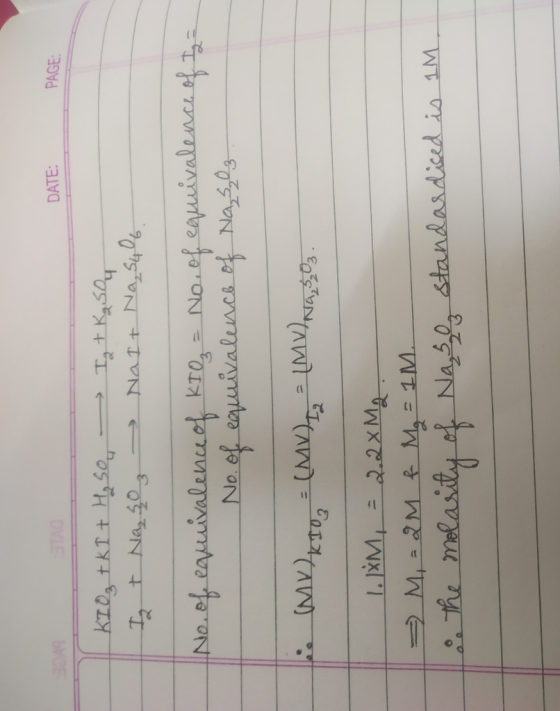
balance: KIO3(aq) + KI(aq) + H2SO4(aq) -----> I2(aq) + K2SO4(aq) I2(aq) + Na2S2O3(aq) ------> NaI(aq) + Na2S4O6(aq) &nb
balance:
KIO3(aq) + KI(aq) + H2SO4(aq) -----> I2(aq) + K2SO4(aq)
I2(aq) + Na2S2O3(aq) ------> NaI(aq) + Na2S4O6(aq)
Assume that 1.1 mL of the above potassium iodate solution
is measured and that 2.20 mL of the unstandardized sodium thiosulfate is required to
reach the endpoint. What is the molarity (M), now standardized, sodium
thiosulfate?
Homework Answers
Add Answer to:
balance:
KIO3(aq) + KI(aq) +
H2SO4(aq) -----> I2(aq) +
K2SO4(aq)
I2(aq) + Na2S2O3(aq)
------> NaI(aq) +
Na2S4O6(aq) &nb
Using the rules for balancing redox equations either from your textbook or from lecture, balance KIO3(aq)...
Using the rules for balancing redox equations either from your textbook or from lecture, balance KIO3(aq) + KI(aq) + H2SO4(aq) -----> I2(aq) + K2SO4 I2(aq) + Na2S2O3(aq) ---------> NaI(aq) + Na2S4O6(aq) . Note that these are molecular equations that use neutral chemical formulas and that the reactions occur in an acidic medium as indicated by the presence of sulfuric acid. It may be easier to “remove” the spectator ions and write the net ionic equation before you balance (Hint: Na+ and...
A solution of sodium thiosulfate, Na2S2O3, is 0.7707 M. 7.42 mL of this solution reacts with...
A solution of sodium thiosulfate, Na2S2O3, is 0.7707 M. 7.42 mL of this solution reacts with 24.81 mL of I2 solution. What is the molarity of the I2 solution? 2(Na2S2O3) + I2↔Na2S4O6 + 2(NaI) 20.28 mL of the I2 solution from above is required to titrate a sample containing As2O3. Calculate the mass of As2O3 (197.8 g/mol) in the sample. As2O3 + 5(H2O) + 2I2 → 2(H3AsO4) + 4HI
Calculate the molarities and normalities of the following solutions. The reactions are those given in problem...
Calculate the molarities and normalities of the following solutions. The reactions are those given in problem 1. 4.50 g of Hg(NO3)2 in 150.0 mL of solution 15.0 g of Ba(OH)2 in 1.15 L of solution 12.0 g of KCN in 200 mL of solution A solution of sodium thiosulfate, Na2S2O3 is standardized using pure potassium dichromate, K2Cr2O7, as the primary standard. A sample of K2Cr2O7 weighing 0.2263 g was dissolved, acidified, and excess KI added to liberate I2. The I2...
1. A sample contains an unknown amount of tartaric acid, H2C4H4O6. If 0.3888 g of the...
1. A sample contains an unknown amount of tartaric acid, H2C4H4O6. If 0.3888 g of the sample requires 37.74 mL of 0.1000 M NaOH to neutralize the H2C4H4O6 completely, what is the percentage of H2C4H4O6 in the sample? The molar mass of H2C4H4O6 is 150.09 g/mol. The balanced equation for the reaction is: H2C4H4O6 + 2 NaOH → 2 H2O + Na2C4H4O6 2. Sodium thiosulfate, Na2S2O3, is an important reagent for titrations. Its solutions can be standardized by titrating the...
15. The mixing of which pair of reactants will result in a precipitation reaction? CsI(aq)...
15. The mixing of which pair of reactants will result in a precipitation reaction? CsI(aq) + NaOH(aq) HCl(aq) + Ca(OH)2(aq) K2SO4(aq) + Hg2(NO3)2(aq) NaNO3(aq) + NH4Cl(aq) 16. Which of the following is a precipitation reaction? Zn(s) + 2 AgNO3(aq) 2 Ag(s) + Zn(NO3)2(aq) NaCl(aq) + LiI(aq) NaI(aq) + LiCl(aq) 2 KI(aq) + Hg2(NO3)2(aq) Hg2I2(s) + 2 KNO3(aq) HI(aq) + NaOH(aq) NaI(aq) + H2O(l) None of these are precipitation reactions. 17. Which...
I need it right now, please help me?? PROCEDURE PART I: DILUTING THE VINEGAR SOLUTION The...
 I
need it right now, please help me??
PROCEDURE PART I: DILUTING THE VINEGAR SOLUTION The vinegar solution must be diluted by a factor of 5 to be suitable for titration. 1. Obtain - 20 ml of the stock vinegar solution from the fume hood. 2. Using the 10-ml. pipet, pipet" 10 mL of the stock solution to a 50-ml volumetric flask. 3. Fill the volumetric flask to the calibration line with distilled water. Be sure not to go over...
I
need it right now, please help me??
PROCEDURE PART I: DILUTING THE VINEGAR SOLUTION The vinegar solution must be diluted by a factor of 5 to be suitable for titration. 1. Obtain - 20 ml of the stock vinegar solution from the fume hood. 2. Using the 10-ml. pipet, pipet" 10 mL of the stock solution to a 50-ml volumetric flask. 3. Fill the volumetric flask to the calibration line with distilled water. Be sure not to go over...
 I
need it right now, please help me??
PROCEDURE PART I: DILUTING THE VINEGAR SOLUTION The vinegar solution must be diluted by a factor of 5 to be suitable for titration. 1. Obtain - 20 ml of the stock vinegar solution from the fume hood. 2. Using the 10-ml. pipet, pipet" 10 mL of the stock solution to a 50-ml volumetric flask. 3. Fill the volumetric flask to the calibration line with distilled water. Be sure not to go over...
I
need it right now, please help me??
PROCEDURE PART I: DILUTING THE VINEGAR SOLUTION The vinegar solution must be diluted by a factor of 5 to be suitable for titration. 1. Obtain - 20 ml of the stock vinegar solution from the fume hood. 2. Using the 10-ml. pipet, pipet" 10 mL of the stock solution to a 50-ml volumetric flask. 3. Fill the volumetric flask to the calibration line with distilled water. Be sure not to go over...
Most questions answered within 3 hours.
-
Where is the error in this code sequence?
String s1 = "Hello";
String s2 = "ello";...
asked 11 months ago -
Financial data for Joel de Paris, Inc., for last year
follow:
Joel de Paris, Inc.
Balance...
asked 11 months ago -
Consider this reaction:
Al2(SO4)3 (aq)+ BaCl3
(aq) Al2Cl6 (aq)- +
3BaSO4(s) . What is the...
asked 11 months ago -
Suppose that Savneet is considering increasing her
recent random sample from 20 car rentals to 40...
asked 11 months ago -
Trucks arrive at an unloading terminal at an average rate of 120
per hour.
Trucks arrive...
asked 11 months ago -
Why are methanol and ethanol completely soluble in water while
octanol is not very little soluble....
asked 11 months ago -
A facilities manager at a university reads in a research report
that the mean amount of...
asked 11 months ago -
When the CuSO4 is rehydrated by adding water to the anhydrous
compound, is this an endothermic...
asked 11 months ago -
A ray of sunlight is passing from diamond into crown glass; the
angle of incidence is...
asked 11 months ago -
A block of mass 0.249 kg is placed on top of a light, vertical
spring of...
asked 11 months ago -
how do the kidneys compensate in the presences of acidosis
a) trigger hyperventilate
b) reserve acid...
asked 11 months ago -
Question 501 pts
The rental rate of capital to the firm increases. Which of the
following...
asked 11 months ago