In need of help 1 – List four factors that affect the strength of an acid....
In need of help
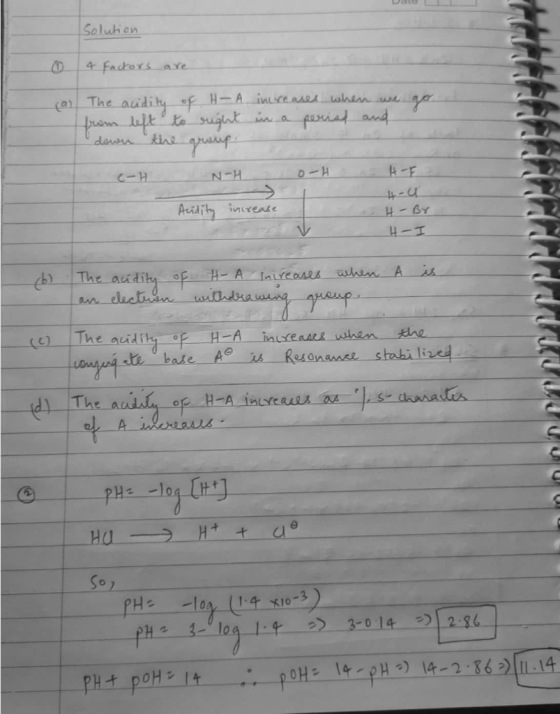
1 – List four factors that affect the strength of an acid. All four may not apply to every acid.
2 – Calculate [OH-] for a 1.4 x 10⁻³ M HCl solution.
3 – Calculate the pH of an aqueous solution at 25 ̊C at is 0.34 M in phenol (Ka = 1.3 x 10⁻¹⁰)
.4 – Calculate the concentration at which a monoprotic acid with Ka = 4.5 x 10⁻⁵ will be 2.5% ionized. (The percent ionization will yield the ratio of reactants and products at equilibrium.)
5 – Calculate the concentrations of H+, HCO3- and CO32- in a 0.025 M H2CO3 solution.
6 – Classify the following as a Lewis acid, Lewis base, both or neither:CO2, H2O, I-, SO2, NH3, OH-, H+, BCl37 –
7-Calculate the pH of a solution that is 0.20 M NH3 and 0.30 M NH4Cl.8 –
8-The pH of blood plasma is 7.40. Assuming the principal buffer system is HCO3-/H2CO3, calculate the ratio [HCO3-]/[H2CO3]
.9 – A 0.2688 g sample of a monoprotic acid neutralizes 16.4 mL of a 0.8133 M KOH solution. Calculate the molar mass of the acid.
10 – A 10.0 mL solution of 0.300 M ammonia is titrated with 0.100 M HCl solution. Calculate the pH aft ether following additions of HCl:a) 10.0 mLb) 30.0 mLc) 40.0 mL
11 – Calculate the concentration of I- ions in a solution of AgI with [Ag+] = 9.1 x 10⁻⁹ M.
12 – A solution of 0.060 M NaF (75 mL) is mixed with 0.15 M Sr(NO3)2 (25 mL). Calculate the concentrations of each ion after equilibrium is achieved given Ksp for SrF2 = 2.0 x 10⁻¹⁰.Hint: The ion exchange reaction to produce SrF2 can be considered to go to completion before equilibrium is reestablished starting from the products, much as we’ve done for titration calculations at the equivalence point.13 – a) Calculate the molar solubility of hydroxyapatite given Ksp = 2 x 10-59.b) Calculate the molar solubility of hydroxyapatite in a buffered solution of pH 4.0.You’ll need to find the formula for hydroxyapatite and its solvation reaction in order to write the equilibrium constant expression.
Homework Answers


Add Answer to:
In need of help
1 – List four factors that affect the strength of an acid....
HELP PLEASE 5 – Calculate the concentrations of H+, HCO3- and CO32- in a 0.025 M...
HELP PLEASE 5 – Calculate the concentrations of H+, HCO3- and CO32- in a 0.025 M H2CO3 solution. 6 – Classify the following as a Lewis acid, Lewis base, both or neither:CO2, H2O, I-, SO2, NH3, OH-, H+, BCl37 – 7-Calculate the pH of a solution that is 0.20 M NH3 and 0.30 M NH4Cl.8 – 8-The pH of blood plasma is 7.40. Assuming the principal buffer system is HCO3-/H2CO3, calculate the ratio [HCO3-]/[H2CO3] . 9 – A 0.2688 g...
12 – A solution of 0.060 M NaF (75 mL) is mixed with 0.15 M Sr(NO3)2...
12 – A solution of 0.060 M NaF (75 mL) is mixed with 0.15 M Sr(NO3)2 (25 mL). Calculate the concentrations of each ion after equilibrium is achieved given Ksp for SrF2 = 2.0 x 10⁻¹⁰.Hint: The ion exchange reaction to produce SrF2 can be considered to go to completion before equilibrium is reestablished starting from the products, much as we’ve done for titration calculations at the equivalence point 13 – a) Calculate the molar solubility of hydroxyapatite given Ksp...
A 0.2688 g sample of a monoprotic acid neutralized 16.4 mL of a 0.08133 M LioH...
 A 0.2688 g sample of a monoprotic acid neutralized 16.4 mL of a 0.08133 M LioH solution. Calculate the molar mass of the acid. 5) 6) The molar solubility of MnCOs is 4.2x 10. What is the Kp for this compound? 7) What is the pH of a saturated aluminum hydroxide solution?
1. A weak monoprotic acid has molar mass 180 g/mol. When 1.00 g of this acid is...
1. A weak monoprotic acid has molar mass 180 g/mol. When 1.00 g of this acid is dissolved in enough water to obtain a 300 mL solution, the pH of the resulting solution is found to be 2.62. What is the value of Ka for this acid? 2. A weak monoprotic acid has pKa = 3.08. Calculate the percent ionization of a 0.35 M solution of this acid. 3. Calculate the pH of a solution that is 0.050 M in CH3COOH...
3. i). Write the formula of four strong acids and four strong bases. ii). List four...
 3. i). Write the formula of four strong acids and four strong bases. ii). List four factors that affect the strength of an acid. iii). Predict the relative strength of the following compounds: H2O, H2S and H2Se. iv). Which of the following is the stronger acids: CHCICOOH or CHCI-COOH? Explain. v). Al 3* is not a Bronsted acid, Al(H2O)" is. Explain. vi). All Bronsted acids are Lewis acids, but the reverse is not true. Give two examples of two Lewis...
1. In a 0.200 M solution of an unknown acid, the pH is 5.004. Calculate the...
1. In a 0.200 M solution of an unknown acid, the pH is 5.004. Calculate the Ka for this monoprotic acid 2. A 500.0 mL solution of HCl has a pH of 4.50. How many grams of HCl are there in this solution? The molar mass of HCl is 36.5g/mol. 3. Calculate the pOH of a 0.20 molar solution of NaOH.
1) Consider a 0.040 M solution of carbonic acid. Calculate the pH of this solution as well as the equilibrium concentra...
 1) Consider a 0.040 M solution of carbonic acid. Calculate the pH of this solution as well as the equilibrium concentrations of: [H2CO3], [HCO3-], [H3O+], and [CO32-). H2CO3 + H20 5 HCO3 + H30+ K1 = 4.45 x 10⁻⁷ HCO3 + H20 5 CO32- + H30+ K2 = 4.69 x 10⁻¹¹
1) Which one of the following is a Bronsted-Lowry acid? A) (CH3)3NH+ B) CH3COOH C) HNO2...
1) Which one of the following is a Bronsted-Lowry acid? A) (CH3)3NH+ B) CH3COOH C) HNO2 D) all of the above 2) Which one of the following statements regarding Kw is false? A) pKw is 14.00 at 25 °C. B) The value of Kw is always 1.0 × 10⁻¹⁴. C) Kw changes with temperature. D) The value of Kw shows that water is a weak acid. 3) The Ka of benzoic acid is 6.30 × 10⁻⁵. The pH of a...
1) What is the pH when 5.00 mL of 0.200 M NaOH has been added to...
1) What is the pH when 5.00 mL of 0.200 M NaOH has been added to 50.00 mL of 0.100 M CH3CO2? Strategy Step 1: Use stoichiometry of the neutralization to determine the amounts of acid and conjugate base present in solution Step 2: Solve for equilibrium concentrations using ICE tables or Henderson-Hasselbalch approximation 2) Calculate the molar solubility of silver chromate in pure water. Ksp = 1.12 x 10¯12 3) Calculate Kb for the acetate ion from the Ka...
In waters affected by acid rain the concentrations of the three carbonic acid species (H2CO3, HCO3-,...
In waters affected by acid rain the concentrations of the three carbonic acid species (H2CO3, HCO3-, CO32-) are determined by concentration of the strong acid deposited by acid rain, as well as the concentration of H2CO3 which is controlled by the solubility of carbon dioxide . Under these conditions (constant H2CO3 and relatively low pH) the only carbonic acid equilbrium of importance is the conjugate base reaction of HCO3-, which is related to, but not identical to - and not...
 A 0.2688 g sample of a monoprotic acid neutralized 16.4 mL of a 0.08133 M LioH solution. Calculate the molar mass of the acid. 5) 6) The molar solubility of MnCOs is 4.2x 10. What is the Kp for this compound? 7) What is the pH of a saturated aluminum hydroxide solution?
 3. i). Write the formula of four strong acids and four strong bases. ii). List four factors that affect the strength of an acid. iii). Predict the relative strength of the following compounds: H2O, H2S and H2Se. iv). Which of the following is the stronger acids: CHCICOOH or CHCI-COOH? Explain. v). Al 3* is not a Bronsted acid, Al(H2O)" is. Explain. vi). All Bronsted acids are Lewis acids, but the reverse is not true. Give two examples of two Lewis...
 1) Consider a 0.040 M solution of carbonic acid. Calculate the pH of this solution as well as the equilibrium concentrations of: [H2CO3], [HCO3-], [H3O+], and [CO32-). H2CO3 + H20 5 HCO3 + H30+ K1 = 4.45 x 10⁻⁷ HCO3 + H20 5 CO32- + H30+ K2 = 4.69 x 10⁻¹¹
Most questions answered within 3 hours.
-
Where is the error in this code sequence?
String s1 = "Hello";
String s2 = "ello";...
asked 11 months ago -
Financial data for Joel de Paris, Inc., for last year
follow:
Joel de Paris, Inc.
Balance...
asked 11 months ago -
Consider this reaction:
Al2(SO4)3 (aq)+ BaCl3
(aq) Al2Cl6 (aq)- +
3BaSO4(s) . What is the...
asked 11 months ago -
Suppose that Savneet is considering increasing her
recent random sample from 20 car rentals to 40...
asked 11 months ago -
Trucks arrive at an unloading terminal at an average rate of 120
per hour.
Trucks arrive...
asked 11 months ago -
Why are methanol and ethanol completely soluble in water while
octanol is not very little soluble....
asked 11 months ago -
A facilities manager at a university reads in a research report
that the mean amount of...
asked 11 months ago -
When the CuSO4 is rehydrated by adding water to the anhydrous
compound, is this an endothermic...
asked 11 months ago -
A ray of sunlight is passing from diamond into crown glass; the
angle of incidence is...
asked 11 months ago -
A block of mass 0.249 kg is placed on top of a light, vertical
spring of...
asked 11 months ago -
how do the kidneys compensate in the presences of acidosis
a) trigger hyperventilate
b) reserve acid...
asked 11 months ago -
Question 501 pts
The rental rate of capital to the firm increases. Which of the
following...
asked 11 months ago