For the fair 6-sided die, what is F(3)? F(7)? F(1.5)?
For the fair 6-sided die, what is F(3)? F(7)? F(1.5)?
Homework Answers
here as F(x) is cumulative distribution function which represent probability of getting x or lower then that
therefore F(x)=P(X<=x)
1)F(3)=P(X<=3)=P(X=1)+P(X=2)+P(X=3)=(1/6)+(1/6)+(1/6)=3/6 =1/2
2) F(7)=P(X<=7)=P(X=1)+P(X=2)+P(X=3)+P(X=4)+P(X=5)+P(X=6)+P(X=7)
=(1/6)+(1/6)+(1/6)+(1/6)+(1/6)+(1/6)+0 =1
3)F(1.5)=P(X<=1.5)=P(X=1)=1/6
* Question 1: For the six-sided fair die, what is fk if k= 7? k= 1.5?...
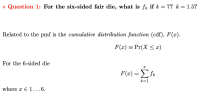 * Question 1: For the six-sided fair die, what is fk if k= 7? k= 1.5? Related to the pmf is the cumulative distribution function (edf) F() For the 6-sided die TC where x E1...6.
If we roll a red 6-sided die and a green 6-sided die (both are fair dice...
If we roll a red 6-sided die and a green 6-sided die (both are fair dice with the numbers 1-6 equally likely to be rolled), what is the probability that we get (i) A 5 on the green die AND a 3 on the red die? (ii) A 5 on the green die OR a 3 on the red die? (iii) A 5 on the green die GIVEN we rolled a 3 on the red die?
7. (3 points) Given a fair 6-sided die. Each time the die is rolled, the probabilities...
 7. (3 points) Given a fair 6-sided die. Each time the die is rolled, the probabilities of rolling any of the numbers from 1 to 6 are all equal. 1) If it is rolled once and let A be the event of rolling a number larger than 3 and B be the event of rolling an odd number. What is P(AV B)? 2) If it is rolled three times, what is the probability that the same number shows up in...
A 20-sided fair die and an 8-sided fair die are rolled. What is the probability of...
A 20-sided fair die and an 8-sided fair die are rolled. What is the probability of rolling: exactly a 5 on the first die OR a 2 or larger on the second die? Enter your answer as a reduced fraction. ________________
We roll a fair 8-sided die five times. (A fair 8-sided die is equally likely to...
 We roll a fair 8-sided die five times. (A fair 8-sided die is equally likely to be 1, 2, 3, 4, 5, 6, 7, or 8.) (a) What is the probability that at least one of the rolls is a 3? (b) Let X be the number of different values rolled. For example, if the five rolls are 2, 3, 8, 8, 7, then X = 4 (since four different values were rolled: 2,3,7,8). Find E[X].
3. A fair coin is tossed, and a fair six-sided die is rolled. What is the...
 3. A fair coin is tossed, and a fair six-sided die is rolled. What is the probability that the coin come up heads and the die will come up 1 or 2? A. 1/2 B. 1/4 C. 1/6 E. 1/3
Suppose that Adam rolls a fair six-sided die and a fair four-sided die simultaneously. Let A...
Suppose that Adam rolls a fair six-sided die and a fair four-sided die simultaneously. Let A be the event that the six-sided die is an even number and B be the event that the four-sided die is an odd number. Using the sample space of possible outcomes below, answer each of the following questions.What is P(A), the probability that the six-sided die is an even number?What is P(B), the probability that the four-sided die is an odd number?What is P(A...
In this experiment, both a fair four-sided die and a fair six-sided die are rolled (these...
In this experiment, both a fair four-sided die and a fair six-sided die are rolled (these dice both have the numbers most people would expect on them). Let Z be a random variable that represents the absolute value of their difference. For instance, if a 4 and a 1 are rolled, the corresponding value of Z is 3. (a) What is the pmf of Z? (b) Draw a graph of the cdf of Z
Abdul rolls a fair six-sided die and a fair four-sided die simultaneously. The sample space of...
 Abdul rolls a fair six-sided die and a fair four-sided die simultaneously. The sample space of all possible outcomes is shown below. Let A be the event that the six-sided die is three and B be the event that Abdul rolls doubles (rolls the same number on each die). What is PCA or B), the probability that the six-sided die is three or Abdul rolls doubles? DAOANAA BADA 02. $ 2 82 02
Suppose Jane has a fair 4-sided die, and Dick has a fair 6-sided die.
1. Suppose Jane has a fair 4-sided die, and Dick has a fair 6-sided die. Each day,they roll their dice (independently) until someone rolls a “1”. (Then the personwho did not roll a “1” does the dishes.) Find the probability that …a) they roll the first “1” at the same time (after equal number of attempts);b) it takes Dick twice as many attempts as it does Jane to roll the first “1”;c) Dick rolls the first “1” before Jane does.
 * Question 1: For the six-sided fair die, what is fk if k= 7? k= 1.5? Related to the pmf is the cumulative distribution function (edf) F() For the 6-sided die TC where x E1...6.
 7. (3 points) Given a fair 6-sided die. Each time the die is rolled, the probabilities of rolling any of the numbers from 1 to 6 are all equal. 1) If it is rolled once and let A be the event of rolling a number larger than 3 and B be the event of rolling an odd number. What is P(AV B)? 2) If it is rolled three times, what is the probability that the same number shows up in...
 We roll a fair 8-sided die five times. (A fair 8-sided die is equally likely to be 1, 2, 3, 4, 5, 6, 7, or 8.) (a) What is the probability that at least one of the rolls is a 3? (b) Let X be the number of different values rolled. For example, if the five rolls are 2, 3, 8, 8, 7, then X = 4 (since four different values were rolled: 2,3,7,8). Find E[X].
 3. A fair coin is tossed, and a fair six-sided die is rolled. What is the probability that the coin come up heads and the die will come up 1 or 2? A. 1/2 B. 1/4 C. 1/6 E. 1/3
 Abdul rolls a fair six-sided die and a fair four-sided die simultaneously. The sample space of all possible outcomes is shown below. Let A be the event that the six-sided die is three and B be the event that Abdul rolls doubles (rolls the same number on each die). What is PCA or B), the probability that the six-sided die is three or Abdul rolls doubles? DAOANAA BADA 02. $ 2 82 02
Most questions answered within 3 hours.
-
Where is the error in this code sequence?
String s1 = "Hello";
String s2 = "ello";...
asked 11 months ago -
Financial data for Joel de Paris, Inc., for last year
follow:
Joel de Paris, Inc.
Balance...
asked 11 months ago -
Consider this reaction:
Al2(SO4)3 (aq)+ BaCl3
(aq) Al2Cl6 (aq)- +
3BaSO4(s) . What is the...
asked 11 months ago -
Suppose that Savneet is considering increasing her
recent random sample from 20 car rentals to 40...
asked 11 months ago -
Trucks arrive at an unloading terminal at an average rate of 120
per hour.
Trucks arrive...
asked 11 months ago -
Why are methanol and ethanol completely soluble in water while
octanol is not very little soluble....
asked 11 months ago -
A facilities manager at a university reads in a research report
that the mean amount of...
asked 11 months ago -
When the CuSO4 is rehydrated by adding water to the anhydrous
compound, is this an endothermic...
asked 11 months ago -
A ray of sunlight is passing from diamond into crown glass; the
angle of incidence is...
asked 11 months ago -
A block of mass 0.249 kg is placed on top of a light, vertical
spring of...
asked 11 months ago -
how do the kidneys compensate in the presences of acidosis
a) trigger hyperventilate
b) reserve acid...
asked 11 months ago -
Question 501 pts
The rental rate of capital to the firm increases. Which of the
following...
asked 11 months ago