
Homework Answers
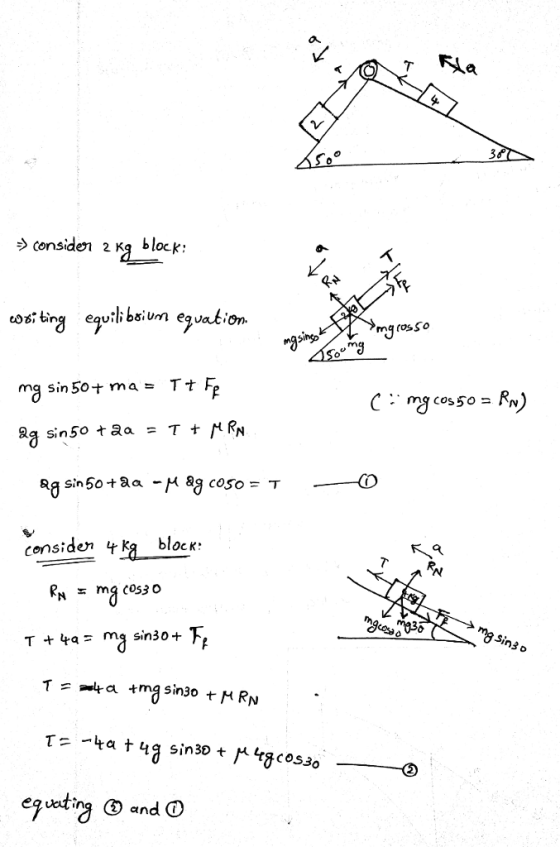
![-[s[to-46791 )1-r8 [-。.tih]] ven the value oF Psictien co-efPicient t assome d](http://img.homeworklib.com/questions/a86d5ef0-705b-11ea-ad3a-87efb9f988f9.png?x-oss-process=image/resize,w_560) The value of acceleration
depends on the co efficient of friction of the inclined plane
The value of acceleration
depends on the co efficient of friction of the inclined plane
If there is no friction the coefficient of friction is 0
Solve according to the value of coefficient of friction
Add Answer to:
There is friction on the system ( mass.(K /61 ). Find the acceleration of the 4...
coefficient of friction is .25 in both systems 2. Find the acceleration if the following system...
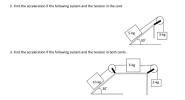 coefficient of friction is .25 in both systems
2. Find the acceleration if the following system and the tension in the cord 5-kg 3-kg 30 3. Find the acceleration if the following system and the tension in both cords. 3-kg 10- 2-kg 30°
coefficient of friction is .25 in both systems
2. Find the acceleration if the following system and the tension in the cord 5-kg 3-kg 30 3. Find the acceleration if the following system and the tension in both cords. 3-kg 10- 2-kg 30°
Page < 2 > of 4 0 - ZOOM + K Determine the acceleration of the...
 Page < 2 > of 4 0 - ZOOM + K Determine the acceleration of the block me for the next system. Take the masses of me and my as 9 kg and 3 kg, respectively. The incline has an angle #: of 25 and the rope makes and angle 82. of 15' with the ramp. Assume a coefficient of kinetic friction of 0.35 for the contact surface between mi and the ramp. Pwley
find acceleration and tension of the pulley system find the accelration and tension TBD m. 3.3...
 find acceleration and tension of the pulley system
find the accelration and tension
TBD m. 3.3 kg GIVEN Coefficient of friction 0.2 FBD Angle of inclination (theta) 71 degrees a=? T=? 4 kg
find acceleration and tension of the pulley system
find the accelration and tension
TBD m. 3.3 kg GIVEN Coefficient of friction 0.2 FBD Angle of inclination (theta) 71 degrees a=? T=? 4 kg
1-2&3 Find the acceleration of the system. How long will it take block B to move...
 1-2&3
Find the acceleration of the system. How long will it take block B to move 5 m? m_A = 10 Kg m_B = 4 Kg mu = 0.1 Find the acceleration of the system and the speed of A after 2 seconds? m_A = 25 Kg m_B 5 Kg mu = 0.2 What is the maximum mass of b so that the system stays at rest? m_A = 12 Kg mu = 0.7 m_B = ?
1-2&3
Find the acceleration of the system. How long will it take block B to move 5 m? m_A = 10 Kg m_B = 4 Kg mu = 0.1 Find the acceleration of the system and the speed of A after 2 seconds? m_A = 25 Kg m_B 5 Kg mu = 0.2 What is the maximum mass of b so that the system stays at rest? m_A = 12 Kg mu = 0.7 m_B = ?
Problem 4 A uniform slender rod of length L- 3 m and mass 2 kg rotates freely (no friction) about...
 Problem 4 A uniform slender rod of length L- 3 m and mass 2 kg rotates freely (no friction) about hinge at A. Att- 0, the initial angle is B 30 and the initial angular velocity SQUARED is 4.9 rads/s in the counter-clockwise direction. a) What are the hinge reaction forces, acceleration of the center of mass, angular velocity (squared) and angular acceleration as functions of B, b) what are the hinge reaction forces, acceleration of the center of mass...
Q1.Part1. Find a correlation between acceleration of objects A and B in the following diagram. Show...
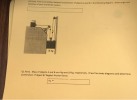 Q1.Part1. Find a correlation between acceleration of objects A and B in the following diagram. Show origin and direction of your coordinate system. 18 kg Q1.Part2. Mass of objects A and B are 4 kg and 18 kg, respectively. Draw free body diagrams and determine acceleration of object B? Neglect friction forces.
1. A force acts on a 2 kg mass and gives it an acceleration of 3...
1. A force acts on a 2 kg mass and gives it an acceleration of 3 m/s2. What acceleration is produced by the same force when acting on a mass of: a) 1 kg (ans = 6) 2. A horizontal force of 200 N is required to cause a 15 kg block to slide up a 20 degree incline with an acceleration of 0.25 m/s2. Find: a) the friction force on the block (ans = 134 N) b) the coefficient...
Determine the acceleration of each mass and the angular acceleration of the pulley (no friction on...
Determine the acceleration of each mass and the angular acceleration of the pulley (no friction on the point like pivot). The following data is assumed to be given. Moment of inertia of pulley relative to the center of mass=2kgm2, M1=M2=0.5kg, R2=2R1=0.5m
Find the acceleration of center of mass for the box. Applied force is 10N Mass of...
 Find the acceleration of center of mass for the box.
Applied force is 10N
Mass of box 30 kg.
Theta is 15 degree.
Find the acceleration of center of mass for the box.
Applied force is 10N
Mass of box 30 kg.
Theta is 15 degree.
A 200 gram mass vibrates horizontally without friction at the end of a horizontal spring for...
 A 200 gram mass vibrates horizontally without friction at the end of a horizontal spring for which k = 7.0 N/m. The mass is displaced x_0 = 5.0 centimeters from equilibrium and released. Apply the conservation of energy for a Spring Mass system: 1/2 k x_0^2 = 1/2 m v^2 + 1/2 k x^2 Find its maximum speed Find its speed when it is 3.0 centimeters from equilibrium. What is its acceleration in each of these cases? There are two...
 coefficient of friction is .25 in both systems
2. Find the acceleration if the following system and the tension in the cord 5-kg 3-kg 30 3. Find the acceleration if the following system and the tension in both cords. 3-kg 10- 2-kg 30°
coefficient of friction is .25 in both systems
2. Find the acceleration if the following system and the tension in the cord 5-kg 3-kg 30 3. Find the acceleration if the following system and the tension in both cords. 3-kg 10- 2-kg 30°
 Page < 2 > of 4 0 - ZOOM + K Determine the acceleration of the block me for the next system. Take the masses of me and my as 9 kg and 3 kg, respectively. The incline has an angle #: of 25 and the rope makes and angle 82. of 15' with the ramp. Assume a coefficient of kinetic friction of 0.35 for the contact surface between mi and the ramp. Pwley
 find acceleration and tension of the pulley system
find the accelration and tension
TBD m. 3.3 kg GIVEN Coefficient of friction 0.2 FBD Angle of inclination (theta) 71 degrees a=? T=? 4 kg
find acceleration and tension of the pulley system
find the accelration and tension
TBD m. 3.3 kg GIVEN Coefficient of friction 0.2 FBD Angle of inclination (theta) 71 degrees a=? T=? 4 kg
 1-2&3
Find the acceleration of the system. How long will it take block B to move 5 m? m_A = 10 Kg m_B = 4 Kg mu = 0.1 Find the acceleration of the system and the speed of A after 2 seconds? m_A = 25 Kg m_B 5 Kg mu = 0.2 What is the maximum mass of b so that the system stays at rest? m_A = 12 Kg mu = 0.7 m_B = ?
1-2&3
Find the acceleration of the system. How long will it take block B to move 5 m? m_A = 10 Kg m_B = 4 Kg mu = 0.1 Find the acceleration of the system and the speed of A after 2 seconds? m_A = 25 Kg m_B 5 Kg mu = 0.2 What is the maximum mass of b so that the system stays at rest? m_A = 12 Kg mu = 0.7 m_B = ?
 Problem 4 A uniform slender rod of length L- 3 m and mass 2 kg rotates freely (no friction) about hinge at A. Att- 0, the initial angle is B 30 and the initial angular velocity SQUARED is 4.9 rads/s in the counter-clockwise direction. a) What are the hinge reaction forces, acceleration of the center of mass, angular velocity (squared) and angular acceleration as functions of B, b) what are the hinge reaction forces, acceleration of the center of mass...
 Q1.Part1. Find a correlation between acceleration of objects A and B in the following diagram. Show origin and direction of your coordinate system. 18 kg Q1.Part2. Mass of objects A and B are 4 kg and 18 kg, respectively. Draw free body diagrams and determine acceleration of object B? Neglect friction forces.
 Find the acceleration of center of mass for the box.
Applied force is 10N
Mass of box 30 kg.
Theta is 15 degree.
Find the acceleration of center of mass for the box.
Applied force is 10N
Mass of box 30 kg.
Theta is 15 degree.
 A 200 gram mass vibrates horizontally without friction at the end of a horizontal spring for which k = 7.0 N/m. The mass is displaced x_0 = 5.0 centimeters from equilibrium and released. Apply the conservation of energy for a Spring Mass system: 1/2 k x_0^2 = 1/2 m v^2 + 1/2 k x^2 Find its maximum speed Find its speed when it is 3.0 centimeters from equilibrium. What is its acceleration in each of these cases? There are two...
Most questions answered within 3 hours.
-
Where is the error in this code sequence?
String s1 = "Hello";
String s2 = "ello";...
asked 11 months ago -
Financial data for Joel de Paris, Inc., for last year
follow:
Joel de Paris, Inc.
Balance...
asked 11 months ago -
Consider this reaction:
Al2(SO4)3 (aq)+ BaCl3
(aq) Al2Cl6 (aq)- +
3BaSO4(s) . What is the...
asked 11 months ago -
Suppose that Savneet is considering increasing her
recent random sample from 20 car rentals to 40...
asked 11 months ago -
Trucks arrive at an unloading terminal at an average rate of 120
per hour.
Trucks arrive...
asked 11 months ago -
Why are methanol and ethanol completely soluble in water while
octanol is not very little soluble....
asked 11 months ago -
A facilities manager at a university reads in a research report
that the mean amount of...
asked 11 months ago -
When the CuSO4 is rehydrated by adding water to the anhydrous
compound, is this an endothermic...
asked 11 months ago -
A ray of sunlight is passing from diamond into crown glass; the
angle of incidence is...
asked 11 months ago -
A block of mass 0.249 kg is placed on top of a light, vertical
spring of...
asked 11 months ago -
how do the kidneys compensate in the presences of acidosis
a) trigger hyperventilate
b) reserve acid...
asked 11 months ago -
Question 501 pts
The rental rate of capital to the firm increases. Which of the
following...
asked 11 months ago