
Homework Answers
Electric field lines moves away from positive charge.
P and R both are at same distances.
But both are in opposite directions.
So equal in magnitude , opposite in direction.
Option (D) is correct.
Add Answer to:
1. Points P and R are equidistant to charged object A, and they are positioned on...
Please explain your answer! 1 point The electric force on a charged object will always point...
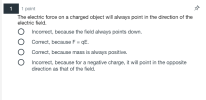 Please explain your answer!
1 point The electric force on a charged object will always point in the direction of the electric field. O Incorrect, because the field always points down. O Correct, because F qE. O Correct, because mass is always positive. O Incorrect, because for a negative charge, it will point in the opposite direction as that of the field.
Please explain your answer!
1 point The electric force on a charged object will always point in the direction of the electric field. O Incorrect, because the field always points down. O Correct, because F qE. O Correct, because mass is always positive. O Incorrect, because for a negative charge, it will point in the opposite direction as that of the field.
Please solve step by step The electric force on a charged object will always point in...
 Please solve step by step
The electric force on a charged object will always point in the direction of the electric field. O Incorrect, because the field always points down. O Incorrect, because for a negative charge, it will point in the opposite direction as that of the field. O Correct, because mass is always positive. O Correct, because F qE.
Please solve step by step
The electric force on a charged object will always point in the direction of the electric field. O Incorrect, because the field always points down. O Incorrect, because for a negative charge, it will point in the opposite direction as that of the field. O Correct, because mass is always positive. O Correct, because F qE.
Two charged bees land simultaneously on flowers that are separated by a finite distance. For a...
Two charged bees land simultaneously on flowers that are separated by a finite distance. For a few moments, the charged bees rest on the flowers. The charged bees both generate an electric field, and while the charged bees are resting on the flowers, the net electric field at some distance between them is zero.(a) Do the bees have the same or opposite signs of charge?Same - the electric fields point in opposite directions and therefore cancel at some midpoint.Same -...
Exercise 23.7 Hints: Getting Started | I'm Stuck A rod 12.5 cm long is uniformly charged...
 Exercise 23.7 Hints: Getting Started | I'm Stuck A rod 12.5 cm long is uniformly charged and has a total charge of -27.0 PC. (a) Determine the magnitude of the electric field along the axis of the rod at a point 31.0 cm from its center. E = 13433.80109 X N/C It might be helpful to carefully follow through the example to make sure you understand the solution. (b) Determine the direction of the electric field along the axis of...
Electric Field around a Point Charged Object 01 Due in 12 hours, 18 minutes In describing...
 Electric Field around a Point Charged Object 01 Due in 12 hours, 18 minutes In describing the electric force we use the concept of the electric field. Every object that has a non-zero charge creates an electric field around it everywhere in space. The field is a vector quantity, so it has a magnitude and a direction at every point in space Refer to your book for a discussion of the electric field created by point-charged object. Take note of...
5. As shown in the diagram, points P and R form a straight line with point...
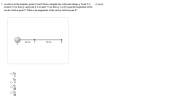 5. As shown in the diagram, points P and R form a straight line with point charge q. Point Pis (1 point) located 25 cm from q, and point R is located 75 cm from q. Let Ep equal the magnitude of the electric field at point P. What is the magnitude of the electric field at point R? 25 cm P 50 cm 09 50 25 0足 Ep
Consider the two negative charges shown. Two negative charges of magnitude minus Q are positioned on...
Consider the two negative charges shown. Two negative charges of magnitude minus Q are positioned on the X axis in an X Y coordinate system. The charges are equidistant from the Y axis and located to either side of it. Point P is on the Y axis and above the X axis, forming the apex of an isoceles triangle with the two charges. At point P, the net electric field due to these charges A. points to the left. points...
- 1/2 points Previous Answers My Notes A man is standing beneath two rain clouds, equidistant...
 - 1/2 points Previous Answers My Notes A man is standing beneath two rain clouds, equidistant from each cloud, as shown in the figure. Cloud A has an excess of 4.2 X 10 negative charges while dood has 4.2 X10positive charges (where a charge has magnitude e). (a) What is the magnitude of the net electric field where the man is standing? 4.0E-11 X What is the equation for the electric field from a point charge? How do you determine...
5. (5 points) Two very long, straight parallel wires carry currents of equal magnitude, but opposite...
 5. (5 points) Two very long, straight parallel wires carry currents of equal magnitude, but opposite direction, perpendicular to the paper in the directions shown in the Figure. The direction of the net magnetic field due to these two wires at point a, which is equidistant from both wires, is 1O Current out of page I ⓧ Current into page (a) directly to the right (b) directly to the left (c) straight downward (d) straight upward
1) An electrostatically charged object (e.g. plastic rod that was vigorously rubbed with wool/fur) is put...
1) An electrostatically charged object (e.g. plastic rod that was vigorously rubbed with wool/fur) is put in contact with a neural metallic soda can. Consequently, charges are transferred from the plastic rod to the soda can. On which surface the charges will stay on the soda can (inside, outside, both inside and outside, …). EXPLAIN WHY. (2 points) 2) Describe in a few words a method to generate an electric field, in which the field lines are straight, parallel, and...
 Please explain your answer!
1 point The electric force on a charged object will always point in the direction of the electric field. O Incorrect, because the field always points down. O Correct, because F qE. O Correct, because mass is always positive. O Incorrect, because for a negative charge, it will point in the opposite direction as that of the field.
Please explain your answer!
1 point The electric force on a charged object will always point in the direction of the electric field. O Incorrect, because the field always points down. O Correct, because F qE. O Correct, because mass is always positive. O Incorrect, because for a negative charge, it will point in the opposite direction as that of the field.
 Please solve step by step
The electric force on a charged object will always point in the direction of the electric field. O Incorrect, because the field always points down. O Incorrect, because for a negative charge, it will point in the opposite direction as that of the field. O Correct, because mass is always positive. O Correct, because F qE.
Please solve step by step
The electric force on a charged object will always point in the direction of the electric field. O Incorrect, because the field always points down. O Incorrect, because for a negative charge, it will point in the opposite direction as that of the field. O Correct, because mass is always positive. O Correct, because F qE.
 Exercise 23.7 Hints: Getting Started | I'm Stuck A rod 12.5 cm long is uniformly charged and has a total charge of -27.0 PC. (a) Determine the magnitude of the electric field along the axis of the rod at a point 31.0 cm from its center. E = 13433.80109 X N/C It might be helpful to carefully follow through the example to make sure you understand the solution. (b) Determine the direction of the electric field along the axis of...
 Electric Field around a Point Charged Object 01 Due in 12 hours, 18 minutes In describing the electric force we use the concept of the electric field. Every object that has a non-zero charge creates an electric field around it everywhere in space. The field is a vector quantity, so it has a magnitude and a direction at every point in space Refer to your book for a discussion of the electric field created by point-charged object. Take note of...
 5. As shown in the diagram, points P and R form a straight line with point charge q. Point Pis (1 point) located 25 cm from q, and point R is located 75 cm from q. Let Ep equal the magnitude of the electric field at point P. What is the magnitude of the electric field at point R? 25 cm P 50 cm 09 50 25 0足 Ep
 - 1/2 points Previous Answers My Notes A man is standing beneath two rain clouds, equidistant from each cloud, as shown in the figure. Cloud A has an excess of 4.2 X 10 negative charges while dood has 4.2 X10positive charges (where a charge has magnitude e). (a) What is the magnitude of the net electric field where the man is standing? 4.0E-11 X What is the equation for the electric field from a point charge? How do you determine...
 5. (5 points) Two very long, straight parallel wires carry currents of equal magnitude, but opposite direction, perpendicular to the paper in the directions shown in the Figure. The direction of the net magnetic field due to these two wires at point a, which is equidistant from both wires, is 1O Current out of page I ⓧ Current into page (a) directly to the right (b) directly to the left (c) straight downward (d) straight upward
Most questions answered within 3 hours.
-
Where is the error in this code sequence?
String s1 = "Hello";
String s2 = "ello";...
asked 10 months ago -
Financial data for Joel de Paris, Inc., for last year
follow:
Joel de Paris, Inc.
Balance...
asked 10 months ago -
Consider this reaction:
Al2(SO4)3 (aq)+ BaCl3
(aq) Al2Cl6 (aq)- +
3BaSO4(s) . What is the...
asked 10 months ago -
Suppose that Savneet is considering increasing her
recent random sample from 20 car rentals to 40...
asked 10 months ago -
Trucks arrive at an unloading terminal at an average rate of 120
per hour.
Trucks arrive...
asked 10 months ago -
Why are methanol and ethanol completely soluble in water while
octanol is not very little soluble....
asked 10 months ago -
A facilities manager at a university reads in a research report
that the mean amount of...
asked 10 months ago -
When the CuSO4 is rehydrated by adding water to the anhydrous
compound, is this an endothermic...
asked 10 months ago -
A ray of sunlight is passing from diamond into crown glass; the
angle of incidence is...
asked 10 months ago -
A block of mass 0.249 kg is placed on top of a light, vertical
spring of...
asked 10 months ago -
how do the kidneys compensate in the presences of acidosis
a) trigger hyperventilate
b) reserve acid...
asked 10 months ago -
Question 501 pts
The rental rate of capital to the firm increases. Which of the
following...
asked 10 months ago