All of the following may be considered in computing the QBI deduction, EXCEPT: Taxpayer's Form W-2...
All of the following may be considered in computing the QBI deduction, EXCEPT:
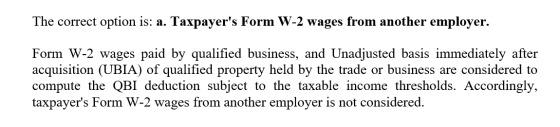
Taxpayer's Form W-2 wages from another employer.
Taxable income thresholds.
Form W-2 wages paid by the business.
UBIA (unadjusted basis immediately after acquisition) of qualified property.
Homework Answers
Add Answer to:
All of the following may be considered in computing the QBI
deduction, EXCEPT:
Taxpayer's Form W-2...
All of the following would report QBI, Form W-2 wages, and UBIA of qualified property to...
All of the following would report QBI, Form W-2 wages, and UBIA of qualified property to the taxpayer on a Schedule K-1 EXCEPT: Partnership. Estate. S corporation. Sole proprietor.
Melissa, a single taxpayer, has qualified business income of $150,000. Her business paid Form W-2 wages...
Melissa, a single taxpayer, has qualified business income of $150,000. Her business paid Form W-2 wages and holds qualified property. As Melissa's Tax Professional, you determine that her qualified business income deduction will be limited because her taxable income exceeds the lower threshold for her filing status. You will begin figuring the amount of her deduction by multiplying $150,000, the amount of her qualified business income, by 20%. Your next step is to: Deduct the lowest threshold, $157,500, from her...
melissa self employed accountant. net sch c income of 120000. taxable income was 99522 for the...
 melissa self employed accountant. net sch c income of
120000. taxable income was 99522 for the qbi threshold. she will
claim depreciation.
to accurately figure the computation must take account the ubia of
any property held by business
figure deduction using simple 2 step computation her taxable is
below the lower threshold
since she is involved in specified trade she will us multi step
process to compute deduction
none of these apply cause not entitled to deduction
Question 20 of...
melissa self employed accountant. net sch c income of
120000. taxable income was 99522 for the qbi threshold. she will
claim depreciation.
to accurately figure the computation must take account the ubia of
any property held by business
figure deduction using simple 2 step computation her taxable is
below the lower threshold
since she is involved in specified trade she will us multi step
process to compute deduction
none of these apply cause not entitled to deduction
Question 20 of...
Becker CPA Review 2-7 Calculate the taxpayer's 2019 qualifying business income deduction for a qualified trade...
Becker CPA Review 2-7 Calculate the taxpayer's 2019 qualifying business income deduction for a qualified trade or business: Filing status: Single Taxable income: $180,000 Net capital gains: $0 Qualified business income (QBI): $80,000 W–2 wages: $20,000 a.$16,000 b.$10,000 c.$2,700 d.$13,684
All of the following assets can have an unadjusted basis immediately after acquisition (UBIA) for purposes...
All of the following assets can have an unadjusted basis immediately after acquisition (UBIA) for purposes of the QBI deduction, EXCEPT: Land. Vehicle. Machinery. Improvements.
Thad, a single taxpayer, reports taxable income before the QBI deduction of $185,000. Thad, a CPA,...
Thad, a single taxpayer, reports taxable income before the QBI deduction of $185,000. Thad, a CPA, operates an accounting practice as a single member LLC (which he reports as a sole proprietorship). During the tax year, his proprietorship generates qualified business income of $148,000 after deducting self-employment taxes, W–2 wages of $111,000, and $11,600 of qualified property. Assume the QBI amount is net of the self-employment tax deduction. What is Thad's QBI deduction? Please provide solution and answer
Thad, a single taxpayer, has taxable income before the QBI deduction of $190,700. Thad, a CPA,...
Thad, a single taxpayer, has taxable income before the QBI deduction of $190,700. Thad, a CPA, operates an accounting practice as a single-member LLC (which he reports as a sole proprietorship). During 2019, his proprietorship generates a qualified business income of $150,000, W–2 wages of $125,000, and $10,000 of qualified property. Assume the QBI amount is net of the self-employment tax deduction. What is Thad's qualified business income deduction?
Exercise 2-19 (LO. 3, 4) Thad, a single taxpayer, has taxable income before the QBI deduction...
 Exercise 2-19 (LO. 3, 4) Thad, a single taxpayer, has taxable income before the QBI deduction of $190,700. Thad, a CPA, operates an accounting practice as a single member LLC (which he reports as a sole proprietorship). During 2019, his proprietorship generates qualified business income of $150,000, W-2 wages of $125,000, and $10,000 of qualified property. Assume the QBI amount is net of the self-employment tax deduction. What is Thad's qualified business income deduction? $
Sam and Jane Hill, both age 35, are married filing a joint return. Jane is employed...
Sam and Jane Hill, both age 35, are married filing a joint return. Jane is employed full time and Sam is a part owner in several local businesses. They have contacted you inquiring about the Section 199A qualified business income (QBI) deduction. They have provided information for their Year 1 business income in the exhibit above. Sam and Jane do not elect to aggregate any of the qualifying businesses. Their only other income in Year 1 is Jane's salary of...
Thad, a single taxpayer, has taxable income before the QBI deduction of $189,500. Thad, a CPA,...
Thad, a single taxpayer, has taxable income before the QBI deduction of $189,500. Thad, a CPA, operates an accounting practice as a single member LLC (which he reports as a sole proprietorship). During 2020, his proprietorship generates qualified business income of $151,600, W–2 wages of $113,700, and $10,800 of qualified property. Assume the QBI amount is net of the self-employment tax deduction. If required, round any division to two decimal places. Round your final answer to the nearest dollar. What...
 melissa self employed accountant. net sch c income of
120000. taxable income was 99522 for the qbi threshold. she will
claim depreciation.
to accurately figure the computation must take account the ubia of
any property held by business
figure deduction using simple 2 step computation her taxable is
below the lower threshold
since she is involved in specified trade she will us multi step
process to compute deduction
none of these apply cause not entitled to deduction
Question 20 of...
melissa self employed accountant. net sch c income of
120000. taxable income was 99522 for the qbi threshold. she will
claim depreciation.
to accurately figure the computation must take account the ubia of
any property held by business
figure deduction using simple 2 step computation her taxable is
below the lower threshold
since she is involved in specified trade she will us multi step
process to compute deduction
none of these apply cause not entitled to deduction
Question 20 of...
 Exercise 2-19 (LO. 3, 4) Thad, a single taxpayer, has taxable income before the QBI deduction of $190,700. Thad, a CPA, operates an accounting practice as a single member LLC (which he reports as a sole proprietorship). During 2019, his proprietorship generates qualified business income of $150,000, W-2 wages of $125,000, and $10,000 of qualified property. Assume the QBI amount is net of the self-employment tax deduction. What is Thad's qualified business income deduction? $
Most questions answered within 3 hours.
-
Where is the error in this code sequence?
String s1 = "Hello";
String s2 = "ello";...
asked 11 months ago -
Financial data for Joel de Paris, Inc., for last year
follow:
Joel de Paris, Inc.
Balance...
asked 11 months ago -
Consider this reaction:
Al2(SO4)3 (aq)+ BaCl3
(aq) Al2Cl6 (aq)- +
3BaSO4(s) . What is the...
asked 11 months ago -
Suppose that Savneet is considering increasing her
recent random sample from 20 car rentals to 40...
asked 11 months ago -
Trucks arrive at an unloading terminal at an average rate of 120
per hour.
Trucks arrive...
asked 11 months ago -
Why are methanol and ethanol completely soluble in water while
octanol is not very little soluble....
asked 11 months ago -
A facilities manager at a university reads in a research report
that the mean amount of...
asked 11 months ago -
When the CuSO4 is rehydrated by adding water to the anhydrous
compound, is this an endothermic...
asked 11 months ago -
A ray of sunlight is passing from diamond into crown glass; the
angle of incidence is...
asked 11 months ago -
A block of mass 0.249 kg is placed on top of a light, vertical
spring of...
asked 11 months ago -
how do the kidneys compensate in the presences of acidosis
a) trigger hyperventilate
b) reserve acid...
asked 11 months ago -
Question 501 pts
The rental rate of capital to the firm increases. Which of the
following...
asked 11 months ago