

Homework Answers
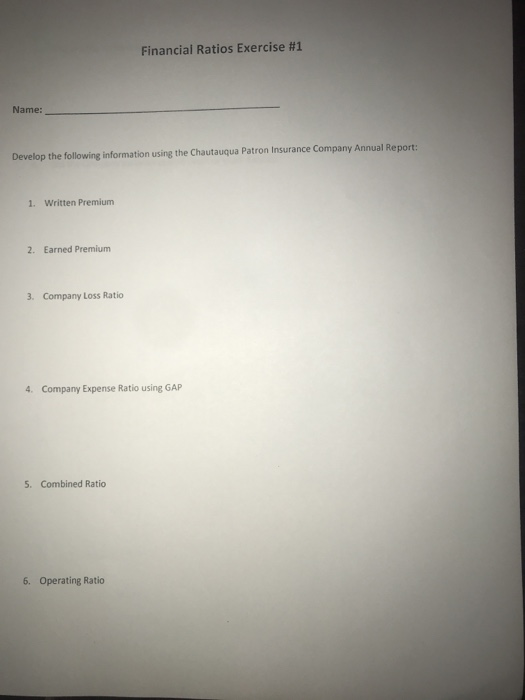
1. Written Premium : A written premium describes the total premiums collected on policies issued by an insurance company during a period of time.,
In other words, Written Premium is the gross sum of Insurance premiums received from the customers.
Written Premium is not available in the given financials, it will be reflected in Cash flow statement.
2. Earned Premium : Earned premium as the word suggests is "EARNED" by the insurer, it is a prorated amount of paid-in-advance premiums that has been earned and now belongs to the insurer.
In other words, the earned premium is the part of an insurance premium that paid for a part of time in which the insurance policy was in effect, but has now passed and expired. Since the insurance company covered the risk already during that passed time, it can now consider the premium payments it took from the customers as "EARNED."
Earned Premium for 2011 =$ 6,036,258.
3. Loss Ratio : Loss ratio describes the proportion of Incurred Losses to Earned Premium.
In other words, it is the proportion of Earned Premium that has been used to pay for underwritten policies.
Loss Ratio = (Incurred Losses + Loss exp incurred )/ Earned Premium =(3057509+952731) / 6036258 = 66.43%.
4. Expense Ratio : Expense Ratio = Proportion of all expenses to premium earned.
=(3057509+962371+2445291)/6036258 = 107.11%.
8. The company did make a profit for the year, even though the losses from expenses from policy unaderwriting is more than the premium earned, profit is made thanks to income from investments of $ 523,489. and Financial Charges on calls of $ 101684
Net Profit made after Taxes is $ 290,180
Add Answer to:
Please answer the questions all of them
hy Statement of Admitted Assets, Liabilities & Surplus t...
Exercise in Financial Ratios Answer the following questions: If the annual cost of an insurance policy...
 Exercise in Financial Ratios Answer the following questions: If the annual cost of an insurance policy is $1,500.00, and it is effective on May 01, 20 10. I. What is the reported written premium amount for 2010 2. What is the earned premium on September 01, 2010? 3. What is the earned premium on January 01, 2011? 4. When the premium is fully earned? XXX Insurance Company posted the following results for 2006: 1. Written Premium: $240,000,000.00 2. Earned Premium:...
 Exercise in Financial Ratios Answer the following questions: If the annual cost of an insurance policy is $1,500.00, and it is effective on May 01, 20 10. I. What is the reported written premium amount for 2010 2. What is the earned premium on September 01, 2010? 3. What is the earned premium on January 01, 2011? 4. When the premium is fully earned? XXX Insurance Company posted the following results for 2006: 1. Written Premium: $240,000,000.00 2. Earned Premium:...
Most questions answered within 3 hours.
-
Where is the error in this code sequence?
String s1 = "Hello";
String s2 = "ello";...
asked 10 months ago -
Financial data for Joel de Paris, Inc., for last year
follow:
Joel de Paris, Inc.
Balance...
asked 10 months ago -
Consider this reaction:
Al2(SO4)3 (aq)+ BaCl3
(aq) Al2Cl6 (aq)- +
3BaSO4(s) . What is the...
asked 10 months ago -
Suppose that Savneet is considering increasing her
recent random sample from 20 car rentals to 40...
asked 10 months ago -
Trucks arrive at an unloading terminal at an average rate of 120
per hour.
Trucks arrive...
asked 10 months ago -
Why are methanol and ethanol completely soluble in water while
octanol is not very little soluble....
asked 10 months ago -
A facilities manager at a university reads in a research report
that the mean amount of...
asked 10 months ago -
When the CuSO4 is rehydrated by adding water to the anhydrous
compound, is this an endothermic...
asked 10 months ago -
A ray of sunlight is passing from diamond into crown glass; the
angle of incidence is...
asked 10 months ago -
A block of mass 0.249 kg is placed on top of a light, vertical
spring of...
asked 10 months ago -
how do the kidneys compensate in the presences of acidosis
a) trigger hyperventilate
b) reserve acid...
asked 10 months ago -
Question 501 pts
The rental rate of capital to the firm increases. Which of the
following...
asked 10 months ago