
Homework Answers
a) It is not easy to explain how to find a symmetry plane, since it is purely based in observation. For sure, you need to pay special attention to those carbon atoms that look chiral, since the plane of symmetry will go through them (if it exists). In these cases, the compounds are not chiral, dure to the presence of the symmetry plane. Knowing that, a little bit of imagination to survey the molecule is always helpful. For example, for molecule A, the potential chiral carbon is the one at the "tip" of the molecule, with the methyl group. If looked at carefully, you will see there is a symmetry plane going through this carbon, cutting the molecule in half. It goes through that C atom and through the C-C bonds at the right and left:
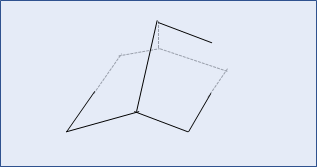
The dotted lines are behind the plane, which slices the molecule in two equal halves (the methyl group at the top is also sliced in half, transversally).
b) There is a symmetry plane, although in a different direction, "cutting" the methyl group in half (I hope this is understandable):
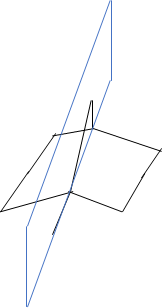
c) and d) don't have any symmetry planes, which means they are chiral. If you try, you will not fin a symmetry plane (remember that it always has to go through the "chiral" carbon).
Add Answer to:
locate any planes of symmetry in each. please explain how to
do this.
Problem 4.3 Locate...
If you can find a plane of symmetry in the flat hexagonal drawing of a substituted...
 If you can find a plane of symmetry in the flat hexagonal drawing of a substituted cyclohexane ring, the molecule is achiral. If you cannot find a plane of symmetry, it is chiral. h. Using this simplification, determine whether the following substituted cyclo- hexane rings are chiral or achiral. Draw plane of symmetry for any achiral molecules. CH3 "Сн, CH₂ OH н, c cн, HO
Please Explain. (2) How many stereocenters does each molecule have. How many stereoisomers each molecule can...
 Please Explain.
(2) How many stereocenters does each molecule have. How many stereoisomers each molecule can have in theory? Br Br CI Br а от OH ОН ОН ОН (3) Circle the chiral molecules. If molecule is achiral – show its plane of symmetry. Н Н. СІ CI Br Br Br да» 2 HT / / CH3 CH3 1 1
Please Explain.
(2) How many stereocenters does each molecule have. How many stereoisomers each molecule can have in theory? Br Br CI Br а от OH ОН ОН ОН (3) Circle the chiral molecules. If molecule is achiral – show its plane of symmetry. Н Н. СІ CI Br Br Br да» 2 HT / / CH3 CH3 1 1
Problem #10. One chair conformation is shown for each compound. a) Complete the structure of the other chair conformati...
 Problem #10. One chair conformation is shown for each compound. a) Complete the structure of the other chair conformation after the chair flip), and complete the wedge- and-dash drawing. Other Conformation Wedge-and-Dash Drawing CH3 нTM CH3CH2 CH3 CH3 CH3 b) For each compound, the wedge-and-dash drawing corresponds to which chair conformation? Explain. c) Which of these compounds are chiral? Which are achiral? How do you know?
6.3 un pas mujecu a pair of scissors Show the planes and centers of symmetry (if...
 6.3 un pas mujecu a pair of scissors Show the planes and centers of symmetry (if any) in cach of the following achiral objects. (a) the methane molecule (b) a cone (c) the ethylene molecule (d) the trans-2-butene molecule (e) the cis-2-butene molecule the anti conformation of butane
please explain why this is achiral and not chiral. 1 (4 pts). Draw the expected major...
 please explain why this is achiral and not chiral.
1 (4 pts). Draw the expected major product from the following reaction by placing appropriate groups (H, Br, CH3 on the scaffold). Circle whether the product is achiral or chiral. CH3 CH3 Br2 Br H₃C CH3 Br chiral or achiral a How is it achiral?
please explain why this is achiral and not chiral.
1 (4 pts). Draw the expected major product from the following reaction by placing appropriate groups (H, Br, CH3 on the scaffold). Circle whether the product is achiral or chiral. CH3 CH3 Br2 Br H₃C CH3 Br chiral or achiral a How is it achiral?
12.32 Identify each dentify each of the following structures as chiral or achiral. If chiral, indicate...
 12.32 Identify each dentify each of the following structures as chiral or achiral. If chiral, indicate the chiral carbon. DE COCINA 12.37 I a. CH2-C 2. CH3 -C-CH2CH=CH3 100CH, D Br SSL b. CH3-C=CH-CH3 St OH OH bon d oc. CH3-C-CH-CH3 Listen Clone d. Br-CH-CH-CH3
Make a model of each of the chair conformations of cis-1,2-dibromocyclo- hexane, and show that they...
 Make a model of each of the chair conformations of cis-1,2-dibromocyclo- hexane, and show that they are nonsuperimpoasble mirror images of each other. Is cis-1,2-dibromocyclohexane isomer optically active? The planar structure has a plane of symmetry, but the chair conformation doesn't! Yes _No Although each conformer is chiral, the rapid interconversion between the two at room temperature means they cannot be separated. The compound is not chiral. Identifying chirality in cyclohexane derivatives can seem daunting. Fortunately we can greatly simplify...
$13.62 Identify the chiral carbons, if any, in each of the following compounds: (13.2) 0-CH, ОН О | | a. CH, CH-CH...
 $13.62 Identify the chiral carbons, if any, in each of the following compounds: (13.2) 0-CH, ОН О | | a. CH, CH-CH, b, CH3-CH-C-CH, ОН Сн, о с. СН, -c-CH, d. CH3 -CH-C-CHz ОН Br е. Сн, -с-CH, CH, ОН
please explain how they are achiral. please explain Which of tinc following compounds is achiral (C...
 please explain how they are achiral.
please explain
Which of tinc following compounds is achiral (C 2-bromobutane
please explain how they are achiral.
please explain
Which of tinc following compounds is achiral (C 2-bromobutane
B. STEREOISOMERS Star the chiral carbon in each of the following molecules. Then indicate how many...
 B. STEREOISOMERS Star the chiral carbon in each of the following molecules. Then indicate how many forms exist for those compounds with at least one chiral carbon. OH OH OH OH O CH3 a) b) HOC2- CH-CH-CH-CH-CH CH3-CHCH2OH OH c) CHCH3 d) CH3CCH2CH3
 If you can find a plane of symmetry in the flat hexagonal drawing of a substituted cyclohexane ring, the molecule is achiral. If you cannot find a plane of symmetry, it is chiral. h. Using this simplification, determine whether the following substituted cyclo- hexane rings are chiral or achiral. Draw plane of symmetry for any achiral molecules. CH3 "Сн, CH₂ OH н, c cн, HO
 Please Explain.
(2) How many stereocenters does each molecule have. How many stereoisomers each molecule can have in theory? Br Br CI Br а от OH ОН ОН ОН (3) Circle the chiral molecules. If molecule is achiral – show its plane of symmetry. Н Н. СІ CI Br Br Br да» 2 HT / / CH3 CH3 1 1
Please Explain.
(2) How many stereocenters does each molecule have. How many stereoisomers each molecule can have in theory? Br Br CI Br а от OH ОН ОН ОН (3) Circle the chiral molecules. If molecule is achiral – show its plane of symmetry. Н Н. СІ CI Br Br Br да» 2 HT / / CH3 CH3 1 1
 Problem #10. One chair conformation is shown for each compound. a) Complete the structure of the other chair conformation after the chair flip), and complete the wedge- and-dash drawing. Other Conformation Wedge-and-Dash Drawing CH3 нTM CH3CH2 CH3 CH3 CH3 b) For each compound, the wedge-and-dash drawing corresponds to which chair conformation? Explain. c) Which of these compounds are chiral? Which are achiral? How do you know?
 6.3 un pas mujecu a pair of scissors Show the planes and centers of symmetry (if any) in cach of the following achiral objects. (a) the methane molecule (b) a cone (c) the ethylene molecule (d) the trans-2-butene molecule (e) the cis-2-butene molecule the anti conformation of butane
 please explain why this is achiral and not chiral.
1 (4 pts). Draw the expected major product from the following reaction by placing appropriate groups (H, Br, CH3 on the scaffold). Circle whether the product is achiral or chiral. CH3 CH3 Br2 Br H₃C CH3 Br chiral or achiral a How is it achiral?
please explain why this is achiral and not chiral.
1 (4 pts). Draw the expected major product from the following reaction by placing appropriate groups (H, Br, CH3 on the scaffold). Circle whether the product is achiral or chiral. CH3 CH3 Br2 Br H₃C CH3 Br chiral or achiral a How is it achiral?
 12.32 Identify each dentify each of the following structures as chiral or achiral. If chiral, indicate the chiral carbon. DE COCINA 12.37 I a. CH2-C 2. CH3 -C-CH2CH=CH3 100CH, D Br SSL b. CH3-C=CH-CH3 St OH OH bon d oc. CH3-C-CH-CH3 Listen Clone d. Br-CH-CH-CH3
 Make a model of each of the chair conformations of cis-1,2-dibromocyclo- hexane, and show that they are nonsuperimpoasble mirror images of each other. Is cis-1,2-dibromocyclohexane isomer optically active? The planar structure has a plane of symmetry, but the chair conformation doesn't! Yes _No Although each conformer is chiral, the rapid interconversion between the two at room temperature means they cannot be separated. The compound is not chiral. Identifying chirality in cyclohexane derivatives can seem daunting. Fortunately we can greatly simplify...
 $13.62 Identify the chiral carbons, if any, in each of the following compounds: (13.2) 0-CH, ОН О | | a. CH, CH-CH, b, CH3-CH-C-CH, ОН Сн, о с. СН, -c-CH, d. CH3 -CH-C-CHz ОН Br е. Сн, -с-CH, CH, ОН
 please explain how they are achiral.
please explain
Which of tinc following compounds is achiral (C 2-bromobutane
please explain how they are achiral.
please explain
Which of tinc following compounds is achiral (C 2-bromobutane
 B. STEREOISOMERS Star the chiral carbon in each of the following molecules. Then indicate how many forms exist for those compounds with at least one chiral carbon. OH OH OH OH O CH3 a) b) HOC2- CH-CH-CH-CH-CH CH3-CHCH2OH OH c) CHCH3 d) CH3CCH2CH3
Most questions answered within 3 hours.
-
Where is the error in this code sequence?
String s1 = "Hello";
String s2 = "ello";...
asked 11 months ago -
Financial data for Joel de Paris, Inc., for last year
follow:
Joel de Paris, Inc.
Balance...
asked 11 months ago -
Consider this reaction:
Al2(SO4)3 (aq)+ BaCl3
(aq) Al2Cl6 (aq)- +
3BaSO4(s) . What is the...
asked 11 months ago -
Suppose that Savneet is considering increasing her
recent random sample from 20 car rentals to 40...
asked 11 months ago -
Trucks arrive at an unloading terminal at an average rate of 120
per hour.
Trucks arrive...
asked 11 months ago -
Why are methanol and ethanol completely soluble in water while
octanol is not very little soluble....
asked 11 months ago -
A facilities manager at a university reads in a research report
that the mean amount of...
asked 11 months ago -
When the CuSO4 is rehydrated by adding water to the anhydrous
compound, is this an endothermic...
asked 11 months ago -
A ray of sunlight is passing from diamond into crown glass; the
angle of incidence is...
asked 11 months ago -
A block of mass 0.249 kg is placed on top of a light, vertical
spring of...
asked 11 months ago -
how do the kidneys compensate in the presences of acidosis
a) trigger hyperventilate
b) reserve acid...
asked 11 months ago -
Question 501 pts
The rental rate of capital to the firm increases. Which of the
following...
asked 11 months ago