
Homework Answers
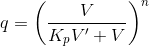
Here,  the fraction of solute that would remain in the water after n
extractions.
the fraction of solute that would remain in the water after n
extractions.
 The partition coefficient between ether and water.
 volume of water
 volume of ether
1) Single extraction with 300 mL of ether


2)
Three extractions with 100 mL of ether


3)
Six extractions with 50 mL of ether


Add Answer to:
Resources Hint A chemist wants to extract a solute from 100 mL of water using only...
A chemist wants to extract a solute from 100 mL of water using only 300 mL...
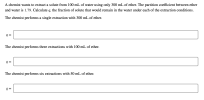 A chemist wants to extract a solute from 100 mL of water using only 300 mL of ether. The partition coefficient between ether and water is 1.79. Calculate q, the fraction of solute that would remain in the water under each of the extraction conditions. The chemist performs a single extraction with 300 mL of ether. q= The chemist performs three extractions with 100 mL of ether. 9 = The chemist performs six extractions with 50 mL of ether. q=
2) The distribution coefficient between methylene chloride and water for solute Y is 9. An amount...
2) The distribution coefficient between methylene chloride and water for solute Y is 9. An amount of 107.0 g of Y is dissolved in 150 mL of water. a) What weight of Y would be removed from water with a single extraction with 150-mL of methylene chloride? Report to 1 decimal place. b) What weight of Y would be removed from water (the original solution) with twosuccessive extractions with 75-mLportions each of methylene chloride? Report to 1 decimal place. 3)...
Solute A has a partition coefficient of 8 between toluene and water. Suppose that 350 mL...
Solute A has a partition coefficient of 8 between toluene and water. Suppose that 350 mL of a 0.01 M aqueous solution of A are extracted with toluene. What would be the extraction efficiency (R%) if 2 extractions with 50 mL toluene were performed? (Keep one decimal place in your final answer.)
Solute A has a partition coefficient K = 2 for an extraction between water (phase 1)...
Solute A has a partition coefficient K = 2 for an extraction between water (phase 1) and benzene (phase 2). If 100 mL of a 0.01M solution of A in water is extracted one time with 300 mL benzene, what fraction will be extracted?
1. An analyte has a partition coefficient of 2.0 between water and 1-pentanol. Given that 200...
 1. An analyte has a partition coefficient of 2.0 between water and 1-pentanol. Given that 200 mL of a 5 % EtOH solution in water was extracted with 1-pentanol, calculate the fraction q of the analyte remaining in the aqueous phase (a) if one extraction of 200 mL is performed and (b) ten extractions of 100 mL are performed. (Hint: see page 49 in the manual. 2. For both 1a and 1b now calculate the Extraction Efficiency as a percentage
The extraction of 8.0 g of a particular organic compound dissolved in 100 ml of water...
The extraction of 8.0 g of a particular organic compound dissolved in 100 ml of water into diethyl ether proceeds with a distribution coefficient of 5. How much of the compound is extracted after three separate extractions using 50 ml of diethyl ether each time? ***Please show work as I am not 100% sure how to solve for X**** Thank you!
need help with number 2 HW #3 for Chem 318 Due: April 29, 2019 1. Solute A has a K 2.5 for an extraction between water (phase 1) and chloroform (phase 2). If 100 mL of a 0.01 fraction will be extr...
 need help with number 2
HW #3 for Chem 318 Due: April 29, 2019 1. Solute A has a K 2.5 for an extraction between water (phase 1) and chloroform (phase 2). If 100 mL of a 0.01 fraction will be extracted? For the same solute and, what fraction will be extracted if 5 extractions wi 80 mL chloroform each are used (instead of one 400 ml extraction)? M solution containing solute A in water is extracted one time with...
need help with number 2
HW #3 for Chem 318 Due: April 29, 2019 1. Solute A has a K 2.5 for an extraction between water (phase 1) and chloroform (phase 2). If 100 mL of a 0.01 fraction will be extracted? For the same solute and, what fraction will be extracted if 5 extractions wi 80 mL chloroform each are used (instead of one 400 ml extraction)? M solution containing solute A in water is extracted one time with...
35. In a distillation set up a) Cold water flows into the condenser from the elevated...
 35. In a distillation set up a) Cold water flows into the condenser from the elevated end of the condenser and flows out of the lower end b) Plastic joint clips should not be used to hold the glass joints of the equipment together, equipment clamps are sufficient c) In a properly set up distillation experiment azeotropes will never occur. d) A and C alone e) None of the above 34. If a distillation is carried out under reduced pressure...
Exercise 2 Separation of a Mixture Based on Acid-Base Properties One purpose of this exercise is...
Exercise 2 Separation of a Mixture Based on Acid-Base Properties One purpose of this exercise is to learn how to use a separatory funnel to extract a single component away from other compounds in solution. To do so, we will apply the principles of solubility and acid-base behavior you’re seeing in class. One of the compounds is neutral in the acid-base sense. It has no ability to either donate or accept a proton from an aqueous solution, and will remain...
1. Procedure A. Lithium 2,6-dimethylphenoxide. In a 300-ml. flask, equipped with a magnetic stirrer and a...
 1. Procedure A. Lithium 2,6-dimethylphenoxide. In a 300-ml. flask, equipped with a magnetic stirrer and a reflux condenser and flushed with nitrogen, are placed 150 ml. of toluene (freshly distilled from sodium), 1.40 g. (0.202 mole) of lithium metal (Note 1) and 25.0 g. (0.205 mole) of resublimed 2,6-dimethylphenol. The mixture is heated under reflux with stirring for 36 hours; a nitrogen atmosphere is maintained for the reflux period (Note 2). The condenser is replaced by a distillation head with...
 A chemist wants to extract a solute from 100 mL of water using only 300 mL of ether. The partition coefficient between ether and water is 1.79. Calculate q, the fraction of solute that would remain in the water under each of the extraction conditions. The chemist performs a single extraction with 300 mL of ether. q= The chemist performs three extractions with 100 mL of ether. 9 = The chemist performs six extractions with 50 mL of ether. q=
 1. An analyte has a partition coefficient of 2.0 between water and 1-pentanol. Given that 200 mL of a 5 % EtOH solution in water was extracted with 1-pentanol, calculate the fraction q of the analyte remaining in the aqueous phase (a) if one extraction of 200 mL is performed and (b) ten extractions of 100 mL are performed. (Hint: see page 49 in the manual. 2. For both 1a and 1b now calculate the Extraction Efficiency as a percentage
 need help with number 2
HW #3 for Chem 318 Due: April 29, 2019 1. Solute A has a K 2.5 for an extraction between water (phase 1) and chloroform (phase 2). If 100 mL of a 0.01 fraction will be extracted? For the same solute and, what fraction will be extracted if 5 extractions wi 80 mL chloroform each are used (instead of one 400 ml extraction)? M solution containing solute A in water is extracted one time with...
need help with number 2
HW #3 for Chem 318 Due: April 29, 2019 1. Solute A has a K 2.5 for an extraction between water (phase 1) and chloroform (phase 2). If 100 mL of a 0.01 fraction will be extracted? For the same solute and, what fraction will be extracted if 5 extractions wi 80 mL chloroform each are used (instead of one 400 ml extraction)? M solution containing solute A in water is extracted one time with...
 35. In a distillation set up a) Cold water flows into the condenser from the elevated end of the condenser and flows out of the lower end b) Plastic joint clips should not be used to hold the glass joints of the equipment together, equipment clamps are sufficient c) In a properly set up distillation experiment azeotropes will never occur. d) A and C alone e) None of the above 34. If a distillation is carried out under reduced pressure...
 1. Procedure A. Lithium 2,6-dimethylphenoxide. In a 300-ml. flask, equipped with a magnetic stirrer and a reflux condenser and flushed with nitrogen, are placed 150 ml. of toluene (freshly distilled from sodium), 1.40 g. (0.202 mole) of lithium metal (Note 1) and 25.0 g. (0.205 mole) of resublimed 2,6-dimethylphenol. The mixture is heated under reflux with stirring for 36 hours; a nitrogen atmosphere is maintained for the reflux period (Note 2). The condenser is replaced by a distillation head with...
Most questions answered within 3 hours.
-
Where is the error in this code sequence?
String s1 = "Hello";
String s2 = "ello";...
asked 10 months ago -
Financial data for Joel de Paris, Inc., for last year
follow:
Joel de Paris, Inc.
Balance...
asked 10 months ago -
Consider this reaction:
Al2(SO4)3 (aq)+ BaCl3
(aq) Al2Cl6 (aq)- +
3BaSO4(s) . What is the...
asked 10 months ago -
Suppose that Savneet is considering increasing her
recent random sample from 20 car rentals to 40...
asked 10 months ago -
Trucks arrive at an unloading terminal at an average rate of 120
per hour.
Trucks arrive...
asked 10 months ago -
Why are methanol and ethanol completely soluble in water while
octanol is not very little soluble....
asked 10 months ago -
A facilities manager at a university reads in a research report
that the mean amount of...
asked 10 months ago -
When the CuSO4 is rehydrated by adding water to the anhydrous
compound, is this an endothermic...
asked 10 months ago -
A ray of sunlight is passing from diamond into crown glass; the
angle of incidence is...
asked 10 months ago -
A block of mass 0.249 kg is placed on top of a light, vertical
spring of...
asked 10 months ago -
how do the kidneys compensate in the presences of acidosis
a) trigger hyperventilate
b) reserve acid...
asked 10 months ago -
Question 501 pts
The rental rate of capital to the firm increases. Which of the
following...
asked 10 months ago