
Homework Answers
P( Hits when windy ) = 0.4
P( Hits when not windy ) = 0.7
P( Windy ) = 0.3
P( Not windy ) = 1 - P( Windy )
P( Not windy ) = 0.7
a) Target hits with a shot
=> P( Hits when windy ) * P( Windy ) + P( Hits when not windy )*P( Not windy )
=> 0.4*0.3 + 0.7*0.7
= 0.12 + 0.49
= 0.61
b) No gust of wind, assuming target was missed
P( No wind | Target missed ) = ?
P (Target missed ) = 1 - P ( Target hits a shot )
= 1 - 0.61
= 0.39
P( No wind and Target missed ) = {1-P( Hits when not windy )}* P( Not windy )
= 0.3 * 0.7
= 0.21
P( No wind | Target missed ) = P( No wind and Target missed ) / P (Target missed )
= 0.21/0.39
=0.54
Add Answer to:
5. The probability that an archer hits the target when it is windy is 0.4, and...
5. The probability that an archer hits the target when it is windy is 0.4, and...
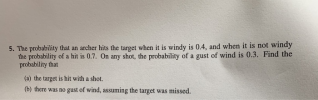 5. The probability that an archer hits the target when it is windy is 0.4, and when it is not windy the probability of a hit is 0.7. On any shot, the probability of a gust of wind is 0.3. Find the probability that (a) the target is hit with a shot. (b) there was no gust of wind, assuming the target was missed.
5. The probability that an archer hits the target when it is windy is 0.4, and...
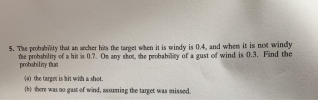 5. The probability that an archer hits the target when it is windy is 0.4, and when it is not windy the probability of a hit is 0.7. On any shot, the probability of a gust of wind is 0.3. Find the probability that (a) the target is hit with a shot. (b) there was no gust of wind, assuming the target was missed.
An archer shoots at a target and hits the target with the probability 1 /4. Let...
An archer shoots at a target and hits the target with the probability 1 /4. Let X be a random variable representing the number of shots preceding the first target hit. Find the distribution of X. Calculate its expected value and variance.
An archer is given five arrows and is told to shoot at a target until he...
 An archer is given five arrows and is told to shoot at a target until he has hit the target or has used up the five arrows. The probability of a hit on each shot is 0.8, independently of the other shots. Let the number of arrows used by the archer be represented by the random variable X. a) (6 points) Find the probability mass function of X. b) (6 points) What is the probability that the archer has to...
Barbara and Diane go target shooting. Suppose that each of Barbara’s shots hits a wooden duck...
Barbara and Diane go target shooting. Suppose that each of Barbara’s shots hits a wooden duck target with probability p 1 , while each shot of Diane’s hits it with probability p 2 . Suppose that they shoot simultaneously at the same target. If we learn that the wooden duck is knocked over (indicating a hit), what is the probability that (a) both shots hit the duck? (b) Barbara’s shot hit the duck? What independence assumptions have you made?
The probability that Jane hits the target on any given attempt is 0.86. The probability that...
The probability that Jane hits the target on any given attempt is 0.86. The probability that Edna hits the target on any given attempt is 0.64. If the two students behave independently, find the probability that if both women shoot at the target at least one of them hits the target? Give your answer to 3 places of decimal. Your Answer:
An Olympic archer can hit the bullseye 89% of the time. Assuming each shot is independent,...
An Olympic archer can hit the bullseye 89% of the time. Assuming each shot is independent, a) find the probability the first bullseye is on her third shot. b) find the probability she has to shot at least 3 times prior to the first bullseye. c) compute E(X), V(X), and ?.
Three persons A, Band C are simultaneously shooting a target. Probability ofA hitting the target is that of B is and that ofC is 2/3 Find the probability (i) exactly one of them will hit the target (ii) at least one of them will hit the target. (i) P (eY
Three persons A, Band C are simultaneously shooting a target.Probability ofA hitting the target is that of B is and that ofC is 2/3Find the probability (i) exactly one of them will hit the target (ii) at leastone of them will hit the target.(i) P (eYactly one hits the target)
Two boys Ben and Matt throw a ball at a target. The probability that Ben will...
 Two boys Ben and Matt throw a ball at a target. The probability that Ben will hit the target on any throw is 0.2, and the probability that Matt will hit the target on any throw is 0.3. Ben throws first, and the two boys will take turns throwing. Find the probability that the target will be hit for the first time on the Ben's third throw.
x New Tab Canvas → XCO Question 5 7 pts You may find the following files...
 x New Tab Canvas → XCO Question 5 7 pts You may find the following files helpful throughout the exam: Statistics Equation Sheet Standard NormalTable An archer is shooting arrows at a target. She hits the target 77% of the time. If she takes 20 shots at the target, what is the probability that she will hit the target exactly 15 times? BIASA-I EE2XXEE ECT T 12pt Paragraph
 5. The probability that an archer hits the target when it is windy is 0.4, and when it is not windy the probability of a hit is 0.7. On any shot, the probability of a gust of wind is 0.3. Find the probability that (a) the target is hit with a shot. (b) there was no gust of wind, assuming the target was missed.
 5. The probability that an archer hits the target when it is windy is 0.4, and when it is not windy the probability of a hit is 0.7. On any shot, the probability of a gust of wind is 0.3. Find the probability that (a) the target is hit with a shot. (b) there was no gust of wind, assuming the target was missed.
 An archer is given five arrows and is told to shoot at a target until he has hit the target or has used up the five arrows. The probability of a hit on each shot is 0.8, independently of the other shots. Let the number of arrows used by the archer be represented by the random variable X. a) (6 points) Find the probability mass function of X. b) (6 points) What is the probability that the archer has to...
 Two boys Ben and Matt throw a ball at a target. The probability that Ben will hit the target on any throw is 0.2, and the probability that Matt will hit the target on any throw is 0.3. Ben throws first, and the two boys will take turns throwing. Find the probability that the target will be hit for the first time on the Ben's third throw.
 x New Tab Canvas → XCO Question 5 7 pts You may find the following files helpful throughout the exam: Statistics Equation Sheet Standard NormalTable An archer is shooting arrows at a target. She hits the target 77% of the time. If she takes 20 shots at the target, what is the probability that she will hit the target exactly 15 times? BIASA-I EE2XXEE ECT T 12pt Paragraph
Most questions answered within 3 hours.
-
Where is the error in this code sequence?
String s1 = "Hello";
String s2 = "ello";...
asked 10 months ago -
Financial data for Joel de Paris, Inc., for last year
follow:
Joel de Paris, Inc.
Balance...
asked 10 months ago -
Consider this reaction:
Al2(SO4)3 (aq)+ BaCl3
(aq) Al2Cl6 (aq)- +
3BaSO4(s) . What is the...
asked 10 months ago -
Suppose that Savneet is considering increasing her
recent random sample from 20 car rentals to 40...
asked 10 months ago -
Trucks arrive at an unloading terminal at an average rate of 120
per hour.
Trucks arrive...
asked 10 months ago -
Why are methanol and ethanol completely soluble in water while
octanol is not very little soluble....
asked 10 months ago -
A facilities manager at a university reads in a research report
that the mean amount of...
asked 10 months ago -
When the CuSO4 is rehydrated by adding water to the anhydrous
compound, is this an endothermic...
asked 10 months ago -
A ray of sunlight is passing from diamond into crown glass; the
angle of incidence is...
asked 10 months ago -
A block of mass 0.249 kg is placed on top of a light, vertical
spring of...
asked 10 months ago -
how do the kidneys compensate in the presences of acidosis
a) trigger hyperventilate
b) reserve acid...
asked 10 months ago -
Question 501 pts
The rental rate of capital to the firm increases. Which of the
following...
asked 10 months ago