I am having trouble computing the NPV for this problem (A). Can you show me the...
I am having trouble computing the NPV for this problem (A). Can you show me the steps to take to calculate this?
Grace and Lydia met as engineering students and quickly discovered they both liked building things, gardening and most mountain sports. As students they earned extra money helping to construct geodesic style greenhouse kits. The women worked on about a dozen of these projects and soon realized a couple of things:
- The kits were expensive
- They used all virgin materials – mostly wood and poly carbonate plastic
- Construction was slow because the triangles were small requiring more connections
As seniors they had to do a major class project so designed a greenhouse kit that was made of mostly recycled materials, was easier to construct and would be less expensive than traditional kits. Their school had a large 3D printer that uses plastic soda and milk bottles as its inputs. By extruding the old bottles as ribbons they could then use thermo-molding to turn them into the triangular wall pieces. A similar process is used to create the framing struts. They built an eight-foot diameter dome this way, so showed proof of concept. After college they kept tinkering with the design and materials. Finally they found some investors and started a company. They didn’t know much about business but their investors stepped in and developed a marketing plan. After some market research, there was still uncertainty about what consumer appeal of the product would be. The business advisors created this table with likely high and low demand scenarios.
|
Year |
1 |
2 |
3 |
4 |
5 |
6 |
|
High Demand (50%) After-tax cash flows |
500,000 |
700,000 |
1,000,000 |
1,300,000 |
1,400,000 |
1,000,000 |
|
Low Demand (50%) After-tax cash flows |
100,000 |
100,000 |
100,000 |
100,000 |
100,000 |
100,000 |
|
Weighted average after-tax cash flow |
300,000 |
400,000 |
550,000 |
700,000 |
750,000 |
550,000 |
The equipment to make full-size greenhouse kits – 16 feet and 22 feet in diameter – would cost about $2.5 million. If the company closes down early the after-tax cash-flow from the sale of the equipment will be $900,000 at the end of Year 1 and $650,000 at the end of Year 2. It has no resale value beyond Year 2.
The table shows projected cash flows for high and low demand scenarios. The cash flows include depreciation, taxes, etc. The only thing missing is the salvage value of the equipment if the project is abandoned early.
- Compute the traditional NPV of the project using a 10% discount rate.
- Compute the NPV of the project using a 10% discount rate and assuming that if demand is low that the company can be shut down after Year 1 or Year 2, whichever is best.
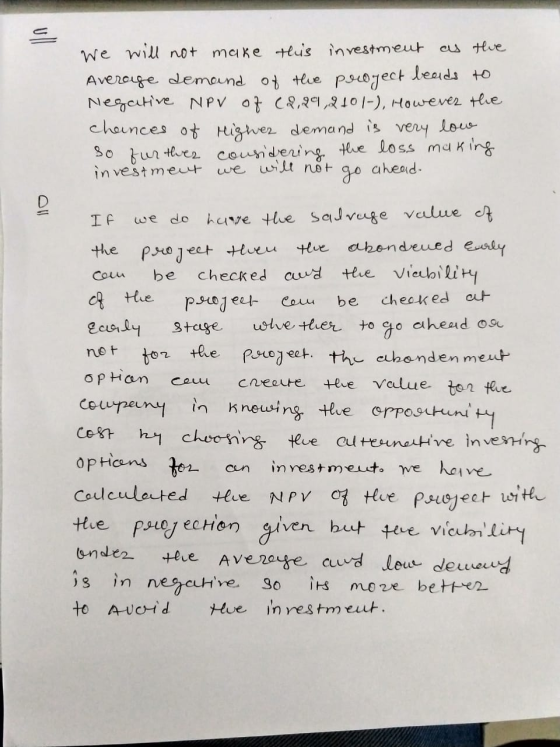
- Should they make this investment?
- D. In a very brief essay (150 words maximum) explain how the abandonment option creates value for the company.
Homework Answers
The Excel calculation of all projection and the narrative
explanation attached as snap.
Add Answer to:
I am having trouble computing the NPV for this problem (A). Can
you show me the...
Year 1 2 3 4 5 6 High Demand (50%) After-tax cash flows 500,000 700,000 1,000,000 1,300,000...
Year 1 2 3 4 5 6 High Demand (50%) After-tax cash flows 500,000 700,000 1,000,000 1,300,000 1,400,000 1,000,000 Low Demand (50%) After-tax cash flows 100,000 100,000 100,000 100,000 100,000 100,000 Weighted average after-tax cash flow 300,000 400,000 550,000 700,000 750,000 550,000 . The equipment to make full-size greenhouse kits – 16 feet and 22 feet in diameter – would cost about $2.5 million. If the company closes down early the after-tax cash-flow from the sale of the equipment will...
In excel or Word doc please You are evaluating the following project. All $ are in millions Initial cost of the proj...
 In excel or Word doc please
You are evaluating the following project. All $ are in millions Initial cost of the project at t-0 is $70. Annual cash flows from the project depends on the demand for the product and is estimated to be as follows: With probability of 30%, the demand is high and the annual cash flow is $45 With probability of 40%, the demand is average and the annual cash flow is $30 With probability of 30%,...
In excel or Word doc please
You are evaluating the following project. All $ are in millions Initial cost of the project at t-0 is $70. Annual cash flows from the project depends on the demand for the product and is estimated to be as follows: With probability of 30%, the demand is high and the annual cash flow is $45 With probability of 40%, the demand is average and the annual cash flow is $30 With probability of 30%,...
I need it the excel document, not a screenshot please I need question 3 answered please...
 I need it the excel document, not a screenshot
please
I need question 3 answered please
You are evaluating the following project. All $ are in millions Initial cost of the project at t-0 is $70. Annual cash flows from the project depends on the demand for the product and is estimated to be as follows: With probability of 30%, the demand is high and the annual cash flow is $45 With probability of 40%, the demand is average and...
I need it the excel document, not a screenshot
please
I need question 3 answered please
You are evaluating the following project. All $ are in millions Initial cost of the project at t-0 is $70. Annual cash flows from the project depends on the demand for the product and is estimated to be as follows: With probability of 30%, the demand is high and the annual cash flow is $45 With probability of 40%, the demand is average and...
Problem 6-15 Project NPV and IRR A project requires an initial investment of $100,000 and is...
 Problem 6-15 Project NPV and IRR A project requires an initial investment of $100,000 and is expected to produce a cash inflow before tax of $26,700 per year for five years. Company A has substantial accumulated tax losses and is unlikely to pay taxes in the foreseeable future. Company B pays corporate taxes at a rate of 21% and can claim 100% bonus depreciation on the investment. Suppose the opportunity cost of capital is 9%. Ignore inflation. a. Calculate project...
Please help me fill in the last blank UPDATE: This is all the information I have...
 Please help me fill in the
last blank
UPDATE: This is all the information I have been given. I just
need help with the last blank.
DCF analysis doesn't always lead to proper capital budgeting decisions because capital budgeting projects are not passive investments like stocks and bonds. Managers can often take positive actions after the investment has been made to alter a project's cash flows. These opportunities are real options that offer the right but not the obligation to...
Please help me fill in the
last blank
UPDATE: This is all the information I have been given. I just
need help with the last blank.
DCF analysis doesn't always lead to proper capital budgeting decisions because capital budgeting projects are not passive investments like stocks and bonds. Managers can often take positive actions after the investment has been made to alter a project's cash flows. These opportunities are real options that offer the right but not the obligation to...
Tropical Sweets is considering a project that will cost $80 million and the cost of capital...
Tropical Sweets is considering a project that will cost $80 million and the cost of capital for this type of project is 10 percent and the risk-free rate is 6 percent. After discussions with the marketing department, you learn that there is a 30 percent chance of high demand, with future after-tax cash flows of $50 million per year for three years. There is a 40 percent chance of average demand, with after-tax cash flows of $40 million per year...
Quantitative Problem: Sunshine Smoothies Company (SSC) manufactures and distributes smoothies. SSC is considering the development of...
Quantitative Problem: Sunshine Smoothies Company (SSC) manufactures and distributes smoothies. SSC is considering the development of a new line of high-protein energy smoothies. SSC's CFO has collected the following information regarding the proposed project, which is expected to last 3 years: The project can be operated at the company's Charleston plant, which is currently vacant. The project will require that the company spend $4.9 million today (t = 0) to purchase additional equipment. This equipment is eligible for 100% bonus...
Replacement Decision, Computing After-Tax Cash Flows, Basic NPV Analysis Okmulgee Hospital (a large metropolitan for-profit hospital)...
Replacement Decision, Computing After-Tax Cash Flows, Basic NPV Analysis Okmulgee Hospital (a large metropolitan for-profit hospital) is considering replacing its MRI equipment with a new model manufactured by a different company. The old MRI equipment was acquired three years ago, has a remaining life of five years, and will have a salvage value of $100,000. The book value is $2,000,000. Straight-line depreciation with a half-year convention is being used for tax purposes. The cash operating costs of the existing MRI...
Can someone please provide steps for calculating IRR on a TI Nspire CX? I can calculate npv alrea...
 can someone please provide steps for calculating IRR
on a TI Nspire CX? I can calculate npv already, but I do not know
how to use the irr function on ti nspire. the problem I am stuck on
is number 10.
thank you
out-content-rid-14522766-1/courses/FINC3321-002-201 920/capital%20decisions%281 %29.pdf P9-10 Your company is considering two mutually exclusive projects-C and R-whose costs and cash flows are shown in the following table: Expected Net Cash Flows Year Project CF Project R $(14,000) 8,000 6,000 2,000...
can someone please provide steps for calculating IRR
on a TI Nspire CX? I can calculate npv already, but I do not know
how to use the irr function on ti nspire. the problem I am stuck on
is number 10.
thank you
out-content-rid-14522766-1/courses/FINC3321-002-201 920/capital%20decisions%281 %29.pdf P9-10 Your company is considering two mutually exclusive projects-C and R-whose costs and cash flows are shown in the following table: Expected Net Cash Flows Year Project CF Project R $(14,000) 8,000 6,000 2,000...
Blaylock Company wants to buy a numerically controlled (NC) machine to be used in producing specially...
 Blaylock Company wants to buy a numerically controlled (NC) machine to be used in producing specially machined parts for manufacturers of trenching machines. The outlay required is $700,000. The NC equipment will last five years with no expected salvage value. The expected after-tax cash flows associated with the project follow: Year Cash Revenues Cash Expenses 1 $1,600,000 $1,000,000 2 1,600,000 1,000,000 1,600,000 1,000,000 1,600,000 1,000,000 1,600,000 1,000,000 Required: Compute the investment's Net Present Value, assuming a required rate of return...
 In excel or Word doc please
You are evaluating the following project. All $ are in millions Initial cost of the project at t-0 is $70. Annual cash flows from the project depends on the demand for the product and is estimated to be as follows: With probability of 30%, the demand is high and the annual cash flow is $45 With probability of 40%, the demand is average and the annual cash flow is $30 With probability of 30%,...
In excel or Word doc please
You are evaluating the following project. All $ are in millions Initial cost of the project at t-0 is $70. Annual cash flows from the project depends on the demand for the product and is estimated to be as follows: With probability of 30%, the demand is high and the annual cash flow is $45 With probability of 40%, the demand is average and the annual cash flow is $30 With probability of 30%,...
 I need it the excel document, not a screenshot
please
I need question 3 answered please
You are evaluating the following project. All $ are in millions Initial cost of the project at t-0 is $70. Annual cash flows from the project depends on the demand for the product and is estimated to be as follows: With probability of 30%, the demand is high and the annual cash flow is $45 With probability of 40%, the demand is average and...
I need it the excel document, not a screenshot
please
I need question 3 answered please
You are evaluating the following project. All $ are in millions Initial cost of the project at t-0 is $70. Annual cash flows from the project depends on the demand for the product and is estimated to be as follows: With probability of 30%, the demand is high and the annual cash flow is $45 With probability of 40%, the demand is average and...
 Problem 6-15 Project NPV and IRR A project requires an initial investment of $100,000 and is expected to produce a cash inflow before tax of $26,700 per year for five years. Company A has substantial accumulated tax losses and is unlikely to pay taxes in the foreseeable future. Company B pays corporate taxes at a rate of 21% and can claim 100% bonus depreciation on the investment. Suppose the opportunity cost of capital is 9%. Ignore inflation. a. Calculate project...
 Please help me fill in the
last blank
UPDATE: This is all the information I have been given. I just
need help with the last blank.
DCF analysis doesn't always lead to proper capital budgeting decisions because capital budgeting projects are not passive investments like stocks and bonds. Managers can often take positive actions after the investment has been made to alter a project's cash flows. These opportunities are real options that offer the right but not the obligation to...
Please help me fill in the
last blank
UPDATE: This is all the information I have been given. I just
need help with the last blank.
DCF analysis doesn't always lead to proper capital budgeting decisions because capital budgeting projects are not passive investments like stocks and bonds. Managers can often take positive actions after the investment has been made to alter a project's cash flows. These opportunities are real options that offer the right but not the obligation to...
 can someone please provide steps for calculating IRR
on a TI Nspire CX? I can calculate npv already, but I do not know
how to use the irr function on ti nspire. the problem I am stuck on
is number 10.
thank you
out-content-rid-14522766-1/courses/FINC3321-002-201 920/capital%20decisions%281 %29.pdf P9-10 Your company is considering two mutually exclusive projects-C and R-whose costs and cash flows are shown in the following table: Expected Net Cash Flows Year Project CF Project R $(14,000) 8,000 6,000 2,000...
can someone please provide steps for calculating IRR
on a TI Nspire CX? I can calculate npv already, but I do not know
how to use the irr function on ti nspire. the problem I am stuck on
is number 10.
thank you
out-content-rid-14522766-1/courses/FINC3321-002-201 920/capital%20decisions%281 %29.pdf P9-10 Your company is considering two mutually exclusive projects-C and R-whose costs and cash flows are shown in the following table: Expected Net Cash Flows Year Project CF Project R $(14,000) 8,000 6,000 2,000...
 Blaylock Company wants to buy a numerically controlled (NC) machine to be used in producing specially machined parts for manufacturers of trenching machines. The outlay required is $700,000. The NC equipment will last five years with no expected salvage value. The expected after-tax cash flows associated with the project follow: Year Cash Revenues Cash Expenses 1 $1,600,000 $1,000,000 2 1,600,000 1,000,000 1,600,000 1,000,000 1,600,000 1,000,000 1,600,000 1,000,000 Required: Compute the investment's Net Present Value, assuming a required rate of return...
Most questions answered within 3 hours.
-
Where is the error in this code sequence?
String s1 = "Hello";
String s2 = "ello";...
asked 10 months ago -
Financial data for Joel de Paris, Inc., for last year
follow:
Joel de Paris, Inc.
Balance...
asked 10 months ago -
Consider this reaction:
Al2(SO4)3 (aq)+ BaCl3
(aq) Al2Cl6 (aq)- +
3BaSO4(s) . What is the...
asked 10 months ago -
Suppose that Savneet is considering increasing her
recent random sample from 20 car rentals to 40...
asked 10 months ago -
Trucks arrive at an unloading terminal at an average rate of 120
per hour.
Trucks arrive...
asked 10 months ago -
Why are methanol and ethanol completely soluble in water while
octanol is not very little soluble....
asked 10 months ago -
A facilities manager at a university reads in a research report
that the mean amount of...
asked 10 months ago -
When the CuSO4 is rehydrated by adding water to the anhydrous
compound, is this an endothermic...
asked 10 months ago -
A ray of sunlight is passing from diamond into crown glass; the
angle of incidence is...
asked 10 months ago -
A block of mass 0.249 kg is placed on top of a light, vertical
spring of...
asked 10 months ago -
how do the kidneys compensate in the presences of acidosis
a) trigger hyperventilate
b) reserve acid...
asked 10 months ago -
Question 501 pts
The rental rate of capital to the firm increases. Which of the
following...
asked 10 months ago