
Homework Answers
Add Answer to:
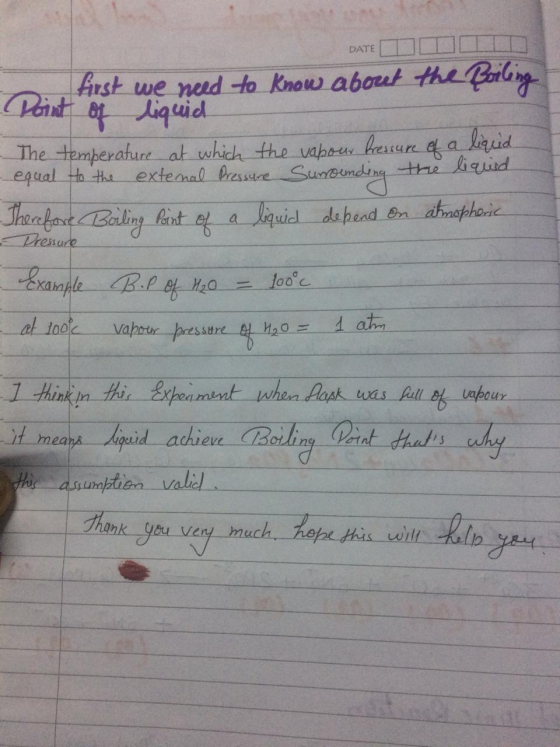
3. The pressure of the vapor in this experiment when the flask was full of vapor...
EXPERIMENT 3: What laboratory conditions (temperature and pressure) were assumed when calculating Ksp based on measured...
 EXPERIMENT 3: What laboratory conditions (temperature and pressure) were assumed when calculating Ksp based on measured electrochemical potential?
Please answer number1 0.3901.96 -0.00L592 miles MASS OF METAL PLACED IN CAPSULE VAPOR PRESSURE OF WATER...
 Please answer number1
0.3901.96 -0.00L592 miles MASS OF METAL PLACED IN CAPSULE VAPOR PRESSURE OF WATER TRIAL 1 TRIAL 2 0, 100 g 21.1 mm Hg ATMOSPHERIC PRESSURE 755. 65 mm Ho MOLES H2 EVOLVED 0.00 6822 moles EQUIVALENT MASS OF METAL 549, 05 g % ERROR st (need extact number) 3 metal ego. mass = 6.94 glad LiL Hinmole H gx 22 Pa- 20.00 6322 med Ha V-nb bau.na = 549:05 g as out UESTIONS (Read textbook TRO chapter...
Please answer number1
0.3901.96 -0.00L592 miles MASS OF METAL PLACED IN CAPSULE VAPOR PRESSURE OF WATER TRIAL 1 TRIAL 2 0, 100 g 21.1 mm Hg ATMOSPHERIC PRESSURE 755. 65 mm Ho MOLES H2 EVOLVED 0.00 6822 moles EQUIVALENT MASS OF METAL 549, 05 g % ERROR st (need extact number) 3 metal ego. mass = 6.94 glad LiL Hinmole H gx 22 Pa- 20.00 6322 med Ha V-nb bau.na = 549:05 g as out UESTIONS (Read textbook TRO chapter...
"Vapor Pressure of Water" assignment: VAPOR PRESSURE OF WATER INTRODUCTION All liquids exist in equilibrium with...
 "Vapor Pressure of Water" assignment:
VAPOR PRESSURE OF WATER INTRODUCTION All liquids exist in equilibrium with the vapor state. As temperature increases, this equilibrium shifts more and more in favor of the vapor until one reaches the boiling point, at which all liquid is converted to gas. The pressure exerted by the vapor over the liquid is known as its vapor pressure and is a function of temperature. Boiling occurs at the temperature at which the vapor pressure is equal...
"Vapor Pressure of Water" assignment:
VAPOR PRESSURE OF WATER INTRODUCTION All liquids exist in equilibrium with the vapor state. As temperature increases, this equilibrium shifts more and more in favor of the vapor until one reaches the boiling point, at which all liquid is converted to gas. The pressure exerted by the vapor over the liquid is known as its vapor pressure and is a function of temperature. Boiling occurs at the temperature at which the vapor pressure is equal...
The manometer shown was open on both sides prior to being attached to the flask containing...
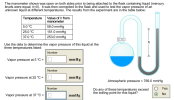 The manometer shown was open on both sides prior to being attached to the flask containing liquid (mercury levels were equal, h=0). It was then connected to the flask and used to test the vapor pressure of an unknown liquid at different temperatures. The results from the experiment are in the table below: Use the data to determine the vapor pressure of this liquid at the three temperatures listed: Vapor pressure at 5 degrees C =
B. QUESTIONS. Show your work for full credit. 1. Why was it important to determine the...
 B. QUESTIONS. Show your work for full credit. 1. Why was it important to determine the mass of the air in the flask? 2. A student obtained a mass of 0.223 g CO2 during his experiment. The atmospheric pressure was 751.6 mmHg and the laboratory temperature was 24.1 °C. The flask used in the experiment had a volume of 146.5 mL. Calculate the molar mass of CO2 from the data 3 What was the percent error from the results of...
What is the pressure of the gas in the flask when the levels of water in...
What is the pressure of the gas in the flask when the levels of water in the buret and leveling bulb are equal?
The vapor pressure of a liquid is the pressure exerted by its vapor when the liquid...
The vapor pressure of a liquid is the pressure exerted by its vapor when the liquid and vapor states are in equilibrium. The relationship between vapor pressure P and temperature T is expressed by the Clausius-Clapeyron equation. lnP2P1=ΔHvapR(1T1−1T2) where P1 and P2 are the vapor pressures at the absolute temperatures T1 and T2, respectively, ΔHvap is the heat of vaporization of the substance in joules per mole, and R is the ideal gas constant, which is equal to 8.3145 J/(mol⋅K)....
Mass of flask and foil (g) = 63.4842 Mass of flask, foil, and condesned vapor (g) = 63.6995 Temperature of boiling wate...
Mass of flask and foil (g) = 63.4842 Mass of flask, foil, and condesned vapor (g) = 63.6995 Temperature of boiling water bath (C) = 95 degrees C Volume of flask (mL) = 134 Barometric pressre (mmHg) = 763.8 Room temperature (C) = 21.0 degrees C Vapor pressure at room temperature (mmHg) = 100 Find the following: 1) Uncorrected mass of condensed vapor (g) = ? 2). Corrected density of air (g/L) = ? 3). Average volume of flask (L)...
3. A flask initially containing 0.815 atm of NOBr decomposed to give an equilibrium mixture for...
 3. A flask initially containing 0.815 atm of NOBr decomposed to give an equilibrium mixture for the reaction below. If the partial pressure of NO gas at equilibrium was 0.116 atr, then what is the value for the equilibrium constant, Kp, for the reaction? (7 pts) 2 NOBr(g) 2 NO(g) + Br2(1) Kp = 4. Would it be valid to make the simplifying assumption below Why or why not? (3 pts) 0.175- X 0.175 if x = 0.0042
3. What experimental factors are assumed to be constant in: a. Pressure-Volume experiment? b. Temperature-Pressure experiment?
3. What experimental factors are assumed to be constant in: a. Pressure-Volume experiment? b. Temperature-Pressure experiment?
 EXPERIMENT 3: What laboratory conditions (temperature and pressure) were assumed when calculating Ksp based on measured electrochemical potential?
 Please answer number1
0.3901.96 -0.00L592 miles MASS OF METAL PLACED IN CAPSULE VAPOR PRESSURE OF WATER TRIAL 1 TRIAL 2 0, 100 g 21.1 mm Hg ATMOSPHERIC PRESSURE 755. 65 mm Ho MOLES H2 EVOLVED 0.00 6822 moles EQUIVALENT MASS OF METAL 549, 05 g % ERROR st (need extact number) 3 metal ego. mass = 6.94 glad LiL Hinmole H gx 22 Pa- 20.00 6322 med Ha V-nb bau.na = 549:05 g as out UESTIONS (Read textbook TRO chapter...
Please answer number1
0.3901.96 -0.00L592 miles MASS OF METAL PLACED IN CAPSULE VAPOR PRESSURE OF WATER TRIAL 1 TRIAL 2 0, 100 g 21.1 mm Hg ATMOSPHERIC PRESSURE 755. 65 mm Ho MOLES H2 EVOLVED 0.00 6822 moles EQUIVALENT MASS OF METAL 549, 05 g % ERROR st (need extact number) 3 metal ego. mass = 6.94 glad LiL Hinmole H gx 22 Pa- 20.00 6322 med Ha V-nb bau.na = 549:05 g as out UESTIONS (Read textbook TRO chapter...
 "Vapor Pressure of Water" assignment:
VAPOR PRESSURE OF WATER INTRODUCTION All liquids exist in equilibrium with the vapor state. As temperature increases, this equilibrium shifts more and more in favor of the vapor until one reaches the boiling point, at which all liquid is converted to gas. The pressure exerted by the vapor over the liquid is known as its vapor pressure and is a function of temperature. Boiling occurs at the temperature at which the vapor pressure is equal...
"Vapor Pressure of Water" assignment:
VAPOR PRESSURE OF WATER INTRODUCTION All liquids exist in equilibrium with the vapor state. As temperature increases, this equilibrium shifts more and more in favor of the vapor until one reaches the boiling point, at which all liquid is converted to gas. The pressure exerted by the vapor over the liquid is known as its vapor pressure and is a function of temperature. Boiling occurs at the temperature at which the vapor pressure is equal...
 The manometer shown was open on both sides prior to being attached to the flask containing liquid (mercury levels were equal, h=0). It was then connected to the flask and used to test the vapor pressure of an unknown liquid at different temperatures. The results from the experiment are in the table below: Use the data to determine the vapor pressure of this liquid at the three temperatures listed: Vapor pressure at 5 degrees C =
 B. QUESTIONS. Show your work for full credit. 1. Why was it important to determine the mass of the air in the flask? 2. A student obtained a mass of 0.223 g CO2 during his experiment. The atmospheric pressure was 751.6 mmHg and the laboratory temperature was 24.1 °C. The flask used in the experiment had a volume of 146.5 mL. Calculate the molar mass of CO2 from the data 3 What was the percent error from the results of...
 3. A flask initially containing 0.815 atm of NOBr decomposed to give an equilibrium mixture for the reaction below. If the partial pressure of NO gas at equilibrium was 0.116 atr, then what is the value for the equilibrium constant, Kp, for the reaction? (7 pts) 2 NOBr(g) 2 NO(g) + Br2(1) Kp = 4. Would it be valid to make the simplifying assumption below Why or why not? (3 pts) 0.175- X 0.175 if x = 0.0042
Most questions answered within 3 hours.
-
Where is the error in this code sequence?
String s1 = "Hello";
String s2 = "ello";...
asked 11 months ago -
Financial data for Joel de Paris, Inc., for last year
follow:
Joel de Paris, Inc.
Balance...
asked 11 months ago -
Consider this reaction:
Al2(SO4)3 (aq)+ BaCl3
(aq) Al2Cl6 (aq)- +
3BaSO4(s) . What is the...
asked 11 months ago -
Suppose that Savneet is considering increasing her
recent random sample from 20 car rentals to 40...
asked 11 months ago -
Trucks arrive at an unloading terminal at an average rate of 120
per hour.
Trucks arrive...
asked 11 months ago -
Why are methanol and ethanol completely soluble in water while
octanol is not very little soluble....
asked 11 months ago -
A facilities manager at a university reads in a research report
that the mean amount of...
asked 11 months ago -
When the CuSO4 is rehydrated by adding water to the anhydrous
compound, is this an endothermic...
asked 11 months ago -
A ray of sunlight is passing from diamond into crown glass; the
angle of incidence is...
asked 11 months ago -
A block of mass 0.249 kg is placed on top of a light, vertical
spring of...
asked 11 months ago -
how do the kidneys compensate in the presences of acidosis
a) trigger hyperventilate
b) reserve acid...
asked 11 months ago -
Question 501 pts
The rental rate of capital to the firm increases. Which of the
following...
asked 11 months ago