A lab student analyzed her nickel-en complex for ethylenediamine, en, content. A 0.579 g sample of...
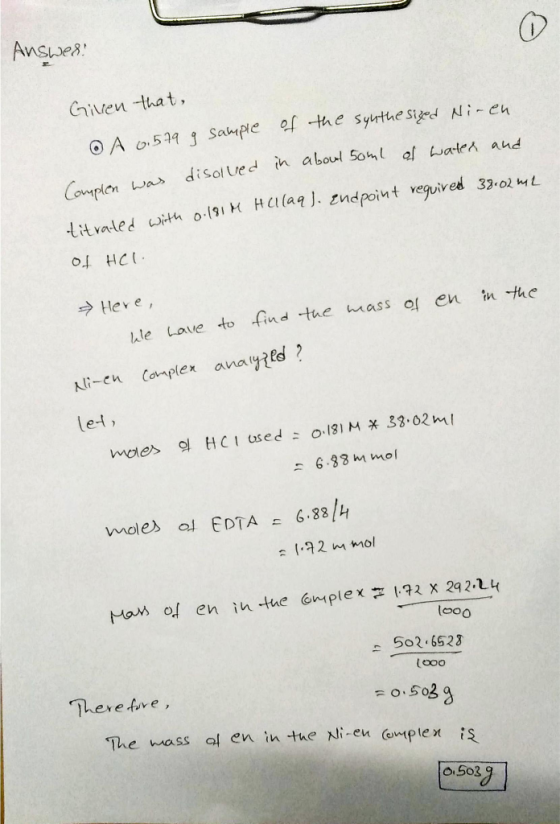
- A lab student analyzed her nickel-en complex for ethylenediamine, en, content. A 0.579 g sample of the synthesized Ni-en complex was dissolved in about 50 mL of water and titrated with 0.181 M HCl (aq). Endpoint required 38.02 mL of the HCl (aq). What is the mass (in grams) of en in the Ni-en complex analyzed?
Homework Answers
Add Answer to:
A lab student analyzed her nickel-en complex for
ethylenediamine, en, content. A 0.579 g sample of...
hexahydrate 3. A lab student analyzed her nickel-en complex for ethylenediamine, en, content. A 0.579 g...
 hexahydrate 3. A lab student analyzed her nickel-en complex for ethylenediamine, en, content. A 0.579 g sample of the synthesized Ni-en complex was dissolved in about 50 mL of water and titrated with 0.181 M HCl (ag). Endpoint required 38.02 mL of the HCl (ag). What is the mass (in grams) of en in the Ni-en complex analyzed? a. 0.153 g b. 0.207 g c. 0.413 g d. 0.104 g e. 0.199 g 4. Continuing on with the analysis of...
A 21.524 g paint sample was analyzed for barium (Ba2+, MW = 137.327 g/mole) by an...
A 21.524 g paint sample was analyzed for barium (Ba2+, MW = 137.327 g/mole) by an EDTA back titration: Ba2+(aq) + Y4–(aq) à BaY2–(aq). The sample was dissolved in acid and sufficient water was added to produce a volume of 100 mL. 10.00 mL of this concentrated solution was diluted to a volume of 50.00 mL. 25.00 mL of the diluted solution was treated with 33.95 mL of excess 0.09456 M EDTA. The excess EDTA was titrated to the endpoint...
A 6.04 g sample of a solid containing Ni is dissolved in 20.0 mL water. A...
A 6.04 g sample of a solid containing Ni is dissolved in 20.0 mL water. A 5.00 mL aliquot of this solution is diluted to 100.0 mL and analyzed in the lab. The analyzed solution was determined to contain 6.88 ppm Ni . Determine the molar concentration of Ni in the 20.0 mL solution. *concentration= ? M Determine the mass, in grams, of Ni in the original sample. *mass= ? g Determine the weight percent of Ni in the sample....
Question 2 (2 points) A 3.2100-g sample of a salt was analyzed for its chloride content...
 Question 2 (2 points) A 3.2100-g sample of a salt was analyzed for its chloride content as follows: the entire sample was dissolved with distilled water in a 500.0-ml volumetric flask. A 100.00-mL aliquot of the solution required 24.89-mL of a 0.03769 M silver nitrate solution to reach equivalence. A blank correction was not required. Calculate the % (w/w) chloride in the sample. The net-ionic equation for the reaction is Ag*(aq) + CI (aq) - AgCl(s). Provide your answer to...
6 b) In the laboratory a student combines 46.6 mL of a 0.322 M potassium sulfate...
6 b) In the laboratory a student combines 46.6 mL of a 0.322 M potassium sulfate solution with 19.0 mL of a 0.503 M cobalt(II) sulfate solution. What is the final concentration of sulfate anion ? M 18 a) A 0.5655 g sample of a pure soluble bromide compound is dissolved in water, and all of the bromide ion is precipitated as AgBr by the addition of an excess of silver nitrate. The mass of the resulting AgBr is found...
1. A 0.4187 g sample of a pure soluble chloride compound is dissolved in water, and...
1. A 0.4187 g sample of a pure soluble chloride compound is dissolved in water, and all of the chloride ion is precipitated as AgCl by the addition of an excess of silver nitrate. The mass of the resulting AgCl is found to be 0.9536 g. What is the mass percentage of chlorine in the original compound? ________% 2. A student determines the calcium content of a solution by first precipitating it as calcium hydroxide, and then decomposing the hydroxide...
Heres are the steps that were followed... Please help. Let me know if their is any...
 Heres are the steps that were followed...
Please help. Let me know if their is any missing
information.
ii) Nickel analysis - Prepare three standard nickel solutions using the following procedure. Accurately weigh approximately 1.0 g of [Ni(H20)6]504 into a 50 mL volumetric flask. Add 10 mL of D.I. water followed by 10 mL of 1 M H2SO4(aq) to dissolve the salt and then dilute to the mark with deionized water. Pipet 10 mL of the solution into one 25...
Heres are the steps that were followed...
Please help. Let me know if their is any missing
information.
ii) Nickel analysis - Prepare three standard nickel solutions using the following procedure. Accurately weigh approximately 1.0 g of [Ni(H20)6]504 into a 50 mL volumetric flask. Add 10 mL of D.I. water followed by 10 mL of 1 M H2SO4(aq) to dissolve the salt and then dilute to the mark with deionized water. Pipet 10 mL of the solution into one 25...
LAB DESCRIPTION: In aqueous solutions the Ni2+ cation forms a complex ion with 6 H2O ligands....
LAB DESCRIPTION: In aqueous solutions the Ni2+ cation forms a complex ion with 6 H2O ligands. The formula of this complex ion is: Ni(H2O)62+. When this complex ion is mixed with aqueous NH3 a reaction occurs where some of the H2O ligands are displaced with NH3 ligands. But how many of the H2O are displaced by NH3? In this experiment you will mix nickel(II) sulfate and aqueous ammonia to synthesize a compound containing a complex ion whose formula is Ni(H2O)6-x(NH3)x2+,...
A student weighs a sample of potassium hydrogen phthalate (KHP) to prepare a primary standard for...
 A student weighs a sample of potassium hydrogen phthalate (KHP) to prepare a primary standard for a titration. She later discovers that the KHP was contaminated with sugar. To determine the amount of KHP in the mixture, she takes 5.942 g of the mixture and make a 100.0 mL solution. The student then titrates 10.00 mL of this solution with a 0.1491 M sodium hydroxide solution. She finds that 13.12 mL of the NaOH solution is needed to reach the...
3. Concentrations in solids and solution. You send a 10-g sample of rice to the lab...
3. Concentrations in solids and solution. You send a 10-g sample of rice to the lab for the determination of the total arsenic content. The analyst dissolves 1.0 g of the rice in 5.0 mL of concentrated acid and then dilutes the solution to a final volume of 25.0 mL. When analyzed by ICP-MS, the solution concentration is found to be 35 µg L-1. What is the concentration of arsenic in the rice (in µg kg-1)? ___________ ppb Hint: Follow...
 hexahydrate 3. A lab student analyzed her nickel-en complex for ethylenediamine, en, content. A 0.579 g sample of the synthesized Ni-en complex was dissolved in about 50 mL of water and titrated with 0.181 M HCl (ag). Endpoint required 38.02 mL of the HCl (ag). What is the mass (in grams) of en in the Ni-en complex analyzed? a. 0.153 g b. 0.207 g c. 0.413 g d. 0.104 g e. 0.199 g 4. Continuing on with the analysis of...
 Question 2 (2 points) A 3.2100-g sample of a salt was analyzed for its chloride content as follows: the entire sample was dissolved with distilled water in a 500.0-ml volumetric flask. A 100.00-mL aliquot of the solution required 24.89-mL of a 0.03769 M silver nitrate solution to reach equivalence. A blank correction was not required. Calculate the % (w/w) chloride in the sample. The net-ionic equation for the reaction is Ag*(aq) + CI (aq) - AgCl(s). Provide your answer to...
 Heres are the steps that were followed...
Please help. Let me know if their is any missing
information.
ii) Nickel analysis - Prepare three standard nickel solutions using the following procedure. Accurately weigh approximately 1.0 g of [Ni(H20)6]504 into a 50 mL volumetric flask. Add 10 mL of D.I. water followed by 10 mL of 1 M H2SO4(aq) to dissolve the salt and then dilute to the mark with deionized water. Pipet 10 mL of the solution into one 25...
Heres are the steps that were followed...
Please help. Let me know if their is any missing
information.
ii) Nickel analysis - Prepare three standard nickel solutions using the following procedure. Accurately weigh approximately 1.0 g of [Ni(H20)6]504 into a 50 mL volumetric flask. Add 10 mL of D.I. water followed by 10 mL of 1 M H2SO4(aq) to dissolve the salt and then dilute to the mark with deionized water. Pipet 10 mL of the solution into one 25...
 A student weighs a sample of potassium hydrogen phthalate (KHP) to prepare a primary standard for a titration. She later discovers that the KHP was contaminated with sugar. To determine the amount of KHP in the mixture, she takes 5.942 g of the mixture and make a 100.0 mL solution. The student then titrates 10.00 mL of this solution with a 0.1491 M sodium hydroxide solution. She finds that 13.12 mL of the NaOH solution is needed to reach the...
Most questions answered within 3 hours.
-
Where is the error in this code sequence?
String s1 = "Hello";
String s2 = "ello";...
asked 10 months ago -
Financial data for Joel de Paris, Inc., for last year
follow:
Joel de Paris, Inc.
Balance...
asked 10 months ago -
Consider this reaction:
Al2(SO4)3 (aq)+ BaCl3
(aq) Al2Cl6 (aq)- +
3BaSO4(s) . What is the...
asked 10 months ago -
Suppose that Savneet is considering increasing her
recent random sample from 20 car rentals to 40...
asked 10 months ago -
Trucks arrive at an unloading terminal at an average rate of 120
per hour.
Trucks arrive...
asked 10 months ago -
Why are methanol and ethanol completely soluble in water while
octanol is not very little soluble....
asked 10 months ago -
A facilities manager at a university reads in a research report
that the mean amount of...
asked 10 months ago -
When the CuSO4 is rehydrated by adding water to the anhydrous
compound, is this an endothermic...
asked 10 months ago -
A ray of sunlight is passing from diamond into crown glass; the
angle of incidence is...
asked 10 months ago -
A block of mass 0.249 kg is placed on top of a light, vertical
spring of...
asked 10 months ago -
how do the kidneys compensate in the presences of acidosis
a) trigger hyperventilate
b) reserve acid...
asked 10 months ago -
Question 501 pts
The rental rate of capital to the firm increases. Which of the
following...
asked 10 months ago