Given the system of forces below, calculate:
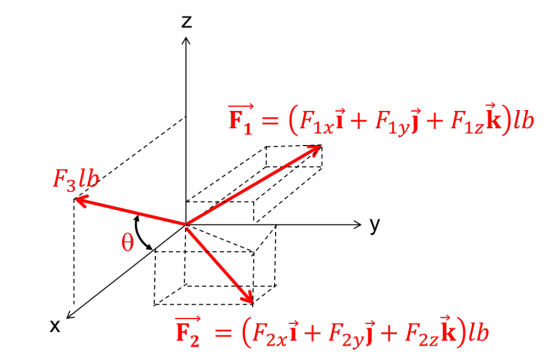
F1x = -7 lb. F1y = 7 lb. F1z = 2 lb. F2x = 7 lb. F2y = 5 lb. F2z = -7 lb. F3 = 44 lb. θ = 58 deg
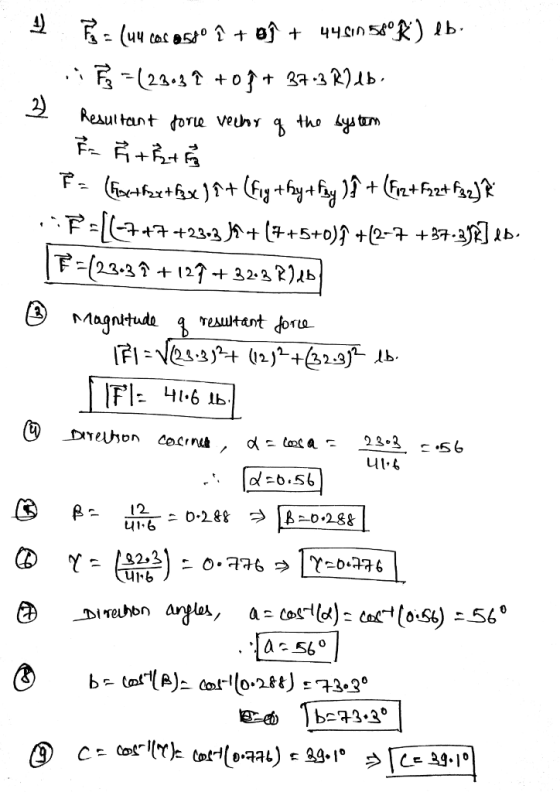
1) Write the F3 force in vector form.(i,j,k)
2) The resultant force vector of the system. (i,j,k)
3) The magnitude of the resultant force. (lb)
4) The directional cosine alpha
5) The directional cosine beta.
6) The directional cosine gamma.
7) The coordinate directional angle alpha. (deg)
8) The coordinate directional angle beta. (deg)
9) The coordinate directional angle gamma. (deg)
Homework Answers
Add Answer to:
Given the system of forces below, calculate:
F1x = -7 lb. F1y = 7 lb.
F1z...
: Given the system of forces below, calculate Given the system of forces below, calculate: F3...
 :
Given the system of forces below, calculate
Given the system of forces below, calculate: F3 COLLAPSE IMAGES Write the F force in vector form k lb ENTER 3 tries remaining. 1 poinf(s) possible The resultant force vector of the system. k lb ENTER 3 tries remaining. 1 paint s) possible The magnitude of the resultant force. b ENTER 3 tries remaining. 1 paint's) possible The directional cosine alpha. ENTER 3 tries remaining. 1 paints) possible The directional cosine beta....
:
Given the system of forces below, calculate
Given the system of forces below, calculate: F3 COLLAPSE IMAGES Write the F force in vector form k lb ENTER 3 tries remaining. 1 poinf(s) possible The resultant force vector of the system. k lb ENTER 3 tries remaining. 1 paint s) possible The magnitude of the resultant force. b ENTER 3 tries remaining. 1 paint's) possible The directional cosine alpha. ENTER 3 tries remaining. 1 paints) possible The directional cosine beta....
5. Suppose the resultant of the three forces is zero. Fs Fi 170 lb 400 30°...
 5. Suppose the resultant of the three forces is zero. Fs Fi 170 lb 400 30° F-250 lb o The magnitude ofz direction component ofthe force 2, F2 o The magnitude of component along OA of the force 2, F2oA?ib o The magnitude of x direction component of the force 2, F2x o The magnitude of y direction component of the force 2, F2y ? o Force 1, F,, in Cartesian vector form? o Force 3, F3, in Cartesian vector...
The hook and spring assembly shown in the figure are equilibrium, calculate: F. lb k lb/ft...
 The hook and spring assembly shown in the figure are equilibrium, calculate: F. lb k lb/ft А (1) Falb В 02 2 ft F3 lb COLLAPSE IMAGES F1 = 110 lb F3 = 52 lb 01 - 21 deg 02 - 35 deg k = 1506 lb/ F2 = 98 lb The magnitude of the resultant force. Ib ENTER 3 tries remaining. 1 points) possible The orientation counter-clockwise from the positive x axis of the spring. deg ENTER 3 tries...
Number 7 only please Three forces act on the anchor bolt connection shown below. The forces...
 Number 7 only please
Three forces act on the anchor bolt connection shown below. The forces are concurrent at point A.Express all answers to three significant figures with the appropriate units. F2 35 kN FI F3 = 10 kN Express force F1 in rectangular vector form. Take F: = 20 kN and 6, = 50.. Problem #2 Express force F2 in rectangular vector form. Problem#3 Express force F, in rectangular vector form. Problem#4 Determine the resultant force FR in rectangular...
Number 7 only please
Three forces act on the anchor bolt connection shown below. The forces are concurrent at point A.Express all answers to three significant figures with the appropriate units. F2 35 kN FI F3 = 10 kN Express force F1 in rectangular vector form. Take F: = 20 kN and 6, = 50.. Problem #2 Express force F2 in rectangular vector form. Problem#3 Express force F, in rectangular vector form. Problem#4 Determine the resultant force FR in rectangular...
Part A The resultant of the three forces acting on the bracket is FR-(-330 k} lb...
 Part A The resultant of the three forces acting on the bracket is FR-(-330 k} lb Note that F3 lies in the z-y plane Figure 1) Specify the magnitude of F Express your answer to three significant figures and include the appropriate units. FValue Units Figure く 1of1 Submit Request Answer Part B Fs400 Ib Yi Specify the coordinate direction angle a of F Express your answer using three significant figures. 30 F2 200 lb Bi vec ▼ Part C...
Four forces act on the origin of an X-Y Cartesian Coordinate system as pictured below. a....
 Four forces act on the origin of an X-Y Cartesian Coordinate system as pictured below. a. Resolve each force into its components along the X and Y axes. b. Find the magnitude and direction of the resultant force acting on the system. Y 300 lb 60° 200 lb 3 0 30 50 lb 400 lb
Two forces are applied at a point in a body as shown below = 120 lb...
 Two forces are applied at a point in a body as shown below = 120 lb F, = 150 lb 60% 14.5 ft O 2 ft 6 fL 15ft Determine the Cartesian vector form of F2. Your final answer should be presented as shown below. F2= { j. k} (units) Bonus: If F1 = { 29.4 | + 117.7 3 + 88.3 k} lb What is the angle 0 between forces F1 and F2?
Problem 2.78 Part A The two forces Fi and F2 acting at A have a resultant force of FR={-180 k lb. (Figure 1) Determine...
 Problem 2.78 Part A The two forces Fi and F2 acting at A have a resultant force of FR={-180 k lb. (Figure 1) Determine the magnitude of F2. Express your answer to three significant figures and include the appropriate units. Value Units Submit Request Answer Figure 1 of 1 Part B Determine the coordinate direction angle a of F2. Express your answer using three significant figures. VA Tvec 30 ? 40 F 60 lb Submit Request Answer Part C Determine...
This system of three forces is in equilbrium.
 A.This system of three forces is in equilbrium. What is the magnitude of \(\mathrm{T} 1\) ? \(\mathrm{W}=40 \mathrm{~N}\)\(\theta 1=30^{\circ}\)\(\theta 2=60^{\circ}\)B.This system of four forces is in equilibrium. \(A=18^{\circ}\)\(\mathrm{B}=32^{\circ}\)\(\mathrm{W}=14.0 \mathrm{lb}\)\(\mathrm{H}=6.0 \mathrm{lb}\)What is the magnitude of G? (include units with answer)C.Determine the direction (angle) of the vector S. (+ CCW from \(X\) )\(\mathbf{A}=-7.0 \mathbf{i}+-3.0 \mathbf{j}\)\(\mathbf{B}=6.0 \mathbf{i}+-2.0 \mathbf{j}\)\(\mathbf{C}=4.0 \mathbf{i}+-8.0 \mathbf{j}\)\(\mathbf{S}=\mathbf{A}+\mathbf{B}-\mathbf{C}\)
7. Calculate the force on the charge at the origin due to the other two charges...
 7. Calculate the force on the charge at the origin due to the other two charges (ollow the steps below). Different approach than Prob. 3, same answer at the end. q+ 2m h) Calculate the magnitude of the electric field of the 2nd charge at the origin E2 = N/C f the 3rd charge at the origin E3 Sketch arrows on the diagram above at the origin to indicate the vector a N/C rrows of E2 and j) Put the...
 :
Given the system of forces below, calculate
Given the system of forces below, calculate: F3 COLLAPSE IMAGES Write the F force in vector form k lb ENTER 3 tries remaining. 1 poinf(s) possible The resultant force vector of the system. k lb ENTER 3 tries remaining. 1 paint s) possible The magnitude of the resultant force. b ENTER 3 tries remaining. 1 paint's) possible The directional cosine alpha. ENTER 3 tries remaining. 1 paints) possible The directional cosine beta....
:
Given the system of forces below, calculate
Given the system of forces below, calculate: F3 COLLAPSE IMAGES Write the F force in vector form k lb ENTER 3 tries remaining. 1 poinf(s) possible The resultant force vector of the system. k lb ENTER 3 tries remaining. 1 paint s) possible The magnitude of the resultant force. b ENTER 3 tries remaining. 1 paint's) possible The directional cosine alpha. ENTER 3 tries remaining. 1 paints) possible The directional cosine beta....
 5. Suppose the resultant of the three forces is zero. Fs Fi 170 lb 400 30° F-250 lb o The magnitude ofz direction component ofthe force 2, F2 o The magnitude of component along OA of the force 2, F2oA?ib o The magnitude of x direction component of the force 2, F2x o The magnitude of y direction component of the force 2, F2y ? o Force 1, F,, in Cartesian vector form? o Force 3, F3, in Cartesian vector...
 The hook and spring assembly shown in the figure are equilibrium, calculate: F. lb k lb/ft А (1) Falb В 02 2 ft F3 lb COLLAPSE IMAGES F1 = 110 lb F3 = 52 lb 01 - 21 deg 02 - 35 deg k = 1506 lb/ F2 = 98 lb The magnitude of the resultant force. Ib ENTER 3 tries remaining. 1 points) possible The orientation counter-clockwise from the positive x axis of the spring. deg ENTER 3 tries...
 Number 7 only please
Three forces act on the anchor bolt connection shown below. The forces are concurrent at point A.Express all answers to three significant figures with the appropriate units. F2 35 kN FI F3 = 10 kN Express force F1 in rectangular vector form. Take F: = 20 kN and 6, = 50.. Problem #2 Express force F2 in rectangular vector form. Problem#3 Express force F, in rectangular vector form. Problem#4 Determine the resultant force FR in rectangular...
Number 7 only please
Three forces act on the anchor bolt connection shown below. The forces are concurrent at point A.Express all answers to three significant figures with the appropriate units. F2 35 kN FI F3 = 10 kN Express force F1 in rectangular vector form. Take F: = 20 kN and 6, = 50.. Problem #2 Express force F2 in rectangular vector form. Problem#3 Express force F, in rectangular vector form. Problem#4 Determine the resultant force FR in rectangular...
 Part A The resultant of the three forces acting on the bracket is FR-(-330 k} lb Note that F3 lies in the z-y plane Figure 1) Specify the magnitude of F Express your answer to three significant figures and include the appropriate units. FValue Units Figure く 1of1 Submit Request Answer Part B Fs400 Ib Yi Specify the coordinate direction angle a of F Express your answer using three significant figures. 30 F2 200 lb Bi vec ▼ Part C...
 Four forces act on the origin of an X-Y Cartesian Coordinate system as pictured below. a. Resolve each force into its components along the X and Y axes. b. Find the magnitude and direction of the resultant force acting on the system. Y 300 lb 60° 200 lb 3 0 30 50 lb 400 lb
 Two forces are applied at a point in a body as shown below = 120 lb F, = 150 lb 60% 14.5 ft O 2 ft 6 fL 15ft Determine the Cartesian vector form of F2. Your final answer should be presented as shown below. F2= { j. k} (units) Bonus: If F1 = { 29.4 | + 117.7 3 + 88.3 k} lb What is the angle 0 between forces F1 and F2?
 Problem 2.78 Part A The two forces Fi and F2 acting at A have a resultant force of FR={-180 k lb. (Figure 1) Determine the magnitude of F2. Express your answer to three significant figures and include the appropriate units. Value Units Submit Request Answer Figure 1 of 1 Part B Determine the coordinate direction angle a of F2. Express your answer using three significant figures. VA Tvec 30 ? 40 F 60 lb Submit Request Answer Part C Determine...
 A.This system of three forces is in equilbrium. What is the magnitude of \(\mathrm{T} 1\) ? \(\mathrm{W}=40 \mathrm{~N}\)\(\theta 1=30^{\circ}\)\(\theta 2=60^{\circ}\)B.This system of four forces is in equilibrium. \(A=18^{\circ}\)\(\mathrm{B}=32^{\circ}\)\(\mathrm{W}=14.0 \mathrm{lb}\)\(\mathrm{H}=6.0 \mathrm{lb}\)What is the magnitude of G? (include units with answer)C.Determine the direction (angle) of the vector S. (+ CCW from \(X\) )\(\mathbf{A}=-7.0 \mathbf{i}+-3.0 \mathbf{j}\)\(\mathbf{B}=6.0 \mathbf{i}+-2.0 \mathbf{j}\)\(\mathbf{C}=4.0 \mathbf{i}+-8.0 \mathbf{j}\)\(\mathbf{S}=\mathbf{A}+\mathbf{B}-\mathbf{C}\)
 7. Calculate the force on the charge at the origin due to the other two charges (ollow the steps below). Different approach than Prob. 3, same answer at the end. q+ 2m h) Calculate the magnitude of the electric field of the 2nd charge at the origin E2 = N/C f the 3rd charge at the origin E3 Sketch arrows on the diagram above at the origin to indicate the vector a N/C rrows of E2 and j) Put the...
Most questions answered within 3 hours.
-
Where is the error in this code sequence?
String s1 = "Hello";
String s2 = "ello";...
asked 11 months ago -
Financial data for Joel de Paris, Inc., for last year
follow:
Joel de Paris, Inc.
Balance...
asked 11 months ago -
Consider this reaction:
Al2(SO4)3 (aq)+ BaCl3
(aq) Al2Cl6 (aq)- +
3BaSO4(s) . What is the...
asked 11 months ago -
Suppose that Savneet is considering increasing her
recent random sample from 20 car rentals to 40...
asked 11 months ago -
Trucks arrive at an unloading terminal at an average rate of 120
per hour.
Trucks arrive...
asked 11 months ago -
Why are methanol and ethanol completely soluble in water while
octanol is not very little soluble....
asked 11 months ago -
A facilities manager at a university reads in a research report
that the mean amount of...
asked 11 months ago -
When the CuSO4 is rehydrated by adding water to the anhydrous
compound, is this an endothermic...
asked 11 months ago -
A ray of sunlight is passing from diamond into crown glass; the
angle of incidence is...
asked 11 months ago -
A block of mass 0.249 kg is placed on top of a light, vertical
spring of...
asked 11 months ago -
how do the kidneys compensate in the presences of acidosis
a) trigger hyperventilate
b) reserve acid...
asked 11 months ago -
Question 501 pts
The rental rate of capital to the firm increases. Which of the
following...
asked 11 months ago