
Homework Answers
![NH₃ + H₂O È Nutton CNH] mass of NH3 molar mass of wh volume of solution (in) 2 21-89 x 1 1700319 517 mexigl mol z 1-28 males](http://img.homeworklib.com/questions/2856b180-70af-11ea-835a-5be110d08505.png?x-oss-process=image/resize,w_560)
Add Answer to:
please show show work, very confused! will RATE
Problem 1. You are asked to prepare a...
Problem 1. You are asked to prepare a pH = 10.7 buffer starting from 517 mL...
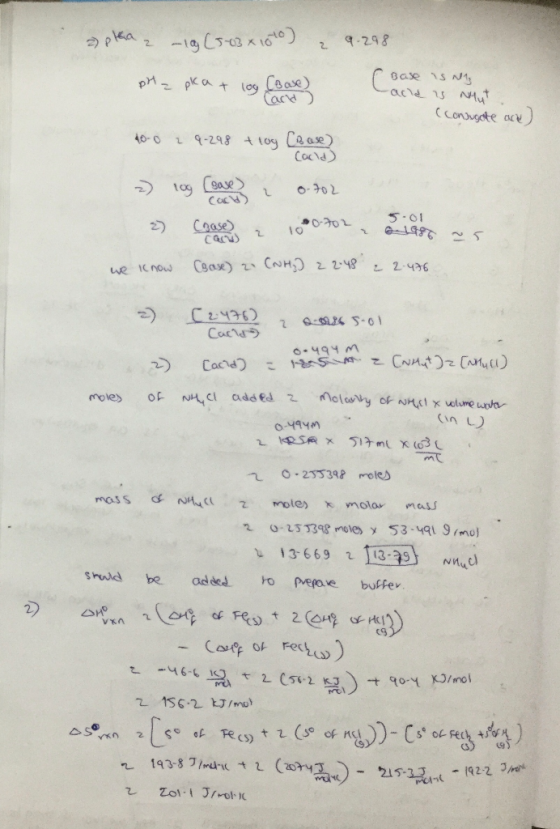
 Problem 1. You are asked to prepare a pH = 10.7 buffer starting from 517 mL of water to which 18.78 of ammonia have been added. The buffer will be prepared by the addition of ammonium chloride. fammonia add to water is 1.90x10⁵. Assume that the volume does not change on the addition of ammonia or ammonium chloride. (a) Write the balanced net ionic equation for ammonia added to water. (b) What is the pH of the initial ammonia solution?...
********PLEASE PLEASE PLEASE ANSWER 1-3****** THANK YOUU!!! 1a.When 22.0 mL of a 8.66×10⁻⁴ M cobalt(II) iodide...
********PLEASE PLEASE PLEASE ANSWER 1-3****** THANK YOUU!!! 1a.When 22.0 mL of a 8.66×10⁻⁴ M cobalt(II) iodide solution is combined with 25.0 mL of a 1.92×10⁻⁴ M ammonium sulfidesolution does a precipitate form? (yes or no) For these conditions the Reaction Quotient, Q, is equal to______ 1b.When 22.0 mL of a 6.52×10⁻⁴M ammonium iodide solution is combined with 12.0 mL of a 1.05×10⁻⁴M lead acetatesolution does a precipitate form? (yes or no) For these conditions the Reaction Quotient, Q, is equal to_____. 2a.A...
1) Which of the following aqueous solutions are good buffer systems? . a. 0.29 M hydroiodic...
1) Which of the following aqueous solutions are good buffer systems? . a. 0.29 M hydroiodic acid + 0.20 M sodium iodide . b. 0.12 M barium hydroxide + 0.29 M barium chloride . c. 0.14 M nitrous acid + 0.12 M potassium nitrite . d. 0.34 M ammonium nitrate + 0.36 M ammonia . e. 0.31 M hydrofluoric acid + 0.29 M potassium fluoride . 2)A solution contains 0.486 M NH4I and 0.480 M ammonia. The pH of this...
Solutions available 1.Acetic acid (CHCOH, K = 1.8 10) and sodium acetate (NaCHO). 2.Ammonium chloride (NHCl,...
Solutions available 1.Acetic acid (CHCOH, K = 1.8 10) and sodium acetate (NaCHO). 2.Ammonium chloride (NHCl, K for NH = 5.6 10) and ammonia (NH). (The buffer will be prepared by choosing the appropriate acid-base pair, calculating the molar ratio of acid to base that will produce the assigned pH, and then mixing the calculated amounts of the two compounds with enough deionized water to make 200. mL of buffer solution. A solution with approximately the same pH as...
please show work and maybe explanations ? Practice Problem 1 Calculate AH and AS for the...
 please show work and maybe explanations ?
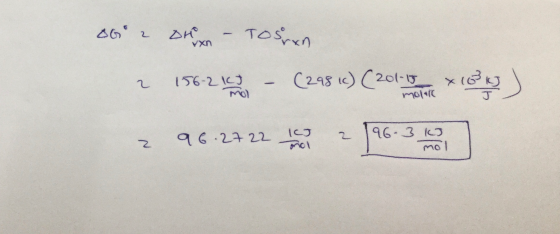
Practice Problem 1 Calculate AH and AS for the following reaction (the Haber process for the manufacture of ammonia) and calculate if the reaction is favorable at STP. N2(g) + 3 H2(g) 2 NH3(g) (The following information may also be obtained from Appendix C in the Jespersen text.) Compound Enthalpy (kJ/mol) Entropy (J/mol-K) N2(9) H2(g) NH3(g) 0 191.61 130.68 192.45 -46.11 Practice Problem 2 Use the values of AH and AS calculated in...
please show work and maybe explanations ?
Practice Problem 1 Calculate AH and AS for the following reaction (the Haber process for the manufacture of ammonia) and calculate if the reaction is favorable at STP. N2(g) + 3 H2(g) 2 NH3(g) (The following information may also be obtained from Appendix C in the Jespersen text.) Compound Enthalpy (kJ/mol) Entropy (J/mol-K) N2(9) H2(g) NH3(g) 0 191.61 130.68 192.45 -46.11 Practice Problem 2 Use the values of AH and AS calculated in...
I added everything thing. this is the lab question you need to solve. First assigned buffer...
 I added everything thing.
this is the lab question you need to solve.
First assigned buffer pH: 2.031 Second assigned buffer pH: 9.171 Available Buffer Systems (acid/ base) pka of Conjugate Acid 2.847 4.757 malonic acid/ monosodium malonate acetic acid/ sodium acetate ammonium chloride/ ammonia triethylammonium chloride/ triethylamine 9.244 10.715 1) Buffer system details: Given pH Name and volume conjugate acid Name and volume conjugate base 2) Calculations for preparation of high capacity buffer system. Introduction In this experiment, you...
I added everything thing.
this is the lab question you need to solve.
First assigned buffer pH: 2.031 Second assigned buffer pH: 9.171 Available Buffer Systems (acid/ base) pka of Conjugate Acid 2.847 4.757 malonic acid/ monosodium malonate acetic acid/ sodium acetate ammonium chloride/ ammonia triethylammonium chloride/ triethylamine 9.244 10.715 1) Buffer system details: Given pH Name and volume conjugate acid Name and volume conjugate base 2) Calculations for preparation of high capacity buffer system. Introduction In this experiment, you...
Please help with solving Question 1 (A-C) Thank you! Unless otherwise specified in the problem, you...
 Please help with solving Question 1 (A-C) Thank you!
Unless otherwise specified in the problem, you may assume that all solutions are at 25°C. 1. 50.0 mL of a pH 6.00 carbonic acid buffer is titrated with 0.2857 M NaOH, requiring 17.47 mL to reach the second equivalence point. a. Calculate the molarity of carbonic acid and bicarbonate in the original buffer. Carbonic acid: Bicarbonate: b. Calculate the pH of the solution after a total of 100.0 mL of 0.2857...
Please help with solving Question 1 (A-C) Thank you!
Unless otherwise specified in the problem, you may assume that all solutions are at 25°C. 1. 50.0 mL of a pH 6.00 carbonic acid buffer is titrated with 0.2857 M NaOH, requiring 17.47 mL to reach the second equivalence point. a. Calculate the molarity of carbonic acid and bicarbonate in the original buffer. Carbonic acid: Bicarbonate: b. Calculate the pH of the solution after a total of 100.0 mL of 0.2857...
Please show work, Thank you! Problem 7-19 (Algo) Simple Rate of Return; Payback Period (LO7-1, LO7-6] Paul Swanson...
 Please show work, Thank you!
Problem 7-19 (Algo) Simple Rate of Return; Payback Period (LO7-1, LO7-6] Paul Swanson has an opportunity to acquire a franchise from The Yogurt Place, Inc., to dispense frozen yogurt products under The Yogurt Place name. Mr. Swanson has assembled the following information relating to the franchise: a. A suitable location in a large shopping mall can be rented for $4,300 per month. b. Remodeling and necessary equipment would cost $366,000. The equipment would have a...
Please show work, Thank you!
Problem 7-19 (Algo) Simple Rate of Return; Payback Period (LO7-1, LO7-6] Paul Swanson has an opportunity to acquire a franchise from The Yogurt Place, Inc., to dispense frozen yogurt products under The Yogurt Place name. Mr. Swanson has assembled the following information relating to the franchise: a. A suitable location in a large shopping mall can be rented for $4,300 per month. b. Remodeling and necessary equipment would cost $366,000. The equipment would have a...
10. Write a one-page summary of the attached paper? INTRODUCTION Many problems can develop in activated...
10. Write a one-page summary of the attached paper? INTRODUCTION Many problems can develop in activated sludge operation that adversely affect effluent quality with origins in the engineering, hydraulic and microbiological components of the process. The real "heart" of the activated sludge system is the development and maintenance of a mixed microbial culture (activated sludge) that treats wastewater and which can be managed. One definition of a wastewater treatment plant operator is a "bug farmer", one who controls the aeration...
 Problem 1. You are asked to prepare a pH = 10.7 buffer starting from 517 mL of water to which 18.78 of ammonia have been added. The buffer will be prepared by the addition of ammonium chloride. fammonia add to water is 1.90x10⁵. Assume that the volume does not change on the addition of ammonia or ammonium chloride. (a) Write the balanced net ionic equation for ammonia added to water. (b) What is the pH of the initial ammonia solution?...
 please show work and maybe explanations ?
Practice Problem 1 Calculate AH and AS for the following reaction (the Haber process for the manufacture of ammonia) and calculate if the reaction is favorable at STP. N2(g) + 3 H2(g) 2 NH3(g) (The following information may also be obtained from Appendix C in the Jespersen text.) Compound Enthalpy (kJ/mol) Entropy (J/mol-K) N2(9) H2(g) NH3(g) 0 191.61 130.68 192.45 -46.11 Practice Problem 2 Use the values of AH and AS calculated in...
please show work and maybe explanations ?
Practice Problem 1 Calculate AH and AS for the following reaction (the Haber process for the manufacture of ammonia) and calculate if the reaction is favorable at STP. N2(g) + 3 H2(g) 2 NH3(g) (The following information may also be obtained from Appendix C in the Jespersen text.) Compound Enthalpy (kJ/mol) Entropy (J/mol-K) N2(9) H2(g) NH3(g) 0 191.61 130.68 192.45 -46.11 Practice Problem 2 Use the values of AH and AS calculated in...
 I added everything thing.
this is the lab question you need to solve.
First assigned buffer pH: 2.031 Second assigned buffer pH: 9.171 Available Buffer Systems (acid/ base) pka of Conjugate Acid 2.847 4.757 malonic acid/ monosodium malonate acetic acid/ sodium acetate ammonium chloride/ ammonia triethylammonium chloride/ triethylamine 9.244 10.715 1) Buffer system details: Given pH Name and volume conjugate acid Name and volume conjugate base 2) Calculations for preparation of high capacity buffer system. Introduction In this experiment, you...
I added everything thing.
this is the lab question you need to solve.
First assigned buffer pH: 2.031 Second assigned buffer pH: 9.171 Available Buffer Systems (acid/ base) pka of Conjugate Acid 2.847 4.757 malonic acid/ monosodium malonate acetic acid/ sodium acetate ammonium chloride/ ammonia triethylammonium chloride/ triethylamine 9.244 10.715 1) Buffer system details: Given pH Name and volume conjugate acid Name and volume conjugate base 2) Calculations for preparation of high capacity buffer system. Introduction In this experiment, you...
 Please help with solving Question 1 (A-C) Thank you!
Unless otherwise specified in the problem, you may assume that all solutions are at 25°C. 1. 50.0 mL of a pH 6.00 carbonic acid buffer is titrated with 0.2857 M NaOH, requiring 17.47 mL to reach the second equivalence point. a. Calculate the molarity of carbonic acid and bicarbonate in the original buffer. Carbonic acid: Bicarbonate: b. Calculate the pH of the solution after a total of 100.0 mL of 0.2857...
Please help with solving Question 1 (A-C) Thank you!
Unless otherwise specified in the problem, you may assume that all solutions are at 25°C. 1. 50.0 mL of a pH 6.00 carbonic acid buffer is titrated with 0.2857 M NaOH, requiring 17.47 mL to reach the second equivalence point. a. Calculate the molarity of carbonic acid and bicarbonate in the original buffer. Carbonic acid: Bicarbonate: b. Calculate the pH of the solution after a total of 100.0 mL of 0.2857...
 Please show work, Thank you!
Problem 7-19 (Algo) Simple Rate of Return; Payback Period (LO7-1, LO7-6] Paul Swanson has an opportunity to acquire a franchise from The Yogurt Place, Inc., to dispense frozen yogurt products under The Yogurt Place name. Mr. Swanson has assembled the following information relating to the franchise: a. A suitable location in a large shopping mall can be rented for $4,300 per month. b. Remodeling and necessary equipment would cost $366,000. The equipment would have a...
Please show work, Thank you!
Problem 7-19 (Algo) Simple Rate of Return; Payback Period (LO7-1, LO7-6] Paul Swanson has an opportunity to acquire a franchise from The Yogurt Place, Inc., to dispense frozen yogurt products under The Yogurt Place name. Mr. Swanson has assembled the following information relating to the franchise: a. A suitable location in a large shopping mall can be rented for $4,300 per month. b. Remodeling and necessary equipment would cost $366,000. The equipment would have a...
Most questions answered within 3 hours.
-
Where is the error in this code sequence?
String s1 = "Hello";
String s2 = "ello";...
asked 10 months ago -
Financial data for Joel de Paris, Inc., for last year
follow:
Joel de Paris, Inc.
Balance...
asked 10 months ago -
Consider this reaction:
Al2(SO4)3 (aq)+ BaCl3
(aq) Al2Cl6 (aq)- +
3BaSO4(s) . What is the...
asked 10 months ago -
Suppose that Savneet is considering increasing her
recent random sample from 20 car rentals to 40...
asked 10 months ago -
Trucks arrive at an unloading terminal at an average rate of 120
per hour.
Trucks arrive...
asked 10 months ago -
Why are methanol and ethanol completely soluble in water while
octanol is not very little soluble....
asked 10 months ago -
A facilities manager at a university reads in a research report
that the mean amount of...
asked 10 months ago -
When the CuSO4 is rehydrated by adding water to the anhydrous
compound, is this an endothermic...
asked 10 months ago -
A ray of sunlight is passing from diamond into crown glass; the
angle of incidence is...
asked 10 months ago -
A block of mass 0.249 kg is placed on top of a light, vertical
spring of...
asked 10 months ago -
how do the kidneys compensate in the presences of acidosis
a) trigger hyperventilate
b) reserve acid...
asked 10 months ago -
Question 501 pts
The rental rate of capital to the firm increases. Which of the
following...
asked 10 months ago