
Homework Answers
ANSWER
Given that,
A particle,rest and located at point is =(3ft,2ft,5ft)
acceleration of a={6ti+12t^2k}ft/s^2


Add Answer to:
Solve question 2
Z. A particle, originally at rest and located at point (3 ft, 2...
Solve questions 1,2 and 3 1. The v-t graph for the motion of a car as...
 Solve questions 1,2 and 3
1. The v-t graph for the motion of a car as it moves along a straight road is shown. Draw the s t graph and determine the average speed and the distance traveled for the 30-s time interval. The car starts from rest at s v (ft/s) 60 +30 40 t (s) 10 30 z. A particle, originally at rest and located at point (3 ft, 2 ft, 5 ft), is subjected to an [M...
Solve questions 1,2 and 3
1. The v-t graph for the motion of a car as it moves along a straight road is shown. Draw the s t graph and determine the average speed and the distance traveled for the 30-s time interval. The car starts from rest at s v (ft/s) 60 +30 40 t (s) 10 30 z. A particle, originally at rest and located at point (3 ft, 2 ft, 5 ft), is subjected to an [M...
Problem 3 (planar particle kinematics) A small particle starts from rest at point A and is...
 Problem 3 (planar particle kinematics) A small particle starts from rest at point A and is forced to travel along horizontal path ABCD (no gravitational effects) During the entire motion, the magnitude of the tangential component of acceleration a 0.2t ft/sec, where t is in seconds. Find the acceleration and velocity of the particle when it is located at points B and C Motion 3 ft 1 ft 2 ft
A particle moves in the x-y plane such that its position is defined by r (2t...
 A particle moves in the x-y plane such that its position is defined by r (2t i+ 4tj) ft, where t is in seconds. Determine the radial and transverse components of the particle's velocity and acceleration whent-2 s.
the velocity of a particle is given by v=[16t^2i+4t^3j +(5t+2)k]m/s, where t is in seconds
the velocity of a particle is given by v=[16t^2i+4t^3j +(5t+2)k]m/s, where t is in seconds. If the particle is at the origin when t=0, determine the magnitude of the particle's acceleration when t=2s. What is the x,y,z coordinate position of the particle at this instant.
Problem 12. (5pts) A particle on the x-axis, starting at time t=0 at rest and at...
 Problem 12. (5pts) A particle on the x-axis, starting at time t=0 at rest and at x=0, undergoes acceleration x”(t)=6t. Find the particle's position after 3 seconds.
4. A particle starts from an initial position with coordinates To = 8 + 5ſm, at...
 4. A particle starts from an initial position with coordinates To = 8 + 5ſm, at time t= 0, with a velocity of V. = 3i-8 m/s. The particle moves in the r-y plane with a constant acceleration, à = -21 - m/s. (a) At the instant the y-coordinate of the particle's position is -10 m, find the x- coordinate of its position. (b) Calculate the x- and y-components of the particle's position when the particle reaches its turning point...
The position of a particle along a straight-line path is defined by s=(t3−6t2−15t+7) ft, wheret is...
The position of a particle along a straight-line path is defined by s=(t3−6t2−15t+7) ft, wheret is in seconds. Part A: Determine the total distance traveled when t = 8.3 s . Part B: What are the particle's average velocity at the time given in part A? Part C: What are the particle's average speed at the time given in part A? Part D: What are the particle's instantaneous velocity at the time given in part A? Part E: What are...
1.The "kinematic equations" are used to solve problems when there is a particle with constant acceleration....
1.The "kinematic equations" are used to solve problems when there is a particle with constant acceleration. increasing acceleration. variable acceleration. decreasing acceleration. 2. A Honda Civic initially starts from rest, then accelerates at a rate of 3 m/s2 for 10 s. What is its final velocity? 30 m 30 m/s 3 m/s 0.3 m/s 3. magnitude of this acceleration is approximately 9.80 m/s2, and is known as the acceleration due to gravity. We use the following symbol to indicate this...
A particle moves according to a law of motion s = ft), t 0, where t...
 A particle moves according to a law of motion s = ft), t 0, where t is measured in seconds and s in feet. t)-te-t2 (a) Find the velocity at time t (in ft/s) v(t) e (b) What is the velocity after 2 s? (Round your answer to two decimal places.) v(2) ft/s (c) When is the particle at rest? (d) When is the particle moving in the positive direction? (Enter your answer using interval notation.) (e) Find the total...
1) A particle of charge 2 C is momentarily located at the position (8,5, 2) [all...
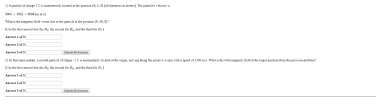 1) A particle of charge 2 C is momentarily located at the position (8,5, 2) [all distances in meters). The particle's velocity is 200i + 100j + 350k (in m/s] What is the magnetic field vector due to the particle at the position (8, 10, 2)? [Use the first answer box for Bo, the second for By, and the third for B2.] Answer 1 of 3: Answer 2 of 3: Answer 3 of 3:1 Submit All Answers 2) At that...
 Solve questions 1,2 and 3
1. The v-t graph for the motion of a car as it moves along a straight road is shown. Draw the s t graph and determine the average speed and the distance traveled for the 30-s time interval. The car starts from rest at s v (ft/s) 60 +30 40 t (s) 10 30 z. A particle, originally at rest and located at point (3 ft, 2 ft, 5 ft), is subjected to an [M...
Solve questions 1,2 and 3
1. The v-t graph for the motion of a car as it moves along a straight road is shown. Draw the s t graph and determine the average speed and the distance traveled for the 30-s time interval. The car starts from rest at s v (ft/s) 60 +30 40 t (s) 10 30 z. A particle, originally at rest and located at point (3 ft, 2 ft, 5 ft), is subjected to an [M...
 Problem 3 (planar particle kinematics) A small particle starts from rest at point A and is forced to travel along horizontal path ABCD (no gravitational effects) During the entire motion, the magnitude of the tangential component of acceleration a 0.2t ft/sec, where t is in seconds. Find the acceleration and velocity of the particle when it is located at points B and C Motion 3 ft 1 ft 2 ft
 A particle moves in the x-y plane such that its position is defined by r (2t i+ 4tj) ft, where t is in seconds. Determine the radial and transverse components of the particle's velocity and acceleration whent-2 s.
 Problem 12. (5pts) A particle on the x-axis, starting at time t=0 at rest and at x=0, undergoes acceleration x”(t)=6t. Find the particle's position after 3 seconds.
 4. A particle starts from an initial position with coordinates To = 8 + 5ſm, at time t= 0, with a velocity of V. = 3i-8 m/s. The particle moves in the r-y plane with a constant acceleration, à = -21 - m/s. (a) At the instant the y-coordinate of the particle's position is -10 m, find the x- coordinate of its position. (b) Calculate the x- and y-components of the particle's position when the particle reaches its turning point...
 A particle moves according to a law of motion s = ft), t 0, where t is measured in seconds and s in feet. t)-te-t2 (a) Find the velocity at time t (in ft/s) v(t) e (b) What is the velocity after 2 s? (Round your answer to two decimal places.) v(2) ft/s (c) When is the particle at rest? (d) When is the particle moving in the positive direction? (Enter your answer using interval notation.) (e) Find the total...
 1) A particle of charge 2 C is momentarily located at the position (8,5, 2) [all distances in meters). The particle's velocity is 200i + 100j + 350k (in m/s] What is the magnetic field vector due to the particle at the position (8, 10, 2)? [Use the first answer box for Bo, the second for By, and the third for B2.] Answer 1 of 3: Answer 2 of 3: Answer 3 of 3:1 Submit All Answers 2) At that...
Most questions answered within 3 hours.
-
Where is the error in this code sequence?
String s1 = "Hello";
String s2 = "ello";...
asked 11 months ago -
Financial data for Joel de Paris, Inc., for last year
follow:
Joel de Paris, Inc.
Balance...
asked 11 months ago -
Consider this reaction:
Al2(SO4)3 (aq)+ BaCl3
(aq) Al2Cl6 (aq)- +
3BaSO4(s) . What is the...
asked 11 months ago -
Suppose that Savneet is considering increasing her
recent random sample from 20 car rentals to 40...
asked 11 months ago -
Trucks arrive at an unloading terminal at an average rate of 120
per hour.
Trucks arrive...
asked 11 months ago -
Why are methanol and ethanol completely soluble in water while
octanol is not very little soluble....
asked 11 months ago -
A facilities manager at a university reads in a research report
that the mean amount of...
asked 11 months ago -
When the CuSO4 is rehydrated by adding water to the anhydrous
compound, is this an endothermic...
asked 11 months ago -
A ray of sunlight is passing from diamond into crown glass; the
angle of incidence is...
asked 11 months ago -
A block of mass 0.249 kg is placed on top of a light, vertical
spring of...
asked 11 months ago -
how do the kidneys compensate in the presences of acidosis
a) trigger hyperventilate
b) reserve acid...
asked 11 months ago -
Question 501 pts
The rental rate of capital to the firm increases. Which of the
following...
asked 11 months ago