
Homework Answers
Add Answer to:
Five years ago, you purchased a $1,000 par value corporate bond with a coupon interest rate...
If you purchased a ten-year corporate bond, $1,000 par value, with a 5 percent coupon, and...
If you purchased a ten-year corporate bond, $1,000 par value, with a 5 percent coupon, and suddenly the rate on comparable bonds are at 7 percent, what is the price of the bond today? Show all work.
Eight years ago, Burt Brownlee purchased a government bond that pays 6.50 percent interest. The face...
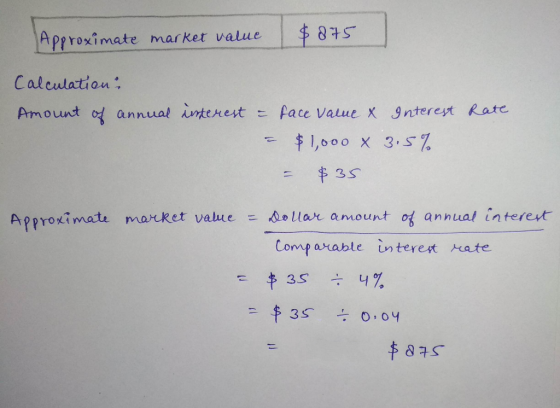
 Eight years ago, Burt Brownlee purchased a government bond that pays 6.50 percent interest. The face value of the bond was $1,000. (a) What is the dollar amount of annual interest that Burt received from his bond investment each year? (Do not round intermediate calculations.Round your answer to 2 decimal places.) ts Amount of annual interest 65.00 eBook Print ferences (b) Assume that comparable bonds are now paying 6.15 percent. What is the approximate dollar price for which Burt could...
A $1,000 par value bond was issued five years ago at a coupon rate of 10...
 A $1,000 par value bond was issued five years ago at a coupon rate of 10 percent. It currently has 10 years remaining to maturity. Interest rates on similar debt obligations are now 12 percent. Use Appendix B and Appendix D for an approximate answer but calculate your final answer using the formula and financial calculator methods a. Compute the current price of the bond using an assumption of semiannual payments. (Do not round intermediate calculations and round your answer...
A $1,000 par value bond was issued five years ago at a 6 percent coupon rate....
A $1,000 par value bond was issued five years ago at a 6 percent coupon rate. It currently has 20 years remaining to maturity. Interest rates on similar debt obligations are now 8 percent. Use Appendix B and Appendix D for an approximate answer but calculate your final answer using the formula and financial calculator methods. a. Compute the current price of the bond using an assumption of semiannual payments. (Do not round intermediate calculations and round your answer to...
A $1,000 par value bond was issued five years ago at a 8 percent coupon rate....
A $1,000 par value bond was issued five years ago at a 8 percent coupon rate. It currently has 7 years remaining to maturity. Interest rates on similar debt obligations are now 10 percent. Use Appendix B and Appendix D for an approximate answer but calculate your final answer using the formula and financial calculator methods. A. Compute the current price of the bond using an assumption of semiannual payments. B. If Mr. Robinson initially bought the bond at par value,...
A $1,000 par value bond was issued five years ago at a 10 percent coupon rate....
 A $1,000 par value bond was issued five years ago at a 10 percent coupon rate. It currently has 20 years remaining to maturity. Interest rates on similar debt obligations are now 12 percent. Use Appendix Band Appendix D for ar approximate answer but calculate your final answer using the formula and financial calculator methods. a. Compute the current price of the bond using an assumption of semiannual payments. (Do not round intermediate calculations and round your answer to 2...
1. Suppose today a 10 percent coupon bond sells at par. Two years from now, the...
1. Suppose today a 10 percent coupon bond sells at par. Two years from now, the required return on the same bond is 8 percent. What is the coupon rate on the bond? What is the YTM on the bond? 2. Vinya Inc. has 7.5 percent coupon bonds on the market that have 10 years left to maturity. The bonds make annual payments. If the YTM on these bonds is 8.75 percent, what is the current bond price? Assume the...
#6. Five years ago, you purchased five corporate bonds that each pay 5.80 percent annual interest....
#6. Five years ago, you purchased five corporate bonds that each pay 5.80 percent annual interest. Each bond has a face value of $1,000. how much interest do you earn on the five bonds each year?
A $1,000 par value bond was issued 25 years ago at a 12 percent coupon rate....
 A $1,000 par value bond was issued 25 years ago at a 12 percent coupon rate. It currently has 15 years remaining to maturity. Interest rates on similar obligations are now 8 percent. Assume Ms. Bright bought the bond three years ago when it had a price of $1,050. Further assume Ms. Bright paid 30 percent of the purchase price in cash and borrowed the rest (known as buying on margin). She used the interest payments from the bond to...
Ten years ago your grandfather purchased for you a 25-year $1,000 bond with a coupon rate...
 Ten years ago your grandfather purchased for you a 25-year
$1,000 bond with a coupon rate of 9 percent. You now wish to sell
the bond and read that yields are 8 percent. What price should you
receive for the bond? Assume that the bond pays interest annually.
Use Appendix B and Appendix D to answer the question. Round your
answer to the nearest dollar.
$
Appendix B
Appendix D
Ten years ago your grandfather purchased for you a 25-year
$1,000 bond with a coupon rate of 9 percent. You now wish to sell
the bond and read that yields are 8 percent. What price should you
receive for the bond? Assume that the bond pays interest annually.
Use Appendix B and Appendix D to answer the question. Round your
answer to the nearest dollar.
$
Appendix B
Appendix D
 Eight years ago, Burt Brownlee purchased a government bond that pays 6.50 percent interest. The face value of the bond was $1,000. (a) What is the dollar amount of annual interest that Burt received from his bond investment each year? (Do not round intermediate calculations.Round your answer to 2 decimal places.) ts Amount of annual interest 65.00 eBook Print ferences (b) Assume that comparable bonds are now paying 6.15 percent. What is the approximate dollar price for which Burt could...
 A $1,000 par value bond was issued five years ago at a coupon rate of 10 percent. It currently has 10 years remaining to maturity. Interest rates on similar debt obligations are now 12 percent. Use Appendix B and Appendix D for an approximate answer but calculate your final answer using the formula and financial calculator methods a. Compute the current price of the bond using an assumption of semiannual payments. (Do not round intermediate calculations and round your answer...
 A $1,000 par value bond was issued five years ago at a 10 percent coupon rate. It currently has 20 years remaining to maturity. Interest rates on similar debt obligations are now 12 percent. Use Appendix Band Appendix D for ar approximate answer but calculate your final answer using the formula and financial calculator methods. a. Compute the current price of the bond using an assumption of semiannual payments. (Do not round intermediate calculations and round your answer to 2...
 A $1,000 par value bond was issued 25 years ago at a 12 percent coupon rate. It currently has 15 years remaining to maturity. Interest rates on similar obligations are now 8 percent. Assume Ms. Bright bought the bond three years ago when it had a price of $1,050. Further assume Ms. Bright paid 30 percent of the purchase price in cash and borrowed the rest (known as buying on margin). She used the interest payments from the bond to...
Most questions answered within 3 hours.
-
Where is the error in this code sequence?
String s1 = "Hello";
String s2 = "ello";...
asked 10 months ago -
Financial data for Joel de Paris, Inc., for last year
follow:
Joel de Paris, Inc.
Balance...
asked 10 months ago -
Consider this reaction:
Al2(SO4)3 (aq)+ BaCl3
(aq) Al2Cl6 (aq)- +
3BaSO4(s) . What is the...
asked 10 months ago -
Suppose that Savneet is considering increasing her
recent random sample from 20 car rentals to 40...
asked 10 months ago -
Trucks arrive at an unloading terminal at an average rate of 120
per hour.
Trucks arrive...
asked 10 months ago -
Why are methanol and ethanol completely soluble in water while
octanol is not very little soluble....
asked 10 months ago -
A facilities manager at a university reads in a research report
that the mean amount of...
asked 10 months ago -
When the CuSO4 is rehydrated by adding water to the anhydrous
compound, is this an endothermic...
asked 10 months ago -
A ray of sunlight is passing from diamond into crown glass; the
angle of incidence is...
asked 10 months ago -
A block of mass 0.249 kg is placed on top of a light, vertical
spring of...
asked 10 months ago -
how do the kidneys compensate in the presences of acidosis
a) trigger hyperventilate
b) reserve acid...
asked 10 months ago -
Question 501 pts
The rental rate of capital to the firm increases. Which of the
following...
asked 10 months ago