Please Solve this 3 Problems. Problem 10, 11, 12.
with hand writing and explaining.
Thank you much

Homework Answers

Add Answer to:
Please Solve this 3 Problems. Problem 10, 11,
12.
with hand writing and explaining.
Thank you...
10) A kayaker can paddle at 2 m/s. She wants to cross a 50 m wide...
 10) A kayaker can paddle at 2 m/s. She wants to cross a 50 m wide river that is flowing at 0.75 m/s. If she points her kayak straight across and moves 2 m/s relative to the water, what a. is her net velocity vector relative to the shore? How far downstream will she be when she reaches the other side? She wants to paddle straight across. What angle upstream should she point the b. c. kayak and how long...
11) A projectile is launched with velocity vo at angle θ. a. Derive a general equation...
 11) A projectile is launched with velocity vo at angle θ. a. Derive a general equation for the time of flight in terms of vo. 0, and g. b. Derive a general equation for the distance traveled (range) c. What elevation angle results in the maximum range? d. Prove your result from c by taking o of your range formula. de
olerance-Canvas-CS 2019Spring PH141 Week02 Two Cars Ars Traveling Along A Straight Road (c) Give the magnitude...
 olerance-Canvas-CS 2019Spring PH141 Week02 Two Cars Ars Traveling Along A Straight Road (c) Give the magnitude and direction of the position vector in part (b). 21.8 53 。(counterclockwise from the +xaxis) eBook 11. O 1/3 points I Previous Answers Tipler6 3.P.056. My Notes Ask Your T directly across a river, swimming at 1.1 m/s relative to the water. She arrives at a point 45 m downstream from the point directly across the river, which is 85 m wide. (a) What...
Please help me with no 48 a. What is the wheel's angular velocity, in rpm, 10...
 Please help me with no 48
a. What is the wheel's angular velocity, in rpm, 10 s later? b. How many revolutions does the wheel make during this time? an e 43. Starting from rest, a DVD steadily accelerates to 500 rpm in 1.0s, rotates at this angular speed for 3.0 s, then steadily deceler- ates to a halt in 2.0s. How many revolutions does it make? ie y Problems 44.l A spaceship maneuvering near Planet Zeta is located at...
Please help me with no 48
a. What is the wheel's angular velocity, in rpm, 10 s later? b. How many revolutions does the wheel make during this time? an e 43. Starting from rest, a DVD steadily accelerates to 500 rpm in 1.0s, rotates at this angular speed for 3.0 s, then steadily deceler- ates to a halt in 2.0s. How many revolutions does it make? ie y Problems 44.l A spaceship maneuvering near Planet Zeta is located at...
Please Solve for me this problems. Thank you so much 10) A ball is dropped from...
 Please Solve for me this problems. Thank you so
much
10) A ball is dropped from height H and accelerates downward with acceleration g. In terms of H and g, solve for the time it takes to hit the ground. 15) A particle is moving in a straight line with constant a cceleration a. Derive a general equation for velocity v at position x in terms of initial velocity vo, initial position x0, and acceleration a.
Please Solve for me this problems. Thank you so
much
10) A ball is dropped from height H and accelerates downward with acceleration g. In terms of H and g, solve for the time it takes to hit the ground. 15) A particle is moving in a straight line with constant a cceleration a. Derive a general equation for velocity v at position x in terms of initial velocity vo, initial position x0, and acceleration a.
Could I get help with these problems please. For the first problem are we using two...
 Could I get help with these problems please. For the first
problem are we using two different equations. Are we using a
horizontal and vertical equation. V(t)=axt+vox. I am confused
here
Suppose a baseball player throws a ball. When she releases the ball, her hand is 1 meter above the ground, and the ball leaves her hand at 18 m/s in a direction that makes a 32° angle with the horizontal. (a) What is the maximum height above the ground...
Could I get help with these problems please. For the first
problem are we using two different equations. Are we using a
horizontal and vertical equation. V(t)=axt+vox. I am confused
here
Suppose a baseball player throws a ball. When she releases the ball, her hand is 1 meter above the ground, and the ball leaves her hand at 18 m/s in a direction that makes a 32° angle with the horizontal. (a) What is the maximum height above the ground...
3. Explain whether the following particular do or don not have acceleration: (a) a particle moving...
 3. Explain whether the following particular do or don not have acceleration: (a) a particle moving in a 4. Two projects are thrown with the same initial speed, one at an angle θ with respect to the level . Old book, problem 24, new book, problem 32. A fireman 50.0 m away from a burning building straight line with constant speed and (b) a particle moving around with constant speed. ground and the other an angle 90°-8. Both projectiles strike...
Please answer 5-8 accurately. Thank you. Only answer if you know everything thank you 5. The...
 Please answer 5-8 accurately. Thank you. Only answer if you
know everything thank you
5. The velocity of a projectile at its highest point is always b Positive a Negative c Zero d Equal to the initial velocity 6. If a projectile is launched with an initial velocity of 20 m/s from a height of 50 m in the direction 60 east of north, how long does it take the projectile to return to its original height? 7. Peterson traveled...
Please answer 5-8 accurately. Thank you. Only answer if you
know everything thank you
5. The velocity of a projectile at its highest point is always b Positive a Negative c Zero d Equal to the initial velocity 6. If a projectile is launched with an initial velocity of 20 m/s from a height of 50 m in the direction 60 east of north, how long does it take the projectile to return to its original height? 7. Peterson traveled...
would you please explain it to me step by step? EXAMPLE 3-10 Level horizontal range. (a)...
 would you please explain it to me step by step?
EXAMPLE 3-10 Level horizontal range. (a) Derive a to zontal range R of a projectile in terms of its initial speed lo horizontal range is defined as the horizontal distance the before returning to its original height (which is typically the y (final) = yo. See Fig. 3-27a. (b) Suppose one of Napoleon's car muzzle speed, vo, of 60.0 m/s. At what angle should it have been air resistance) to...
would you please explain it to me step by step?
EXAMPLE 3-10 Level horizontal range. (a) Derive a to zontal range R of a projectile in terms of its initial speed lo horizontal range is defined as the horizontal distance the before returning to its original height (which is typically the y (final) = yo. See Fig. 3-27a. (b) Suppose one of Napoleon's car muzzle speed, vo, of 60.0 m/s. At what angle should it have been air resistance) to...
Please solve for me 12, 13, 14 problems for me. Thank you 12) What initial velocity...
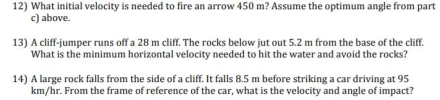 Please solve for me 12, 13, 14 problems for
me. Thank you
12) What initial velocity is needed to fire an arrow 450 m? Assume the optimum angle from part c) above. 13) A cliff-jumper runs off a 28 m cliff. The rocks below jut out 5.2 m from the base of the cliff. What is the minimum horizontal velocity needed to hit the water and avoid the rocks? 14) A large rock falls from the side of a cliff....
Please solve for me 12, 13, 14 problems for
me. Thank you
12) What initial velocity is needed to fire an arrow 450 m? Assume the optimum angle from part c) above. 13) A cliff-jumper runs off a 28 m cliff. The rocks below jut out 5.2 m from the base of the cliff. What is the minimum horizontal velocity needed to hit the water and avoid the rocks? 14) A large rock falls from the side of a cliff....
 10) A kayaker can paddle at 2 m/s. She wants to cross a 50 m wide river that is flowing at 0.75 m/s. If she points her kayak straight across and moves 2 m/s relative to the water, what a. is her net velocity vector relative to the shore? How far downstream will she be when she reaches the other side? She wants to paddle straight across. What angle upstream should she point the b. c. kayak and how long...
 11) A projectile is launched with velocity vo at angle θ. a. Derive a general equation for the time of flight in terms of vo. 0, and g. b. Derive a general equation for the distance traveled (range) c. What elevation angle results in the maximum range? d. Prove your result from c by taking o of your range formula. de
 olerance-Canvas-CS 2019Spring PH141 Week02 Two Cars Ars Traveling Along A Straight Road (c) Give the magnitude and direction of the position vector in part (b). 21.8 53 。(counterclockwise from the +xaxis) eBook 11. O 1/3 points I Previous Answers Tipler6 3.P.056. My Notes Ask Your T directly across a river, swimming at 1.1 m/s relative to the water. She arrives at a point 45 m downstream from the point directly across the river, which is 85 m wide. (a) What...
 Please help me with no 48
a. What is the wheel's angular velocity, in rpm, 10 s later? b. How many revolutions does the wheel make during this time? an e 43. Starting from rest, a DVD steadily accelerates to 500 rpm in 1.0s, rotates at this angular speed for 3.0 s, then steadily deceler- ates to a halt in 2.0s. How many revolutions does it make? ie y Problems 44.l A spaceship maneuvering near Planet Zeta is located at...
Please help me with no 48
a. What is the wheel's angular velocity, in rpm, 10 s later? b. How many revolutions does the wheel make during this time? an e 43. Starting from rest, a DVD steadily accelerates to 500 rpm in 1.0s, rotates at this angular speed for 3.0 s, then steadily deceler- ates to a halt in 2.0s. How many revolutions does it make? ie y Problems 44.l A spaceship maneuvering near Planet Zeta is located at...
 Please Solve for me this problems. Thank you so
much
10) A ball is dropped from height H and accelerates downward with acceleration g. In terms of H and g, solve for the time it takes to hit the ground. 15) A particle is moving in a straight line with constant a cceleration a. Derive a general equation for velocity v at position x in terms of initial velocity vo, initial position x0, and acceleration a.
Please Solve for me this problems. Thank you so
much
10) A ball is dropped from height H and accelerates downward with acceleration g. In terms of H and g, solve for the time it takes to hit the ground. 15) A particle is moving in a straight line with constant a cceleration a. Derive a general equation for velocity v at position x in terms of initial velocity vo, initial position x0, and acceleration a.
 Could I get help with these problems please. For the first
problem are we using two different equations. Are we using a
horizontal and vertical equation. V(t)=axt+vox. I am confused
here
Suppose a baseball player throws a ball. When she releases the ball, her hand is 1 meter above the ground, and the ball leaves her hand at 18 m/s in a direction that makes a 32° angle with the horizontal. (a) What is the maximum height above the ground...
Could I get help with these problems please. For the first
problem are we using two different equations. Are we using a
horizontal and vertical equation. V(t)=axt+vox. I am confused
here
Suppose a baseball player throws a ball. When she releases the ball, her hand is 1 meter above the ground, and the ball leaves her hand at 18 m/s in a direction that makes a 32° angle with the horizontal. (a) What is the maximum height above the ground...
 3. Explain whether the following particular do or don not have acceleration: (a) a particle moving in a 4. Two projects are thrown with the same initial speed, one at an angle θ with respect to the level . Old book, problem 24, new book, problem 32. A fireman 50.0 m away from a burning building straight line with constant speed and (b) a particle moving around with constant speed. ground and the other an angle 90°-8. Both projectiles strike...
 Please answer 5-8 accurately. Thank you. Only answer if you
know everything thank you
5. The velocity of a projectile at its highest point is always b Positive a Negative c Zero d Equal to the initial velocity 6. If a projectile is launched with an initial velocity of 20 m/s from a height of 50 m in the direction 60 east of north, how long does it take the projectile to return to its original height? 7. Peterson traveled...
Please answer 5-8 accurately. Thank you. Only answer if you
know everything thank you
5. The velocity of a projectile at its highest point is always b Positive a Negative c Zero d Equal to the initial velocity 6. If a projectile is launched with an initial velocity of 20 m/s from a height of 50 m in the direction 60 east of north, how long does it take the projectile to return to its original height? 7. Peterson traveled...
 would you please explain it to me step by step?
EXAMPLE 3-10 Level horizontal range. (a) Derive a to zontal range R of a projectile in terms of its initial speed lo horizontal range is defined as the horizontal distance the before returning to its original height (which is typically the y (final) = yo. See Fig. 3-27a. (b) Suppose one of Napoleon's car muzzle speed, vo, of 60.0 m/s. At what angle should it have been air resistance) to...
would you please explain it to me step by step?
EXAMPLE 3-10 Level horizontal range. (a) Derive a to zontal range R of a projectile in terms of its initial speed lo horizontal range is defined as the horizontal distance the before returning to its original height (which is typically the y (final) = yo. See Fig. 3-27a. (b) Suppose one of Napoleon's car muzzle speed, vo, of 60.0 m/s. At what angle should it have been air resistance) to...
 Please solve for me 12, 13, 14 problems for
me. Thank you
12) What initial velocity is needed to fire an arrow 450 m? Assume the optimum angle from part c) above. 13) A cliff-jumper runs off a 28 m cliff. The rocks below jut out 5.2 m from the base of the cliff. What is the minimum horizontal velocity needed to hit the water and avoid the rocks? 14) A large rock falls from the side of a cliff....
Please solve for me 12, 13, 14 problems for
me. Thank you
12) What initial velocity is needed to fire an arrow 450 m? Assume the optimum angle from part c) above. 13) A cliff-jumper runs off a 28 m cliff. The rocks below jut out 5.2 m from the base of the cliff. What is the minimum horizontal velocity needed to hit the water and avoid the rocks? 14) A large rock falls from the side of a cliff....
Most questions answered within 3 hours.
-
Where is the error in this code sequence?
String s1 = "Hello";
String s2 = "ello";...
asked 10 months ago -
Financial data for Joel de Paris, Inc., for last year
follow:
Joel de Paris, Inc.
Balance...
asked 10 months ago -
Consider this reaction:
Al2(SO4)3 (aq)+ BaCl3
(aq) Al2Cl6 (aq)- +
3BaSO4(s) . What is the...
asked 10 months ago -
Suppose that Savneet is considering increasing her
recent random sample from 20 car rentals to 40...
asked 10 months ago -
Trucks arrive at an unloading terminal at an average rate of 120
per hour.
Trucks arrive...
asked 10 months ago -
Why are methanol and ethanol completely soluble in water while
octanol is not very little soluble....
asked 10 months ago -
A facilities manager at a university reads in a research report
that the mean amount of...
asked 10 months ago -
When the CuSO4 is rehydrated by adding water to the anhydrous
compound, is this an endothermic...
asked 10 months ago -
A ray of sunlight is passing from diamond into crown glass; the
angle of incidence is...
asked 10 months ago -
A block of mass 0.249 kg is placed on top of a light, vertical
spring of...
asked 10 months ago -
how do the kidneys compensate in the presences of acidosis
a) trigger hyperventilate
b) reserve acid...
asked 10 months ago -
Question 501 pts
The rental rate of capital to the firm increases. Which of the
following...
asked 10 months ago