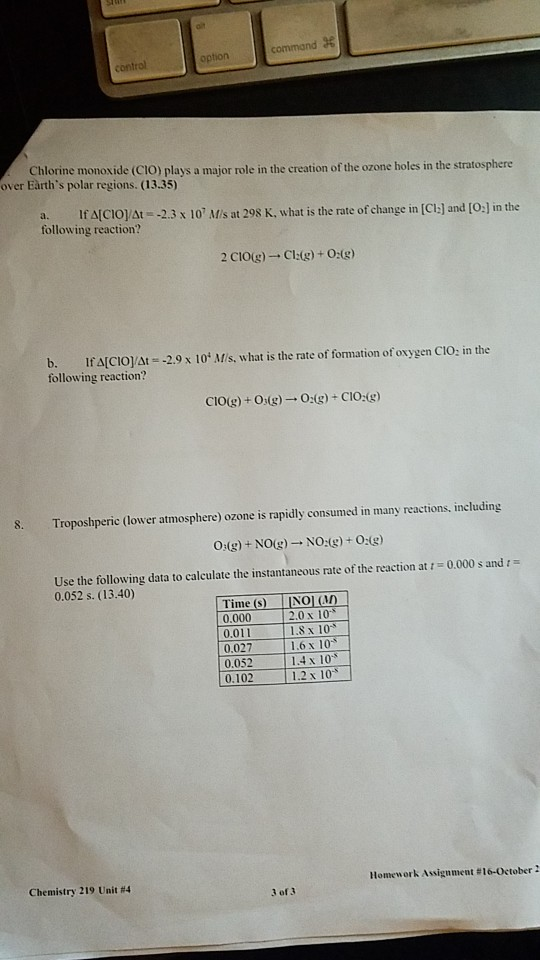
a. If change of [ClO] / change of time = -2.3 × 10^7
M/s at 298 K, what is the rate of change in [Cl2] and [O2] in the
following reaction?
2 ClO -> Cl2 + O2
b. If change of [ClO] / change of time = -2.9 × 10^4
M/s, what is the rate of change of formation of oxygen ClO2 in the
following reaction?
ClO + O3 -> O2 + ClO2
Homework Answers
![2 - 1 0 (g) dicro) chalgt t dich) O₂ (g) = + d(0₂] = at at 2. 3 x 10 AL Gineri ne 40 = -2.3x10⁷ mis >> -1 -2 -3 8109) miatt s](http://img.homeworklib.com/questions/1d27fce0-70c1-11ea-86be-7b402fe7a974.png?x-oss-process=image/resize,w_560) ⁹
⁹
The rate determining step for the destruction of ozone is the formation of the Clo dimer...
 The rate determining step for the destruction of ozone is the formation of the Clo dimer (formula: CloOCI) shown in the equation below. The rate is second order to the concentration of Clo. ClO+ CIO ooc (kaea3.4x1012 molecule cm s) This reaction is followed by the fast photolysis of the dimer and the fast destruction of ozone by Cl atoms: CLOOC+hy 2 CI+O Given the following concentrations: [CIO] 9.8 x 10 molecule cm and initial O, concentration 1 x 10...
The standard enthalpy change for the following reaction is -704 kJ at 298 K. Al(s) +...
 The standard enthalpy change for the following reaction is -704 kJ at 298 K. Al(s) + 3/2 Cl2(g) — AICI3(8) AH° = -704 kJ What is the standard enthalpy change for the reaction at 298 K? 2 AICI3(s) — 2 Al(s) + 3 Cl2(9) kJ The standard enthalpy change for the following reaction is 851 kJ at 298 K. 2 NaOH(s) —— 2 Na(s) + O2(g) + H2(g) AH° = 851 kJ What is the standard enthalpy change for this...
Reaction A $$O3(g)+Cl(g)ClO(g)+O2(g) $$A=2.93×10⁻¹¹ cm3molecule • s and Ea=2.16 kJmol...
 Reaction A
$$O3(g)+Cl(g)ClO(g)+O2(g)
$$A=2.93×10⁻¹¹ cm3molecule • s and
Ea=2.16 kJmol
Reaction B
$$O3(g)+NO(g)NO2(g)+O2(g)
$$A=2.34×10⁻¹² cm3molecule •
s Ea=11.6 kJmol
On the basis of the frequency factors and activation energy
values above, calculate the rate constant for Reaction A at 298
K.
On the basis of the frequency factors and activation energy
values above, calculate the rate constant for Reaction B at 298
K.
We were unable to transcribe this imageWe were unable to transcribe this image
Reaction A
$$O3(g)+Cl(g)ClO(g)+O2(g)
$$A=2.93×10⁻¹¹ cm3molecule • s and
Ea=2.16 kJmol
Reaction B
$$O3(g)+NO(g)NO2(g)+O2(g)
$$A=2.34×10⁻¹² cm3molecule •
s Ea=11.6 kJmol
On the basis of the frequency factors and activation energy
values above, calculate the rate constant for Reaction A at 298
K.
On the basis of the frequency factors and activation energy
values above, calculate the rate constant for Reaction B at 298
K.
We were unable to transcribe this imageWe were unable to transcribe this image
ClO is a reactive gas that is involved in the destruction of the ozone layer in...
ClO is a reactive gas that is involved in the destruction of the ozone layer in the stratosphere. The rate constant, k, for the decomposition of the gas into Cl2 and O2 at 298 K is 7.2 x 10⁹ M-1 s-1and the activation energy is 13.2 kJ/mol. Write the balanced equation for the decomposition reaction. Write the rate law for the reaction and explain how you determined the order of the reaction. What is the rate constant of this reaction...
The following data were collected for dimerization of ClO to Cl2O2 at 298 K. 0 seconds...
 The following data were collected for dimerization of
ClO to Cl2O2 at 298 K.
0 seconds 2.60×10^11
1 seconds 1.08×10^11
2 seconds 6.83×10^10
3 seconds 4.99×10^10
4 seconds 3.93×10^10
5 seconds 3.24×10^10
6 seconds 2.76×10^10
Plot [ClO] and [Cl2O2] as a function of time and determine the
instantaneous rates of change in both at 1s. Please explain how
everything is determined.
6. The following data were collected for the dimerization of CIO to CI:O2 at 298 K. (13.39) Time (s)...
The following data were collected for dimerization of
ClO to Cl2O2 at 298 K.
0 seconds 2.60×10^11
1 seconds 1.08×10^11
2 seconds 6.83×10^10
3 seconds 4.99×10^10
4 seconds 3.93×10^10
5 seconds 3.24×10^10
6 seconds 2.76×10^10
Plot [ClO] and [Cl2O2] as a function of time and determine the
instantaneous rates of change in both at 1s. Please explain how
everything is determined.
6. The following data were collected for the dimerization of CIO to CI:O2 at 298 K. (13.39) Time (s)...
Determine the equilibrium constant for the following reaction at 298 K. Cl(g) + O3(g) → ClO(g)...
Determine the equilibrium constant for the following reaction at 298 K. Cl(g) + O3(g) → ClO(g) + O2(g) ΔG° = - 34.5 kJ Please explain how you enter it into the calculator I get 1.23*10^-14. Which is incorrect the answer is 1.12*10^-6.
How do I do 9 47/니 , Determine the change in enthalpy for the following reaction...
 How do I do 9
47/니 , Determine the change in enthalpy for the following reaction from the enthalpies of formation for the reactants and products. (C2H2Cl2, +4.27 kJ/mol; C2H2Cl4,-155.6 kJ/mol) 9. 3 points 10. The destruction of the ozone layer by chlorofluorocarbons can be described by the following reactions, all occurring in the gas phase. 3 points A 29.90 kJ CIO + 03-> Cl + 202 203- 302 Cl + O3-CIO+ O2 ΔΙΓη,-54.08 kJ What is AfPoo.for he decomposition...
How do I do 9
47/니 , Determine the change in enthalpy for the following reaction from the enthalpies of formation for the reactants and products. (C2H2Cl2, +4.27 kJ/mol; C2H2Cl4,-155.6 kJ/mol) 9. 3 points 10. The destruction of the ozone layer by chlorofluorocarbons can be described by the following reactions, all occurring in the gas phase. 3 points A 29.90 kJ CIO + 03-> Cl + 202 203- 302 Cl + O3-CIO+ O2 ΔΙΓη,-54.08 kJ What is AfPoo.for he decomposition...
The standard enthalpy change for the following reaction is 641 kJ at 298 K. MgCl2(s) Mg(s)...
The standard enthalpy change for the following reaction is 641 kJ at 298 K. MgCl2(s) Mg(s) + Cl2(g) ΔH° = 641 kJ What is the standard enthalpy change for this reaction at 298 K? Mg(s) + Cl2(g) MgCl2(s)
The standard enthalpy change for the following reaction is 220 kJ at 298 K. CuCl2(s) -->Cu(s)...
The standard enthalpy change for the following reaction is 220 kJ at 298 K. CuCl2(s) -->Cu(s) + Cl2(g) ΔH° = 220 kJ What is the standard enthalpy change for this reaction at 298 K? Cu(s) + Cl2(g) --> CuCl2(s) Answer in kJ
The standard enthalpy change for the following reaction is -426 kJ at 298 K. Na(s) +...
 The standard enthalpy change for the following reaction is -426 kJ at 298 K. Na(s) + 1/2 O2(g) + 1/2 H2(g) → NaOH(s) AH° = -426 kJ What is the standard enthalpy change for the reaction at 298 K? 2 Na(s) + O2(0)+ H2()—2 NaOH(s) The standard enthalpy change for the following reaction is 484 kJ at 298 K. CH3COOH(1) ► 2 C(s,graphite) + 2 H2(g) + O2(g) AH° = 484 kJ What is the standard enthalpy change for this...
 The rate determining step for the destruction of ozone is the formation of the Clo dimer (formula: CloOCI) shown in the equation below. The rate is second order to the concentration of Clo. ClO+ CIO ooc (kaea3.4x1012 molecule cm s) This reaction is followed by the fast photolysis of the dimer and the fast destruction of ozone by Cl atoms: CLOOC+hy 2 CI+O Given the following concentrations: [CIO] 9.8 x 10 molecule cm and initial O, concentration 1 x 10...
 The standard enthalpy change for the following reaction is -704 kJ at 298 K. Al(s) + 3/2 Cl2(g) — AICI3(8) AH° = -704 kJ What is the standard enthalpy change for the reaction at 298 K? 2 AICI3(s) — 2 Al(s) + 3 Cl2(9) kJ The standard enthalpy change for the following reaction is 851 kJ at 298 K. 2 NaOH(s) —— 2 Na(s) + O2(g) + H2(g) AH° = 851 kJ What is the standard enthalpy change for this...
 Reaction A
$$O3(g)+Cl(g)ClO(g)+O2(g)
$$A=2.93×10⁻¹¹ cm3molecule • s and
Ea=2.16 kJmol
Reaction B
$$O3(g)+NO(g)NO2(g)+O2(g)
$$A=2.34×10⁻¹² cm3molecule •
s Ea=11.6 kJmol
On the basis of the frequency factors and activation energy
values above, calculate the rate constant for Reaction A at 298
K.
On the basis of the frequency factors and activation energy
values above, calculate the rate constant for Reaction B at 298
K.
We were unable to transcribe this imageWe were unable to transcribe this image
Reaction A
$$O3(g)+Cl(g)ClO(g)+O2(g)
$$A=2.93×10⁻¹¹ cm3molecule • s and
Ea=2.16 kJmol
Reaction B
$$O3(g)+NO(g)NO2(g)+O2(g)
$$A=2.34×10⁻¹² cm3molecule •
s Ea=11.6 kJmol
On the basis of the frequency factors and activation energy
values above, calculate the rate constant for Reaction A at 298
K.
On the basis of the frequency factors and activation energy
values above, calculate the rate constant for Reaction B at 298
K.
We were unable to transcribe this imageWe were unable to transcribe this image
 The following data were collected for dimerization of
ClO to Cl2O2 at 298 K.
0 seconds 2.60×10^11
1 seconds 1.08×10^11
2 seconds 6.83×10^10
3 seconds 4.99×10^10
4 seconds 3.93×10^10
5 seconds 3.24×10^10
6 seconds 2.76×10^10
Plot [ClO] and [Cl2O2] as a function of time and determine the
instantaneous rates of change in both at 1s. Please explain how
everything is determined.
6. The following data were collected for the dimerization of CIO to CI:O2 at 298 K. (13.39) Time (s)...
The following data were collected for dimerization of
ClO to Cl2O2 at 298 K.
0 seconds 2.60×10^11
1 seconds 1.08×10^11
2 seconds 6.83×10^10
3 seconds 4.99×10^10
4 seconds 3.93×10^10
5 seconds 3.24×10^10
6 seconds 2.76×10^10
Plot [ClO] and [Cl2O2] as a function of time and determine the
instantaneous rates of change in both at 1s. Please explain how
everything is determined.
6. The following data were collected for the dimerization of CIO to CI:O2 at 298 K. (13.39) Time (s)...
 How do I do 9
47/니 , Determine the change in enthalpy for the following reaction from the enthalpies of formation for the reactants and products. (C2H2Cl2, +4.27 kJ/mol; C2H2Cl4,-155.6 kJ/mol) 9. 3 points 10. The destruction of the ozone layer by chlorofluorocarbons can be described by the following reactions, all occurring in the gas phase. 3 points A 29.90 kJ CIO + 03-> Cl + 202 203- 302 Cl + O3-CIO+ O2 ΔΙΓη,-54.08 kJ What is AfPoo.for he decomposition...
How do I do 9
47/니 , Determine the change in enthalpy for the following reaction from the enthalpies of formation for the reactants and products. (C2H2Cl2, +4.27 kJ/mol; C2H2Cl4,-155.6 kJ/mol) 9. 3 points 10. The destruction of the ozone layer by chlorofluorocarbons can be described by the following reactions, all occurring in the gas phase. 3 points A 29.90 kJ CIO + 03-> Cl + 202 203- 302 Cl + O3-CIO+ O2 ΔΙΓη,-54.08 kJ What is AfPoo.for he decomposition...
 The standard enthalpy change for the following reaction is -426 kJ at 298 K. Na(s) + 1/2 O2(g) + 1/2 H2(g) → NaOH(s) AH° = -426 kJ What is the standard enthalpy change for the reaction at 298 K? 2 Na(s) + O2(0)+ H2()—2 NaOH(s) The standard enthalpy change for the following reaction is 484 kJ at 298 K. CH3COOH(1) ► 2 C(s,graphite) + 2 H2(g) + O2(g) AH° = 484 kJ What is the standard enthalpy change for this...
Most questions answered within 3 hours.
-
Where is the error in this code sequence?
String s1 = "Hello";
String s2 = "ello";...
asked 11 months ago -
Financial data for Joel de Paris, Inc., for last year
follow:
Joel de Paris, Inc.
Balance...
asked 11 months ago -
Consider this reaction:
Al2(SO4)3 (aq)+ BaCl3
(aq) Al2Cl6 (aq)- +
3BaSO4(s) . What is the...
asked 11 months ago -
Suppose that Savneet is considering increasing her
recent random sample from 20 car rentals to 40...
asked 11 months ago -
Trucks arrive at an unloading terminal at an average rate of 120
per hour.
Trucks arrive...
asked 11 months ago -
Why are methanol and ethanol completely soluble in water while
octanol is not very little soluble....
asked 11 months ago -
A facilities manager at a university reads in a research report
that the mean amount of...
asked 11 months ago -
When the CuSO4 is rehydrated by adding water to the anhydrous
compound, is this an endothermic...
asked 11 months ago -
A ray of sunlight is passing from diamond into crown glass; the
angle of incidence is...
asked 11 months ago -
A block of mass 0.249 kg is placed on top of a light, vertical
spring of...
asked 11 months ago -
how do the kidneys compensate in the presences of acidosis
a) trigger hyperventilate
b) reserve acid...
asked 11 months ago -
Question 501 pts
The rental rate of capital to the firm increases. Which of the
following...
asked 11 months ago